On the morning of November 2, 2026, Nvidia stock was sitting comfortably above $200. Three days earlier, The New York Times had published an article about Nvidia's Singaporean cloud partner Megaspeed and its executive Alice Huang, whom US intelligence suspected of ties to Chinese intelligence services. Wall Street barely flinched at the time: no charges had been filed, and business went on as usual.
Then Sikt Intelligence, a Norwegian startup based in Oslo, ran a bold experiment. The team cut its AI system off from the internet completely, froze its news archive at exactly 09:30 AM on November 2, and asked the model to simulate the next two weeks fifty times in a row. There were no hints about a crisis and no nudges toward a crash. Yet one of those fifty runs independently mapped out an unsettling chain of events: a Congressional inquiry, a special board committee, and Jensen Huang stepping aside as CEO. Each milestone landed within two to three days of when it actually happened.
It sounds like magic or a cheat code for trading stocks. When you put the experiment under a microscope, though, the real picture is far more interesting—and much more sobering.
How a Hard-Freeze Future Backtest Works
Testing AI predictions in hindsight is tricky. Ask a standard LLM to forecast last month's events, and it will quietly peek at the outcome online or pull it from its training weights. Analysts call this lookahead bias. Backtesting—testing a model on past data as if the future hadn't happened yet—turns into a rigged card trick when that leak exists.
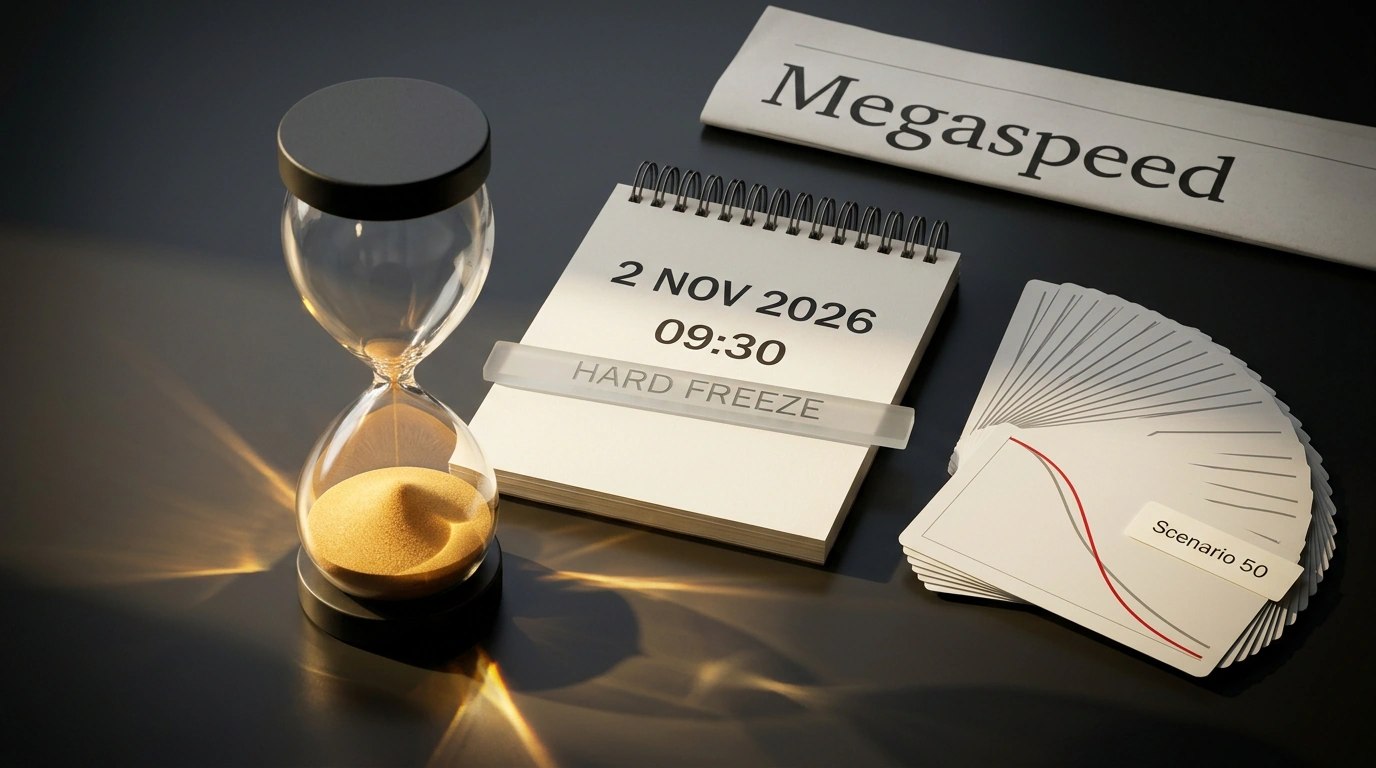
Sikt Intelligence sealed that gap with a hard freeze. The team cut off its collected news archive at 09:30 AM on Monday, November 2, 2026, and disabled live web search completely. The model saw only the exact world that existed that morning, including the early and largely overlooked NYT piece from October 29.
Sikt Intelligence AI superforecasting platform (Source: official Sikt Intelligence website)
Next, the team ran the system in a neutral loop. The prompt was straightforward: imagine it is Monday morning, November 2; review the available news archive, write a coherent story for the next ten trading days (through Friday, November 13), and estimate Nvidia's closing stock price for each day.
One clever rule kept the test honest: the researchers intentionally avoided pushing the model toward bleak outcomes. There were no prompts asking it to "find a reason for a crash." They ran the loop 50 times to generate an honest spread of outcomes, from flat sideways trading and steady gains to a full-blown corporate scandal.
How the AI Unpacks a Quiet News Signal Day by Day
During each run, the model doesn't invent fiction out of thin air. It searches archived articles (logs show calls to real stories from fool.com, 24wallstreet.com, and finance.yahoo.com), records tool calls, and writes a day-by-day chronicle, passing context from Tuesday to Wednesday and Wednesday to Thursday.
The most useful part of the report consists of three required sections the AI must fill out for every story:
- a list of its assumptions;
- a list of what is missing;
- a specific condition for what would break the story.
Look at how this works even in a boring scenario. In one branch, the model sketched a calm rally driven by strong AI hardware earnings, slightly cooled late in week two by interest rates and supply headlines. Nothing dramatic on the surface. Yet under "what would break the story," the model wrote on its own that a formal US Justice Department indictment against Megaspeed or new trade limits on remote compute access would knock several percent off Nvidia's stock.
Even when the team repeated a smaller version of the test with just ten runs, one branch latched onto that half-forgotten October 29 article about Megaspeed and Alice Huang and built a Justice Department investigation around it. In other words, the model spotted a weak signal that was still buried under Monday's regular news noise.
The Outlier vs. the Real Crash: Hits and Misses
By mid-November, the Megaspeed story really did explode. Amid a US intelligence probe into Alice Huang's alleged links to China's Ministry of State Security and her proximity to Jensen Huang, a major scandal erupted. Mid-month, Nvidia's CEO temporarily stepped down. Just over a week later, the board reinstated him, while US authorities added Megaspeed to the Entity List.
Now go back to the two-week test window from November 2 to November 13. In the 50-run simulation, most branches stayed calmly near the median. At the bottom edge, however, sat a sharp outlier titled around a "CEO leave amid spy probe." Here is how its timeline lined up against actual trading.
| Day | What the AI simulated | What happened in the market |
|---|---|---|
| Mon, Nov 2 | New reports keep the spy story alive, stock bounces | Down -1.3%, price above $200 |
| Tue, Nov 3 | Report on counterintelligence review of Huang and Alice Huang's contacts | Up +2.3% ahead of election results and jobs data |
| Wed, Nov 4 | Congressional letter demanding Huang's testimony or a closed briefing | Down -3.2% on rising political risk |
| Thu, Nov 5 | Reports of an FBI review; market prices in a "governance discount" | Largest drop of the window at -9.3% |
| Fri, Nov 6 | Board forms a special committee with outside counsel, Huang steps back from China licenses; strong jobs report pressures market | Bounce of roughly +3% |
| Mon, Nov 9 | Huang temporarily steps down as CEO during the review, interim named; simulated stock drops -9% | Down -4.3% |
| Tue, Nov 10 | Analysts reprice CEO-loss risk and strip out China upside | Down -5.5% to a local bottom |
| Wed, Nov 11 | Interim CEO calms the market; buyers return at 25× forward earnings | Bounce of nearly +3% |
| Thu, Nov 12 | Board review drags on; investors wait for November 17 earnings | Down -4.3% |
| Fri, Nov 13 | Two weeks close without Huang at the helm, price around $176 | Closed at $163 (-2% on the day) |
The storyline match is striking, yet the numbers quickly cool the hype. Not a single one of the fifty runs captured the full depth of the actual sell-off.
Nvidia Stock Drop by November 13: Simulations vs. Reality
An honest fact-check of the scenario, run using Claude, laid out the scorecard clearly. The daily direction of the stock matched in six out of ten trading days—barely better than a coin flip. On major corporate events, however, the accuracy was eerie. A Senate request for Huang's testimony really did happen. The board really did form a special committee of independent directors, though the simulation placed it two days early. Huang's temporary exit as CEO came true as well, appearing in the model three days before the real announcement.
There were plenty of misses too. The closing price was off by thirteen dollars ($176 in the simulation versus $163 in reality). The model also assumed Donald Trump would pull support from Nvidia's chief, when in reality he backed him, and blamed market pressure on a "hot" CPI inflation report that wasn't the main driver. Most importantly, the accurate run was a single outlier out of fifty, while the average branch saw no crash at all.
A Tail-Risk Radar, Not a Crystal Ball
If you are thinking about hooking a tool like this to a brokerage account to short stocks, forget it. Being two or three days off on timing and missing the drop depth in a leveraged trade will wipe out an account faster than you can read the report. Worse, spotting "the right" outlier among forty-nine other runs is easy in hindsight and nearly impossible on the morning of November 2.
The real value of superforecasting—estimating probabilities of major events from news alongside prediction markets—and frozen simulations lies elsewhere. They act as a radar for tail risks: rare, painful scenarios that rarely show up in baseline forecasts yet can wipe out stock prices overnight.
Here is how to use it: run the model 50 or 100 times with neutral instructions so it doesn't default to generic panic. Then set aside the calm middle and read the worst 10 to 15 stories closely. That is where the model pulls a "sleeping thread" out of hundreds of routine articles—like a quiet piece on a Singaporean partner—and maps the steps that could turn a minor headline into a regulatory probe and a leadership shakeup.
Sikt Intelligence itself is still in closed early access, with broader rollout slated for early 2027, and the team hasn't published open calibration scores (such as a Brier score) for this backtest yet. As a crystal ball for guessing Friday's closing price, it doesn't work. As a fast stress test that takes half an hour to reveal where a hidden landmine might sit in your portfolio or industry, the idea looks remarkably practical.