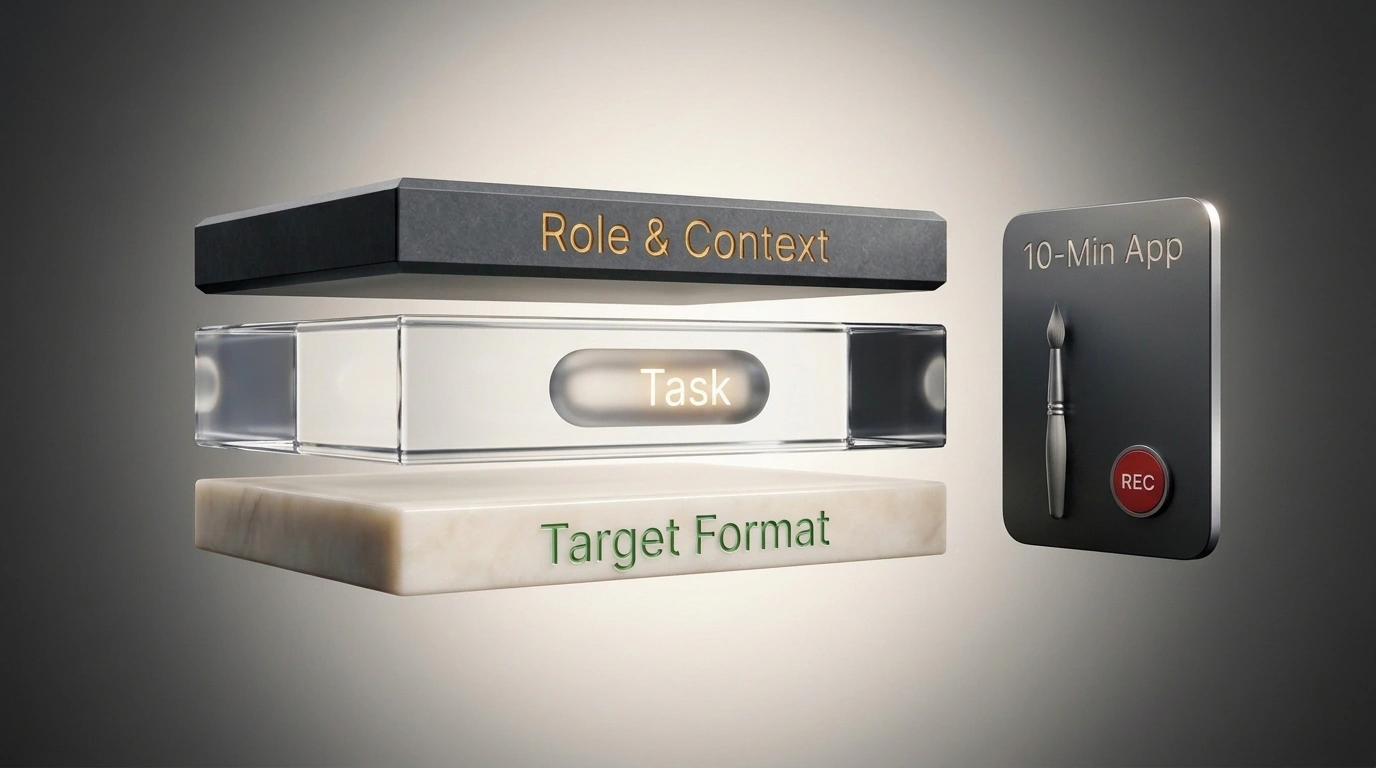
When an AI gives a bland answer, your first instinct is to rewrite the wording: add a "seasoned executive" persona or paste a clever template from your bookmarks. That habit dates back to 2022–2023, when prompt engineering meant dozens of manual tries to find the right phrasing. By late 2026, the bottleneck moved. Modern models refine prompts and build out steps in the background on their own. When a reply misses the mark, the model is usually missing just two anchors: where you stand right now and what a good result looks like.
How the 'Context Sandwich' Works
Phrase-hunting has given way to goal-based prompting: you define the starting point and the destination, and the model maps the route itself.
Imagine hiring a contractor to renovate a room. If you just say "make it nice," the result will be random. If you share the floor plan, state your budget, and show two photos of the style you want, the contractor picks the materials and work order on their own. Language models behave the same way.
It helps to wrap every task in a three-layer context sandwich. The top layer answers "who am I and where am I now": your role, real numbers, constraints, and active tools. The middle holds the actual request in two or three plain sentences, with no magic spells. The bottom layer sets the target benchmark: a specific goal, format, sample contract, or report structure.
When a model has both a starting point and a clear quality standard, it stops guessing and delivers a usable draft on the first try. Paired with personal agents that remember your goals across sessions, you don't even have to rewrite this setup from scratch.
Personal Software in Ten Minutes and Reverse Engineer Anything
This same principle—showing the goal and a reference instead of micromanaging steps—changed how people view small desktop utilities. A year ago, AI-built homemade apps mostly stayed toys. Today, they replace bloated paid software.
Take a real example: you need to record a quick Loom-style screencast, have no company account, and don't have time to sign up. You connect your desktop agent to the open-source project Reverse Engineer Anything (morluto/rea), describe what you need, and ten minutes later a local app sits on your computer. It captures your screen and microphone, skips cloud bloat, costs nothing, and belongs completely to you.
Another familiar pain is screen-annotation tools that picked up twenty extra features over the years. Building a minimalist alternative with a single brush and a semi-transparent toolbar that stays out of the way is now faster than closing extra menus. A homemade tool like that easily earns its keep several times a week.
Technically, morluto/rea is an MIT-licensed open-source project with 480,915 stars on GitHub. It runs on macOS, Windows, and Linux, installs via npx rea-agents setup, and acts as a unified MCP server (Model Context Protocol, a standard for connecting AI to external tools). Through it, coding agents like Claude Code, Cursor, and Codex talk to local analyzers such as Ghidra, Hopper, and IDA Pro to inspect native binaries, Electron/JS apps, .NET builds, and network traffic without source code.
Open-source Reverse Engineer Anything tool analyzing an application (Source: official morluto/rea GitHub repository)
Because morluto/rea is so popular, fake copycat repositories have popped up online. Always check the address before installing: the genuine project lives strictly at github.com/morluto/rea, on rea.tools, and on npm as rea-agents.
Where a Personal Utility Wins—and Where Paid Software Still Matters
"Wait—if I can build my own Loom in ten minutes, can I cancel all my subscriptions and rewrite my work software over a weekend?"
The dividing line is clear. A personal micro-app wins on narrow, single-user local tasks: recording your screen, drawing over slides, converting files, or keeping a personal tracker. In those cases, paid tools get in the way with extra menus, logins, and monthly fees for features you never open.
As soon as you need team collaboration, cloud hosting, link sharing (which is what people actually pay real Loom for), strict security, OS-update maintenance, and tech support, a ten-minute homemade app loses. Maintaining it by hand costs more than a ready-made subscription.
There is also a legal boundary. Building yourself an app around a basic idea like recording your screen and mic is legal. Directly copying protected code, bypassing licenses, or selling clones of someone else's software violates copyright and EULA terms. For your personal desktop, a homemade tool works great; never drag someone else's logic into a commercial product.