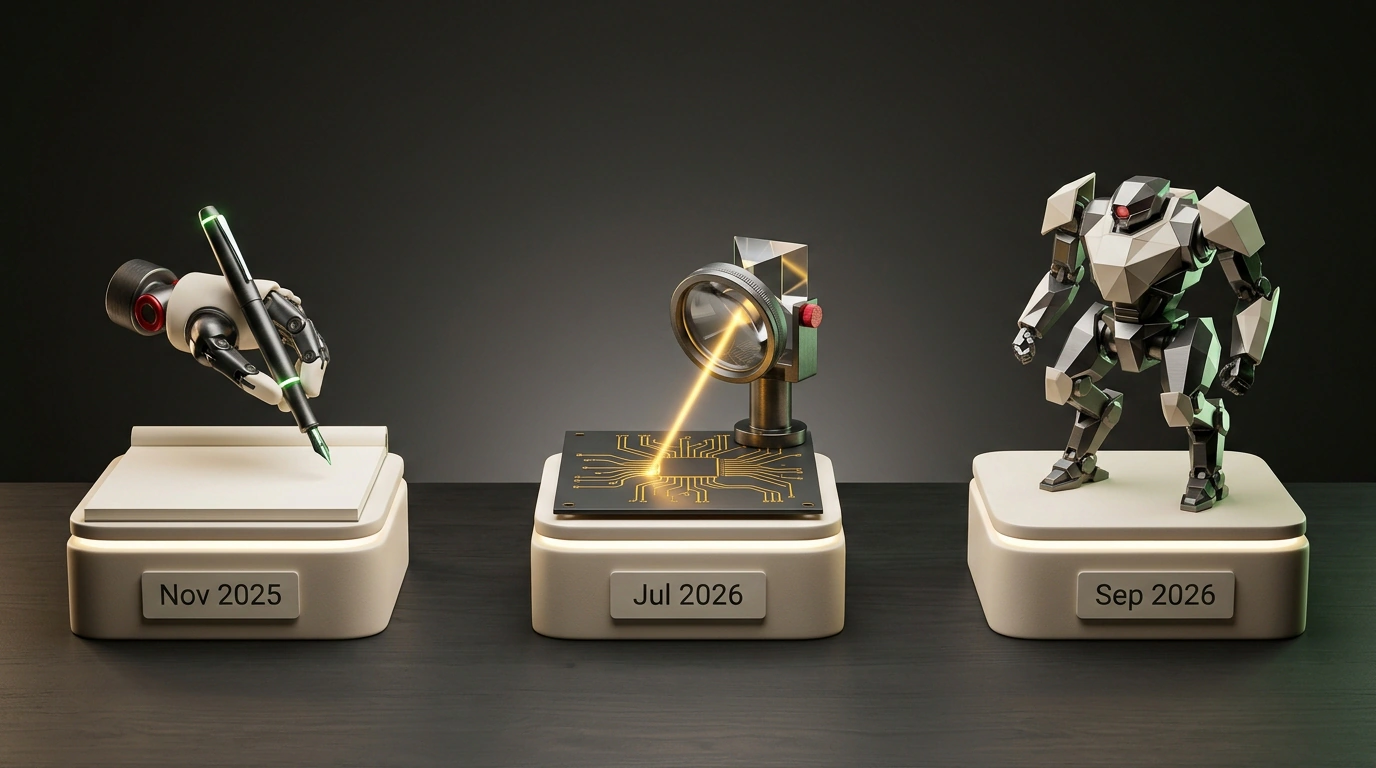
"Software development changed beyond recognition in a year—I doubt I'll ever go back to writing most code by hand." Simon Willison, creator of Datasette and the llm CLI tool, wrote that on November 24, 2026, marking the first anniversary of Claude Opus 4.5. A couple of weeks earlier, he reviewed the year at the AI Engineer Code Summit 2026 and separated real breakthroughs from marketing noise.
New models dropped almost every week, yet the way we actually work with AI shifted three distinct times over twelve months. Each time, a familiar tool leaped into a different league—an inflection point after which old habits don't come back.
November 2025: coding agents stopped needing constant babysitting
By last autumn, the idea of a coding agent that reads a repo, edits files, and runs tests wasn't new. Claude Code itself launched on February 24, 2025 alongside Claude 3.7 Sonnet and had been around for nine months by November. Yet it still hadn't earned a permanent spot in daily workflows.
You had to supervise and correct the agent constantly. Between explaining context, catching broken edge cases, and rewriting half the edits, doing it by hand was faster. There was no net time savings.
Everything flipped on November 24, 2025 with the release of Claude Opus 4.5. In its announcement, Anthropic claimed the model could handle ambiguous specs, weigh trade-offs without hand-holding, and fix tangled multi-system bugs. This time, the promises matched reality.
Comparison of flagship models on the SWE-bench Verified benchmark at the Claude Opus 4.5 launch (Source: official Anthropic blog)
With Opus 4.5, an agent started producing the right result by default for the first time. Hand it an everyday task, and most of the time the code compiled and worked out of the box. Fixing the model's output took less effort than writing from scratch. The threshold had been crossed.
That same November, OpenAI shipped the GPT-5.1 lineup: Instant, Thinking, GPT-5.1-Codex, and GPT-5.1-Codex-Max. For the Codex agent, the effect was identical—it stopped stalling and became a dependable partner. The calendar helped too. Over the December holidays, developers quietly tested agents on side projects, and by January 2026 they brought them into production repositories.
June–July 2026: "Fable-class" models that build their own debuggers
The next leap began with intrigue. In April 2026, Anthropic unveiled Claude Mythos and immediately kept it from the public due to cybersecurity risks. Under Project Glasswing, Mythos proved able to find zero-day vulnerabilities and figure out how to exploit them on its own.
Developers only got to touch the tech in June, when a "defanged" version arrived: Claude Fable 5. It was trained to block offensive security requests while keeping all its engineering horsepower. The celebration lasted three days before US authorities placed export controls on Fable 5 and paused access until July 1.
Even those first few days were enough to reveal a new class of systems. The defining trait of "Fable-class" models is relentless proactivity. While an ordinary agent waits for instructions at every step, a model at this level takes a goal, inspects available tools, and builds whatever missing pieces it needs.
A telling example came from a rendering bug in Safari. Instead of guessing CSS rules blind, Fable 5 built its own debugger: it wrote a screenshot tool using pyobjc-framework-Quartz and spun up a local logging server with CORS. The model captured window screenshots, gathered logs, and saw the bug with its own eyes. When an agent lacks eyes or hands, it builds them along the way.
A second example reads like a household detective story. In November 2026, an annoying beep started coming from a room stacked with boxes. Rather than spending hours digging through clutter, Simon Willison hooked up five microphones through the browser's built-in WebAudio API and fed the stream first to Claude Opus 5.5, then to Fable 5.2. There was no off-the-shelf acoustic-tracking software, so the models wrote the signal processing themselves and pinpointed the beep within about 40 centimeters.
Today, the "Fable class" includes Claude Fable 5, 5.1, and 5.2, the more affordable Claude Opus 5.5 (often nicknamed "cheap Fable" in practice), GPT-6 Astra, and the new Gemini 4 Neon. What looked like a parlor trick six months ago is now the baseline for flagships.
September–October 2026: the 3D breakthrough and the first AI with a sense of fun
Not long ago, asking a model to build a 3D scene produced a crooked cube floating in empty space. Over four autumn months, that picture changed dramatically. Hook a flagship up to Blender or ask for Three.js code, and the model outputs coherent geometry with proper proportions and animation. Fable 5 showed early hints, while Opus 5.5, GPT-5.6 Sol, GPT-6 Astra, and the Gemini 4 family blew the doors open.
In one test, a short prompt to Gemini 4 Neon generated a Three.js animation using real OpenStreetMap data: the Yonkers neighborhood rises off the map as a giant mech and marches across Manhattan, Queens, and Brooklyn. Where did this leap in spatial reasoning come from? Likely robotics. For a vision-equipped robot to move safely in the physical world, its neural network has to understand volume and physics—and the race for robotics appears to have leveled up 3D coding along the way.
The biggest surprise landed in game design. Back in August, it still seemed that a "sense of fun" belonged strictly to humans. In an experiment with a 3D raccoon heist game called Raccoon Heist, Fable 5 built an unplayable prototype, and GPT-5.6 Sol Ultra's version got boring after 90 seconds. In September, Willison even reassured a conference crowd that making genuinely fun games would still be up to us.
That prediction lasted two weeks. On September 22, 2026, Claude Opus 5.5 came out and was handed a Command & Conquer-style strategy game called Battledrones with a simple brief: the game is boring right now, make it way more fun. The model went into autonomous playtesting—running matches for twelve straight hours, adding mechanics, and tuning balance. By morning, the rough sketch had turned into a game you actually wanted to keep playing, and the agent had modeled a clean 3D Goliath mech to boot.
| Stage | Key Models | What Changed | Signature Task |
|---|---|---|---|
| November 2025 | Opus 4.5, GPT-5.1-Codex | Agents became faster than manual coding | Daily features and tricky bugs |
| June–July 2026 | Fable 5, Opus 5.5, GPT-6 Astra, Gemini 4 Neon | Models build their own tools | Safari debugger and beep locator |
| September–October 2026 | Opus 5.5, GPT-5.6 Sol, Gemini 4 | Solid 3D and a sense of balance | Playtesting and refining Battledrones |
| November 2026 | Claude Fable 5.2 | The implementation barrier vanished | Series of Datasette and llm releases |
The dam broke. At two autumn conferences, developers were already demoing agent-built projects that felt like complete, real games. A cultural war over AI game development flared up in the indie scene, and GTA VI is increasingly called the last blockbuster of the pre-generative era.
November 2026: Fable 5.2 and the disappearing implementation barrier
Whether November's Claude Fable 5.2 counts as a fourth inflection point or a major leap forward is still open for debate. Either way, its pace feels uncanny: the model matches a developer's engineering taste and knocks out heavy tasks that sat untouched in backlogs for years.
Changelogs tell the story better than any theory. In just three weeks of November 2026, three alpha releases of Datasette (1.0a42 on Nov 8, 1.0a43 on Nov 15, and 1.0a44 on Nov 22) and five versions of the llm tool (0.37, 0.37.1, 0.37.2, 0.37.3, and 0.38) shipped. Packed inside are dozens of fixes and new features that used to take months.
If this really is the fourth inflection point, the takeaway is simple: if you can picture a program and describe it clearly, a Fable 5.2-class model can build it. Writing code is no longer the main bottleneck. The bottleneck is back inside the human head—knowing precisely what system you want to end up with.