Panic threads about a 'shadowban' pop up constantly in seller forums and business chats. The story repeats with eerie precision: a company posts a listing, it climbs onto the first page of search for target keywords, yet views freeze at zero and the inbox stays dead silent.
The seller assumes the worst. They blame moderators for secret penalties, rush to clone accounts (which triggers an actual permanent ban for multi-accounting), or dump cash into the priciest paid boosts.
Reality is far more interesting. There is no such thing as a 'shadowban' inside Avito's architecture. To see where customers went, you have to look under the hood of the recommendation engine that AvitoTech engineers detailed in a technical report.
The Invisible Top-Spot Paradox: Why Page One of Search Isn't Enough
Classifieds expert Ekaterina Pertseva shared a telling case. A client offered complex B2B services for mandatory product labeling under Russia's Chestny ZNAK system. The account sat inactive for a couple of months, its latest review was three stars, and its overall rating slipped to 4.5.
Even so, its listings held steady on page one for direct search queries. Targeted traffic should have flowed nonstop—yet the phone didn't ring.
The reason is a major shift in how people browse Avito. Shoppers type exact queries into the search bar less and less often. Instead, they open the mobile app and scroll through the personalized feed on the homepage—just like they browse social media.
Power of the Main Showcase: Where 50% of Views Come From
Official data from the platform's developers makes the math clear:
- The homepage recommendation feed generates around 50% of all listing views on Avito.
- Personalized recommendations drive around 30% of all direct contacts (calls and chat inquiries).
If you optimize listings only for keyword search, you're fighting for half the pie. The moment your card drops out of recommendation blocks, inquiries can fall in half—leading sellers to mistake it for a secret ban.
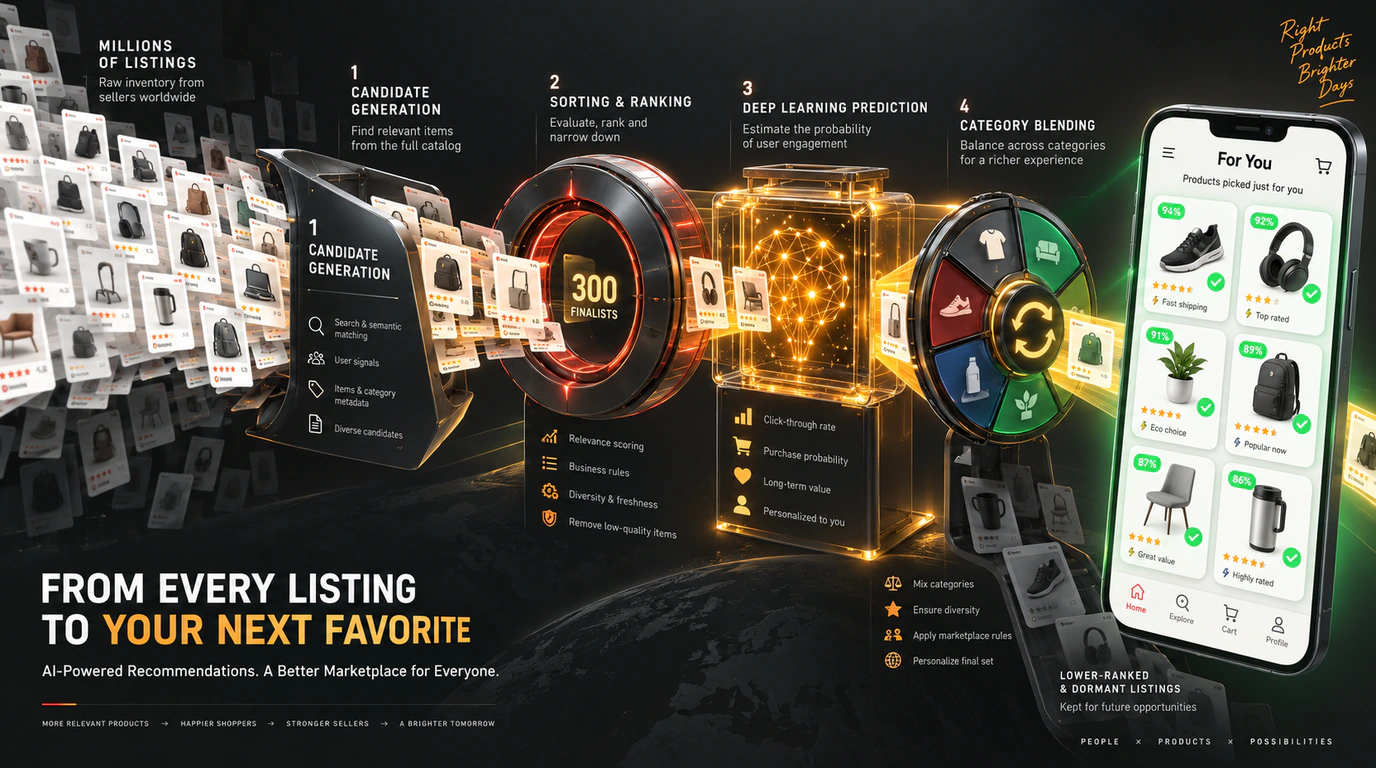
Four Pipeline Stages: How AI Picks 300 Finalists
How does a listing earn a spot on a buyer's home screen? Avito runs a multi-stage machine learning pipeline:
- Candidate Generation. From hundreds of millions of listings, fast collaborative filtering and embeddings (
item2vec/user2vec) pull a few thousand candidates close to a user's interests. - Initial Filtering. That list narrows down to the top 300 candidates based on the user's location, price range, and basic deal terms.
- Heavy Neural Ranking. A deep learning model predicts the chance of a real action—a call or message. It trains on sequences of the user's last 50 meaningful actions (contacts, favorites). Empty accidental clicks get ignored to filter out clickbait.
- Category Blender. A final algorithmic layer mixes the feed so goods, services, cars, and real estate alternate naturally on screen instead of turning into one repetitive niche wall.
Avito's neural model doesn't score listings in a vacuum. It predicts the odds of a deal. If people open your listing often but never message you or save it to favorites, the model tags it as empty bait and drops it from the 300 finalists.
Why a Listing Loses Selection and How to Win Back Views
Your listing vanishes from the homepage not because of moderator politics, but because it loses to rivals on behavioral metrics. Three main triggers cause that drop:
- Weak cover photo and low CTR. Users scan feeds visually. Dark photos, tiny unreadable text, or generic stock images kill clicks, and the algorithm stops showing the card.
- Slow chat replies. If a seller takes longer than 15–30 minutes to reply, the system lowers display priority.
- Activity gaps and stale reviews. The algorithm needs fresh proof that you're active and closing deals well.
To get back into recommendations, refresh your main photo (make it bright, high-contrast, and highlight one clear benefit), keep chat response times under 3–5 minutes, and ask recent happy clients for detailed new reviews. Once the model sees a streak of meaningful actions, views return without any guesswork.