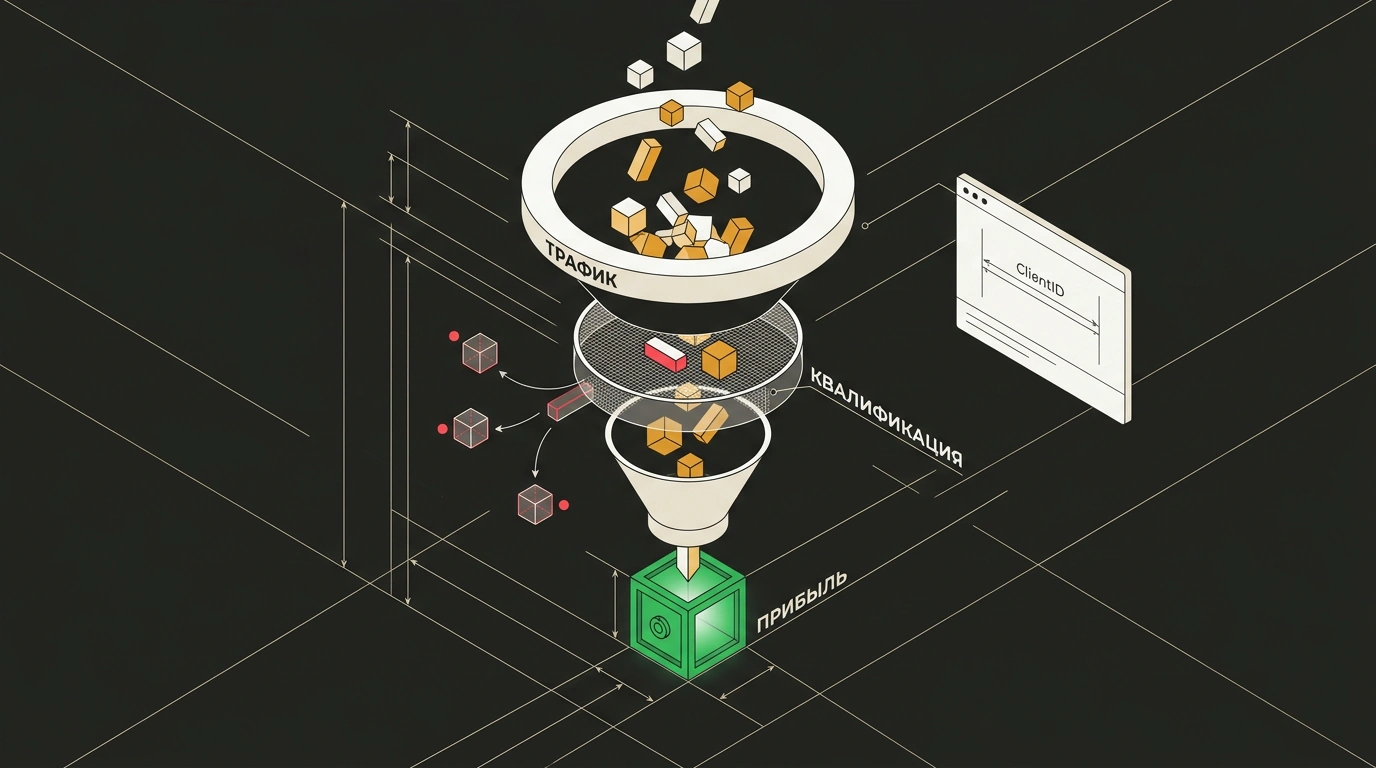
You've probably seen this picture more than once: you open your search ad report, and it looks like a celebration. Clicks are getting cheaper, CTR is climbing, and your ad specialist is cheerfully reporting hundreds of incoming leads. But when you walk into the sales department or check the bank statement, your mood drops. Managers are frustrated, phone numbers are disconnected, and the cash register is empty.
I run into this paradox on client projects all the time. The issue isn't that search advertising is dead. It's a methodology mistake: businesses confuse ad platform metrics with commercial return on investment. Let's take this mechanism apart piece by piece.
Three Tiers of Metrics: Where the Illusion Hides
To evaluate advertising objectively, I separate metrics into three isolated levels:
- Ad platform metrics: impressions, clicks, CTR, and spend. These measure initial attention. A cheap click often comes from exaggerated or clickbait promises ("an air conditioner for 500 rubles") that attract idle browsers.
- Lead quality (qualification): how many inquiries actually match your target audience in geography, budget, and urgency. If ten out of a hundred leads pass qualification, the other ninety are junk that wastes your sales team's time.
- Financial results: actual closed deals, revenue, gross profit, and CAC (customer acquisition cost). We've already covered why high CTR and cheap leads can bankrupt a business when optimization is disconnected from the cash register.
The Cheap CPL Paradox: A Financial Model
Let's look at a financial model for an air-conditioning installation company with a fixed monthly ad budget of 120,000 rubles.
In the first month, the campaign targeted the right audience: 120 leads at 1,000 rubles each. Thirty percent passed qualification (36 leads), and sales reps closed 12 deals. Customer acquisition cost (CAC) was 10,000 rubles (120,000 / 12). With 15,000 rubles in gross profit per deal, the company earned 180,000 rubles in gross profit. After subtracting the ad spend, the business kept 60,000 rubles in net profit.
In the second month, the ad specialist switched the campaign to chase cheap leads. It brought in 200 leads at 600 rubles each—CPL dropped by 40%, a triumph on paper! But because of junk traffic, only 15% passed qualification (30 leads), and sales fell to 8 deals. CAC jumped to 15,000 rubles. Gross profit from those deals was exactly 120,000 rubles (8 × 15,000). After paying for ads, the business broke even at zero.
Training an auto-bidding strategy on intermediate clicks or unprotected forms without spam filtering pushes the algorithm to shift budget toward bot networks simulating activity. On paper, the campaign hits its target for cheap leads, while in reality it paralyzes the sales team with junk contacts.
Why Auto-Bidding Strategies Buy Bot Traffic
Yandex Direct's auto-bidding strategies maximize whatever signal you give them within your budget. Earlier, we examined how auto-bidding strategies drain budgets in Yandex Direct when marketers feed the neural network button clicks or popup opens.
If your site has an unprotected form, bot networks find it immediately. The algorithm sees a stream of conversions, decides the setup is working great, and buys even more of that invalid traffic.
The End-to-End Bridge: Passing ClientID and Offline Conversions
The only way to break this cycle is to train auto-bidding on confirmed sales using Yandex Metrica offline conversions:
- Capture
ClientID: when a form is submitted, a script grabs the unique visit ID viaym(XXXXXX, 'getClientID', ...)and writes it into a hidden field on the CRM deal. - Send statuses from CRM: once a manager verifies the inquiry, a connector sends a "Lead Qualified" event to Metrica. After payment arrives, it sends a "Deal Paid" event with the amount (
Price) and currency (Currency). - Respect the attribution window: Metrica's window for matching an offline conversion to a visit is strictly up to 21 days.
Once enough data accumulates, switch the campaign to "Pay per Conversion" or "Maximize Profit / Target Ad Spend Share." The algorithm stops feeding bots and learns to attract real buyers.
Division of Responsibility: What the Business Fixes vs. the Contractor
To eliminate finger-pointing, split the ownership clearly:
- The ad specialist owns keyword targeting, excluding low-quality Yandex Advertising Network (RSYA) placements, tagging, and reliable
ClientIDtransmission. - The business owns first-call speed (under 15 minutes), sales script quality, and timely CRM updates.
When end-to-end analytics connects every click to a real receipt, the illusion of cheap CPL disappears—and your ads start generating actual profit.