Map services stopped being simple digital directories long ago. Today, Yandex Maps is a full-fledged performance channel with the hottest demand: a person opens the app right on the street or behind the wheel, one tap away from calling you or building a route to your door.
Yet most local businesses treat their map profile as an afterthought. An owner buys paid ads, and potential customers land on a card with three blurry five-year-old photos, an empty price list, and abandoned reviews. Naturally, the ad budget goes to waste.
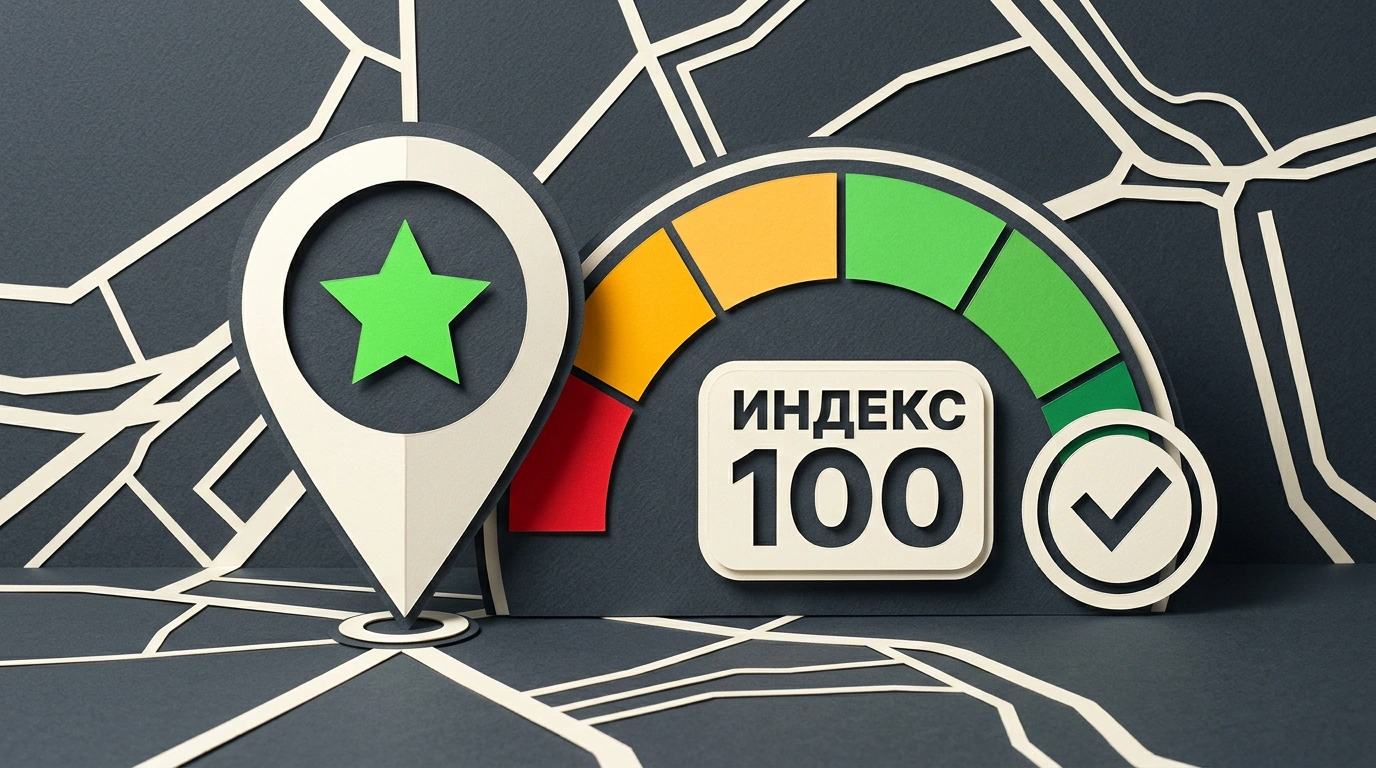
Geomarketing expert Beniamin Mkrtchyan developed a practical model called "Index 100." It's a step-by-step audit system that scores a company profile across seven weighted blocks (100 points max) plus a control block called "Analytics." It helps you spot customer leaks and fix them before turning on paid ads. We've already looked at how to turn a map profile into a steady stream of clients; now let's examine the ranking math underneath.
The Seven Weighted Blocks of Index 100
Each block maps directly to an algorithmic ranking factor or customer trust:
- Rating and reviews (25 points). The most important block. The algorithm recalculates your average score daily, weighing the authority of each reviewer. Aim for 4.7–5.0 with a steady flow of fresh reviews every month. Any fake reviews or spam get penalized.
- Core information (20 points). Owner verification (the blue checkmark), choosing primary and secondary categories to expand search reach, matching your exact storefront name, and placing the entrance pin accurately.
- Price list and catalog (15 points). Maps hides items without prices and dislikes "from... to..." ranges. Use plain service names people actually search for: write "beard trim," not "facial hair sculpting."
- Photos and videos (15 points). Your cover and first ten shots set the first impression. Include the exterior facade, wayfinding to the entrance, interior, work areas, and examples of your work.
- Features and filters (10 points). Payment methods (cards, SBP faster payments, cash), parking, Wi-Fi, and accessibility. Users filter out venues based on these checkboxes.
- Profile activity (10 points). Stories, recent news, and promotions. Posts don't automatically boost rankings, but they show customers the business is active and give them a reason to visit today.
- Review management (5 points). Response speed (within 24 hours) and constructive handling of complaints. Prospects judge your service quality by how you answer negative feedback.
The control block "Analytics" carries 0 points: it doesn't alter your profile, but it validates your results in the Yandex Business dashboard through route builds, calls, and clicks.
Score Tiers and the 12-Point Grid Test
- Under 40 points — critical zone: your profile is invisible in the neighborhood, and customers go to nearby competitors.
- 40–70 points — average level: the basics are there, but gaps in pricing or photos cut incoming inquiries in half.
- 70+ points — strong profile: your card is competitive, and you can focus on expanding your organic reach radius.
To check real visibility, run a 12-point grid test: three radii (1 km, 3 km, and 5 km) in four cardinal directions, plus a check right at your entrance. At each point, search your target query while logged out. Your goal is to hit the top 5 on a smartphone screen without scrolling. Looking at local SEO in Yandex Maps in 2026, it's easy to see why a venue often ranks #1 at its own doorstep yet loses to a competitor just 800 meters away due to missing prices or outdated photos.
Express Audit Checklist for a Yandex Maps Profile
- Profile ownership is verified (blue checkmark "Information confirmed by owner" is active)
- 2–3 relevant secondary business categories are added
- Exact prices are listed in the catalog with photos attached to key services
- Clear photos of the street entrance and parking landmarks are uploaded
- All negative reviews from the past month have polite official replies
Clean up your profile using this checklist, and you'll quickly see how many free customers from nearby blocks were walking right past simply because they couldn't spot you on the map.