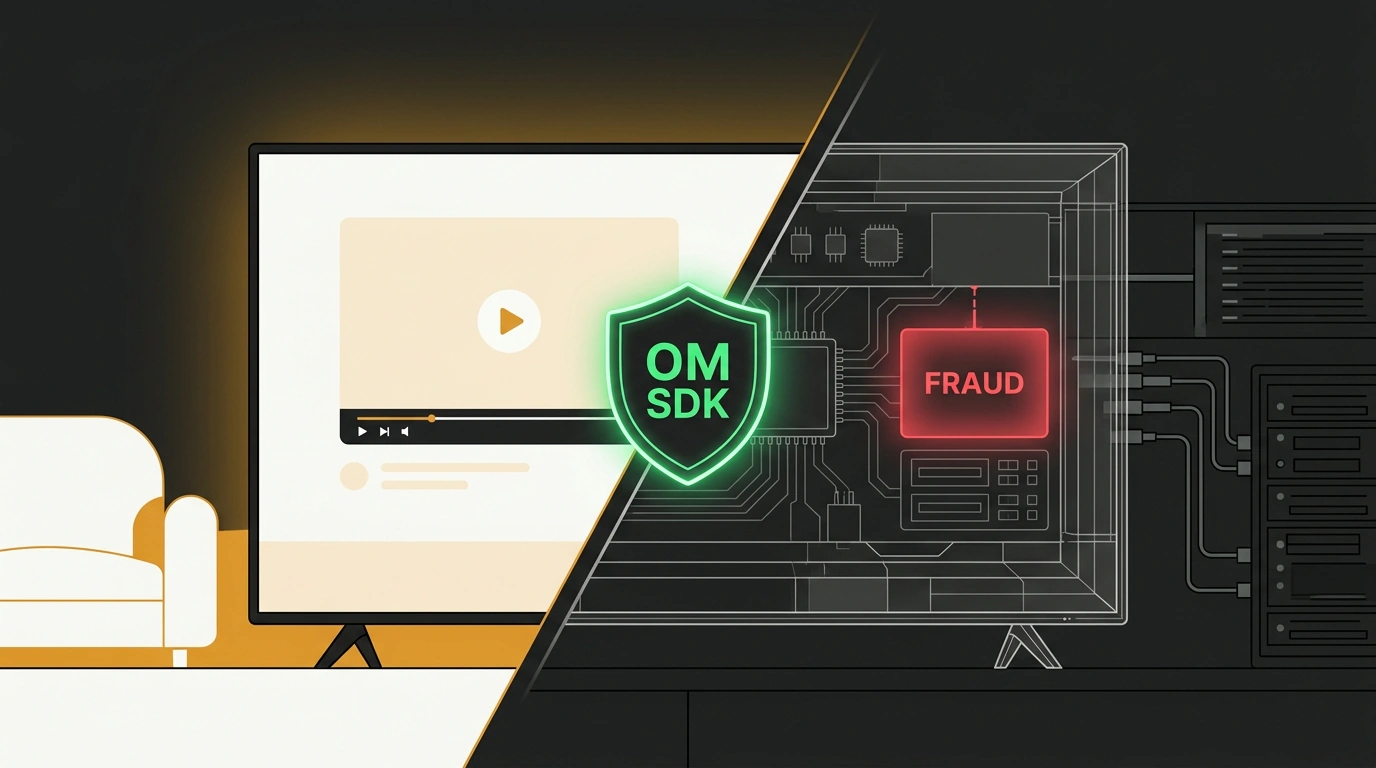
Advertising on Connected TV (CTV and Smart TV) is widely seen as the safest, most premium video format today. A huge screen in the center of the living room, a family watching their favorite series together, high engagement value, and a hefty CPM. Advertisers assume nobody can cheat here: this isn't a shady corner of the web, it's a physical TV from a major brand.
Yet wherever huge budgets meet a shortage of independent measurement, a sophisticated fraud industry grows fast. According to verification firm DoubleVerify, CTV fraud schemes surged 140% year-over-year in Q1 2026 alone. In unprotected campaigns, brand losses to fraud hit a staggering $1.8 million per billion impressions. During holiday peaks in Russia, bot traffic in some Smart TV placements jumps from a baseline 20–25% to an alarming 35–40%.
You pay for a paying household's attention, while a virtual script on a data-center server "watches" your commercial around the clock. Let's look at how this fraud works and how you can protect your ad budget.
Anatomy of Fraud: 5 Ways Impressions Get Stolen
Fraudsters have mastered faking big-screen views by exploiting five core weaknesses in the ecosystem:
- Device spoofing. Scammers run server emulators inside cloud data centers. Software fires off VAST ad requests pretending to be a legitimate Samsung or LG TV or a Roku box. Their main operating cost is renting pools of residential proxies (real home ISP IP addresses) to disguise a cloud server as an ordinary apartment.
- App ID spoofing. The request header swaps in a fake app identifier. Pixalate research found that up to 80% of fraudulent IDs on Roku mimic top legitimate streaming apps, while 74% on Samsung disguise themselves as built-in TV background services.
- Screens-off playback. Because of flaws in how OS power signals are handled, a video player keeps running ad streams and reporting 100% video completion rates (VTR) long after the viewer turned off the TV with the remote and went to bed.
- Server-Side Ad Insertion (SSAI) manipulation. SSAI stitches ads and content into one stream on the server. That blocks ad blockers, but it also stops advertisers from placing client-side tracking pixels. Brands are left with server logs and no proof the frame ever lit up a physical screen.
- Multi-hop traffic arbitrage. Inventory gets resold through long chains of middlemen. Pixalate reports show that 28% of CTV traffic sold as "direct" actually passed through unauthorized resellers mixing in bot traffic.
Reviewing case studies on bringing performance video to big screens, specialists stress that real performance only happens when placements are strictly filtered.
A direct agreement with a well-known streaming service isn't a 100% shield. When a legitimate platform runs short on its own premium inventory, it often fills the gap through partner networks (Audience Extension), where gray traffic easily slips in.
Defense Tech: OM SDK and Cryptographic Attestation
The industry has built practical tools to fight Smart TV fraud:
- IAB Tech Lab Open Measurement SDK (OM SDK) for CTV. A unified open measurement interface (OMID API) built directly into TV operating systems and players. It sends independent verifiers like DoubleVerify and Weborama real signals on container viewability and screen state.
- Cryptographic device attestation. A new IAB Tech Lab standard based on the IETF Privacy Pass protocol. A physical chip inside the Smart TV generates a cryptographic signature proving the request came from real hardware, not a data-center VM.
- Supply-chain checks. Cross-checking sellers against
app-ads.txtandSellers.jsonfiles weeds out unauthorized resellers.
Don't let glossy decks about "premium formats" lull you to sleep. Demand OM SDK support from your media planners, verify app-ads.txt, and lock a strict Invalid Traffic (IVT) cap into your contracts so your ads reach real people instead of server farms.