If you've opened the Telegram Ads dashboard at any point over the past year, you've definitely noticed how the rules of the game have changed. It used to be easy to launch a tidy ad at 1.5–2 euros per thousand impressions (CPM), quietly pick up targeted subscribers at 50–70 cents apiece, and call it a day. Today's reality is harsher: the auction has tripled in price. In competitive niches, bids have climbed into the 6–8 euro range, and big brands are pouring in budgets so aggressively that smaller projects feel ready to throw in the towel.
I've felt the same temptation myself: "Maybe I can just drop my bid to two euros, set the minimum floor, and scoop up leftover traffic?" Except that's not how it works. Telegram Ads runs on a first-price auction. If you bid below your niche's market floor, your ad doesn't start serving cheaper—its impressions simply drop to zero.
Fractional CMO Alexander Sosnovsky put together a blunt, sobering methodology for surviving this new auction: we can't control impression prices (the market dictates those), so we have to ruthlessly control the cost of the final outcome—each subscriber.
Let's break down the math behind this ad-filtering system so you can cut money-losing creatives within the first 24 hours and stop wasting a single extra cent.
Baseline Thresholds and the Required Conversion Formula
To keep a campaign from turning into a charity donation to Telegram, Alexander Sosnovsky sets two ironclad rules:
- A hard ceiling of 2.5 euros per subscriber. Any ad where subscriber cost exceeds this cap gets paused without mercy. No exceptions, no matter how clever the copywriter thinks the copy is.
- A maximum cost per click (CPC) of 0.6 euros. Once clicks cost more than 60 cents, keeping subscriber acquisition under 2.5 euros becomes nearly impossible by basic probability.
Here is where those numbers come from and how they tie back to the auction. On Telegram Ads, the average click-through rate (CTR) for a solid 160-character text ad hovers around 1%. That means 1,000 impressions bring roughly 10 clicks.
From there, you get a simple empirical formula for the channel's required click-to-subscribe conversion rate ($CR_{click \to sub}$):
Let's test this formula on a real example. Suppose you're buying impressions at the market rate of CPM = 6 euros. Your required subscription rate works out to:
That means one in every four people who clicks through to your channel has to hit "Subscribe." If your channel only converts 12% of visitors, then at a 6-euro CPM and a 0.6-euro CPC, each subscriber costs you $0.6 / 0.12 = 5\text{ euros}$—double your allowed ceiling. And the problem isn't that Telegram Ads "doesn't work"; it's that your destination channel isn't ready to convert expensive traffic.
Meanwhile, minimum entry bids in the ad account are strictly enforced: a text post in a channel requires at least 2.0 euros per 1,000 impressions, retargeting to past viewers starts at 2.0 euros, and banner formats start at 1.0–2.0 euros depending on the category. Bidding lower is pointless—you'll get zero impressions.
The Decision Traffic Light: Judging Ads Without Emotion
The biggest trap for marketers and media buyers is getting emotionally attached to their own copy. You spent three days polishing every word inside the 160-character limit, nailed a witty hook, hit launch... and subscriber cost shot up to 3.8 euros. Instead of killing the creative, the excuses start: "Give the algorithm time to learn, once the weekend passes the price will drop."
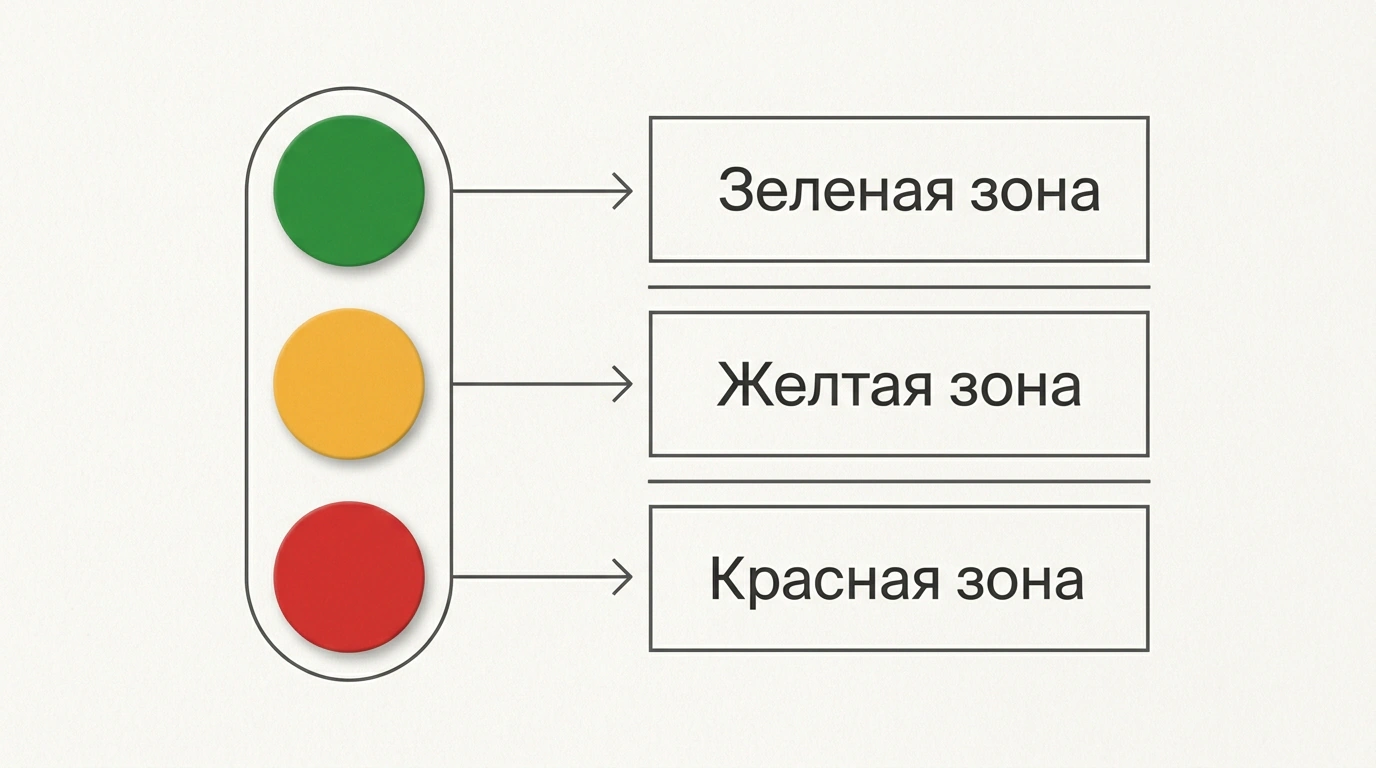
Remember: no algorithm can fix a broken offer. Sosnovsky uses a clear traffic-light system on a 50–60 euro test budget:
- Green Zone (CPL up to 2.5 euros): "Feed it budget." The ad struck a nerve with the audience. The golden rule here: do not touch the CPM bid! Trying to "optimize" a winning combo by shaving 20 cents off the bid instantly throws off the algorithm and chokes reach. Just raise the daily budget limit gradually.
- Yellow Zone (CPL 2.5 – 3.0 euros): "Hold steady." Don't make sudden moves during the first 24–48 hours. Give the system room to gather data and find the right pocket of subscribers inside your selected channels.
- Orange Zone (CPL 3.0 – 3.5 euros): "Test a bid cut." Trim the CPM bid carefully by 10–15%. If impression volume dips by only a couple of percent while subscriber cost slides toward that 2.5-euro target, keep it running. If impressions stall completely, restore the bid and prepare to pause.
- Red Zone (CPL over 3.5 euros): "Kill without regret." You're more than 40% over KPI. The creative isn't working—either the angle fails to hook readers, or channel visitors feel a mismatch between what the ad promised and what's sitting in your pinned post.
Don't wait for an ad to spend the full 60-euro test cap if you spot two red flags early: a CPC above 0.6 euros within the first 50 clicks, or a subscribe rate at half the required benchmark (for example, 10% instead of 24% at a 6-euro CPM). That's a classic sign of clickbait—people click out of curiosity, then immediately bounce once they see the channel.
Also, if you're targeting direct competitors' channels, keep the legal angle in mind alongside the auction math: check out this analysis of the risks of targeting competitor brands in Telegram Ads and FAS's stance so you don't walk into unfair-competition fines.
Walking Through the Math
Let's look at a real 60-euro checkpoint that often trips up beginners:
- The campaign served 10,000 impressions at a 6-euro CPM (spending exactly 60 euros).
- It generated 120 clicks. Cost per click: $60 / 120 = 0.5\text{ euros}$. Great—well under the 0.6-euro cap.
- 22 people subscribed. Conversion rate: $22 / 120 = 18.3%$. Under Sosnovsky's formula, the target at a 6-euro CPM was 24%.
- Final cost per subscriber: $60 / 22 = 2.73\text{ euros}$.
What's the right call? The ad is sitting in the yellow zone (between 2.5 and 3.0 euros). A panicked media buyer kills it immediately; a rookie dumps another 500 euros into it. The smart move is to let it run one more day. If conversion stays stuck at 18% and CPL doesn't drop below 2.5 euros, step the bid down or swap in a fresh creative with a sharper call to action.
In an overheated Telegram Ads auction, the winner isn't the one who pays the most—it's the one who coldly tracks conversion at every step. Hold your 2.5-euro subscriber ceiling, test at least 5–10 short copy variations out of the gate, and never let attachment to a clever line run your ad budget.