You know this scenario all too well: your search or social ad campaign is polished to a shine. Ad copy follows every marketing rule, CTR is strong, clicks roll in steadily, and your budget drains on schedule. Yet the lead counter in your CRM sits stubbornly at zero.
A business owner's first instinct is predictable: "The traffic is junk, the contractor sent bots, wrong audience." Then you open session recordings and watch real visitors—and your jaw drops. People click through, stare at the screen for three seconds flat, flinch, and close the tab.
Vladislav Ivanov, communications director at Reg.resheniya, puts it bluntly: in 80% of cases, the problem isn't traffic quality—it's a total collapse of trust on the first screen of your site.
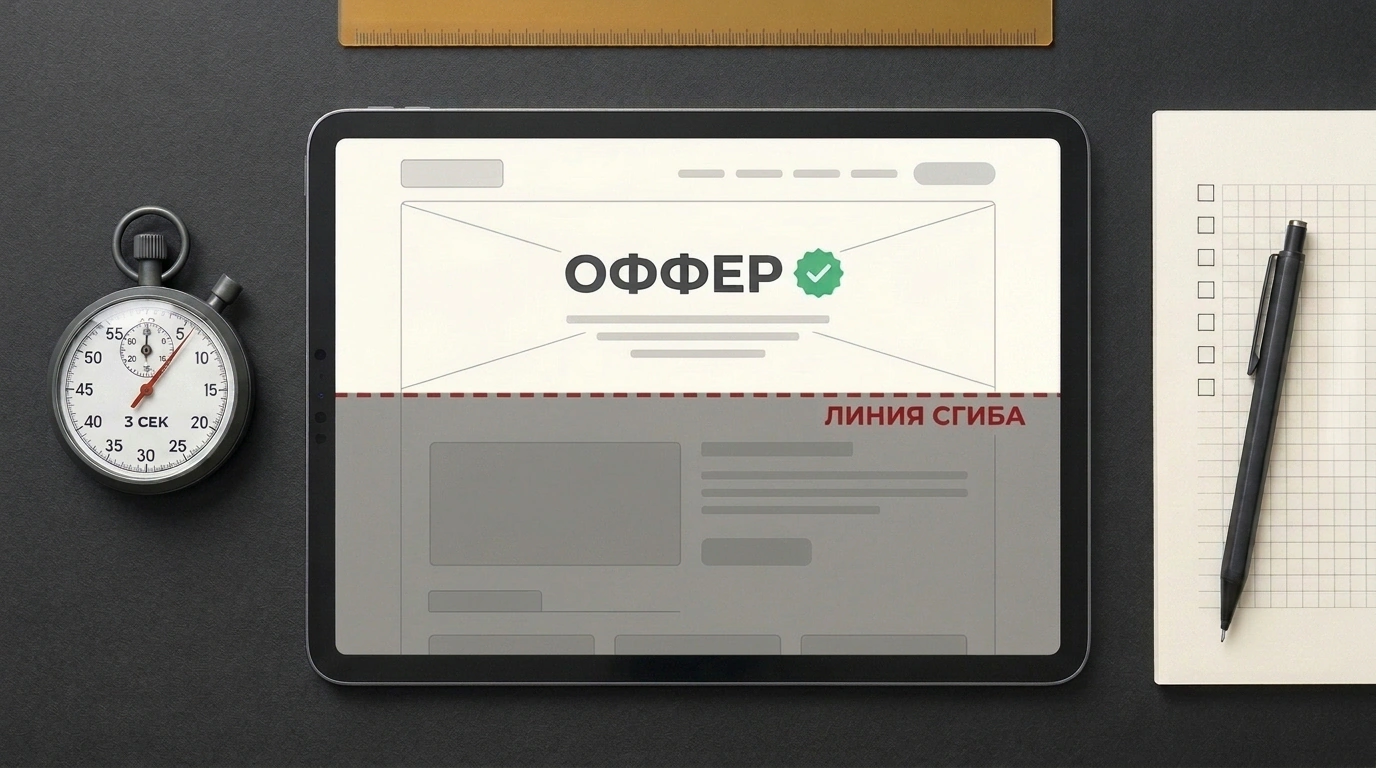
According to Nielsen Norman Group research, up to 80% of user attention concentrates above the fold. If your hero section fails to defuse natural buyer skepticism immediately, visitors won't live long enough to scroll down.
Let's break down the five critical barriers that kill conversion at the door.
Five Above-the-Fold Landmines: From Vague Offers to Hidden Price Tags
- Vague offers and hollow corporate noise. The worst thing you can put in your main headline is "We are a team of professionals with years of experience" or "Innovative solutions for your comfort." That is pure semantic fog. Your first screen has three seconds to answer three questions: what exactly you sell, who it's for, and on what basic terms. If you manufacture industrial warehouse doors, say it straight: "Industrial sectional doors for warehouses and plants in Yekaterinburg. Built and installed in 10 days under contract."
- Classified pricing ("Price on request"). Buyers in 2026 despise price-tag hide-and-seek. A "Request a Quote" button with no baseline number reads like a threat: give us your phone number so a rep can pressure you into overpaying. If an exact quote depends on specs, show a clear range ("from 150,000 rubles"), average completed project size, or an interactive calculator with transparent inputs.
- Zero hard proof (Social Proof). Stock photos of smiling models in spotless white hard hats only trigger irritation. Trust comes from real-world artifacts: scanned thank-you letters on company letterhead, genuine job-site photos of your crew, video testimonials naming the client company, and your legal entity details (Taxpayer ID / INN and Registration Number / OGRN) visible in the header or footer.
- Sluggish load times and broken mobile layouts. Google data shows over 53% of mobile users abandon a page if it takes longer than 3 seconds to load. Worse yet, oversized chat-bot widgets covering the "Submit" button on smartphone screens silently slice your remaining conversions in half.
- Aggressive frontal assault. A lone "Buy Now for 500,000 Rubles" button scares off cold visitors. Offer progressive engagement instead: let people download a technical spec sheet or ask a quick question in Telegram without forcing a mandatory sales call.
For more landing-page layout pitfalls, check out our breakdown Seven Above-the-Fold Landing Page Mistakes That Kill Lead Conversion.
The High-Converting Hero Formula: Clarity Beats Design
Customers don't buy expensive graphics or trendy scroll animations. They buy certainty and a clear fix for their problem.
Run the three-second test on your site: show your above-the-fold screen to someone unfamiliar with your business for three seconds, then close the laptop. If they can't explain clearly what you sell and roughly what it costs, your hero section needs an urgent rewrite.
Make your first screen crystal clear, show honest pricing benchmarks, back claims with verifiable proof—and your ad spend will finally start paying for itself.
