In consumer goods marketing, one stereotype refuses to die: to lift nationwide sales, you have to split your promo budget evenly across regions and distributors. A slice for every city—tastings, flyers, a chain-wide discount. It feels like that kind of reach should push revenue up. In reality, as marketer Nikita Smirnov shows, the cash burns up, the report looks great, and sales sit as still as a cast-iron bridge.
Take a concrete problem: a sauce producer allocates 300,000 rubles for a promo in the Granat retail chain. Why do blanket retail discounts vanish into thin air, and how can you direct your budget only to the shelves where it is guaranteed to drive growth?
Three Traps of Equal Distribution: Where Money Leaks in Blanket Promos
By splitting 300,000 rubles across the entire map, a brand walks into three traps. In my view, smearing a budget across cities is like watering a dry field from a perfume bottle: a drop lands everywhere, yet not a single plant gets enough to drink.
- Slicing up the map "so nobody feels left out." No single city reaches a critical mass of customer touchpoints, and the promo goes unnoticed.
- Focusing on the loudest requesters and top-performing stores. Money flows wherever a sales rep pushes hardest, or into stores where demand is already strong. There, a discount only eats into your margin, subsidizing purchases that would have happened anyway.
- Mixing different goals into a single mechanic. Getting a product back onto an empty shelf (
out-of-stock), expanding the flavor lineup, and entering a new store are three distinct tasks. A single flat discount turns the promo into a lottery (local businesses repeat the same mistake by scattering their budget across a dozen ad channels).
Shelf X-Ray via Chestny Znak: What Hides Behind a 100-Supermarket Sign
I recommend starting any audit on the sales floor: when Smirnov's trade marketer walked into a Granat store to photograph the display, the product wasn't on the shelf at all. Chestny Znak (GIS MT) helps digitize the chain. Every jar carries a Data Matrix code. At checkout, the register sends the receipt through a fiscal data operator (OFD) into the "Объем розничных продаж в разрезе по ИНН и адресам" report, while wholesale movement is visible through electronic universal transfer documents (UPD).
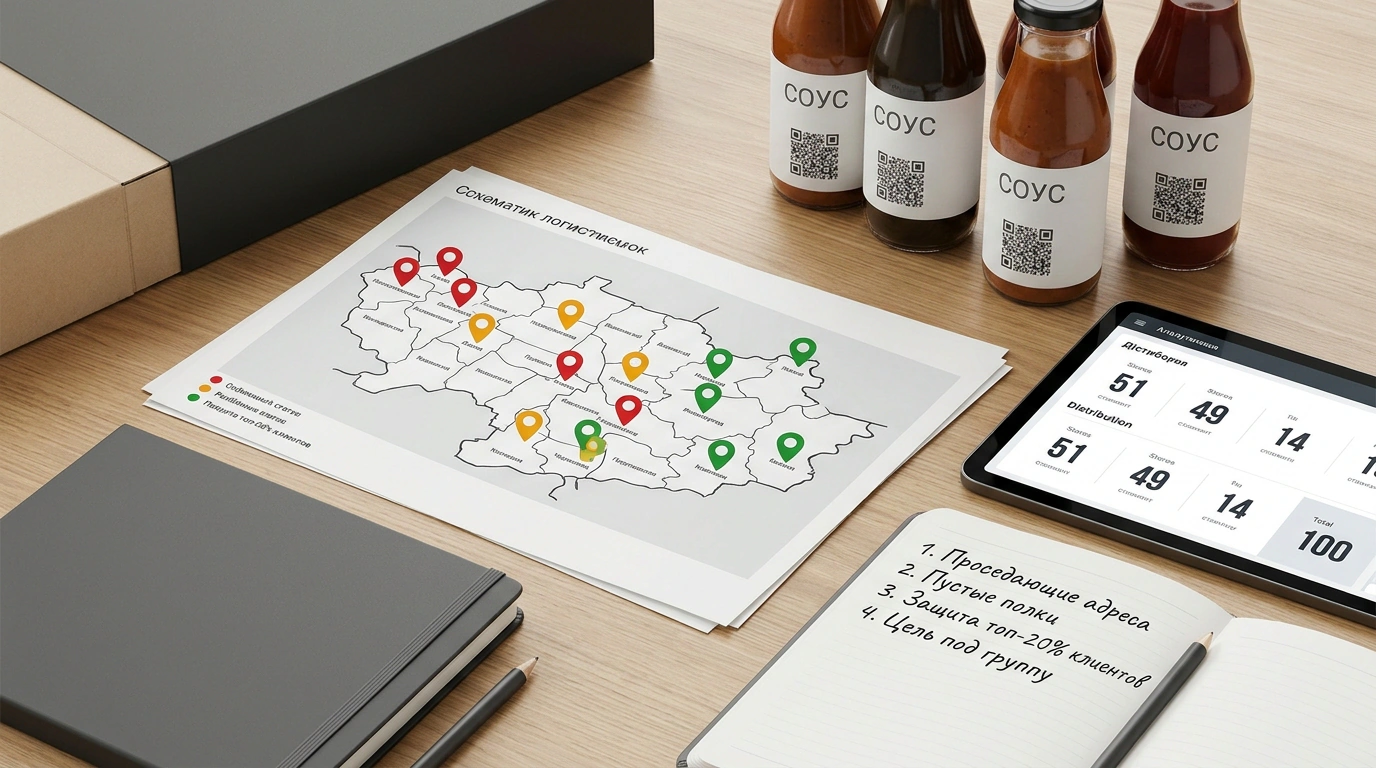
What caught my attention in this case was the picture across the Granat chain of more than 100 stores: in 14 locations, the product had been off the shelves for over 2 months; all 3 listed SKUs (three sauce flavors) were present in only 51 stores; and 49 locations carried just 1–2 items out of 3.
Let's compare two approaches on the sauce maker's 300,000-ruble budget. In the "before" scenario, a 15% discount across 100 stores burns cash in the 51 successful locations and multiplies by zero in the 14 empty ones. In the "after" scenario, I cross-checked the targeting against the labeling data and the Tochka Rosta service, which compares sales against category demand. The discount is canceled in the 51 stores, and the 300,000 rubles are split between merchandiser bonuses for getting the sauce back on shelves in the 14 empty stores and customer cashback on the missing flavors in the 49 locations with an incomplete assortment.
For the business, that changes everything: the budget stops subsidizing loyal buyers and starts opening shelves—the 14 empty stores return to generating sales, and the 49 locations fill out their assortment. That answers our question: a promo delivers growth when the mechanic fixes the problem at a specific address. Just keep in mind that OFD receipts arrive with a 1–2 day lag, and zero sales sometimes mean boxes forgotten in the stockroom, so reports should be paired with in-store checks.
The Pareto Principle, Focusing on Four Steps, and a Pre-Launch Checklist
In wholesale, the Pareto principle (20% of efforts produce 80% of results) is even starker: at one of Smirnov's distributors, 70% of sales came from 3 clients. Those accounts are protected with retention programs, while weak retail coverage is fixed by targeting specific stores. In the Chestny Rost service, the author introduced a rule that resonates with me: every week, the sales team gets exactly 4 growth steps per distributor—not forty tasks, just four. I wrote about how marketing and sales connect in the breakdown of why 700,000 rubles yielded three deals.
Before launching a promo, run through this checklist:
- Underperforming addresses — stores with falling demand, not entire cities.
- Empty shelves — locations with zero sales in a distributor's territory.
- Protecting the top 20% of clients — partners generating 70–80% of turnover.
- A goal per store group — mechanics tailored to restocking shelves, expanding to 3
SKUs, and entering a new store. - Before-and-after measurement — checking address-level sales in Chestny Znak.
In retail, there is no magic button for boxes forgotten in the back room. But now you know the rules of the game: check shelves through labeling data before launching a promo and set no more than four steps a week per distributor—and your promo budget will hit the mark.