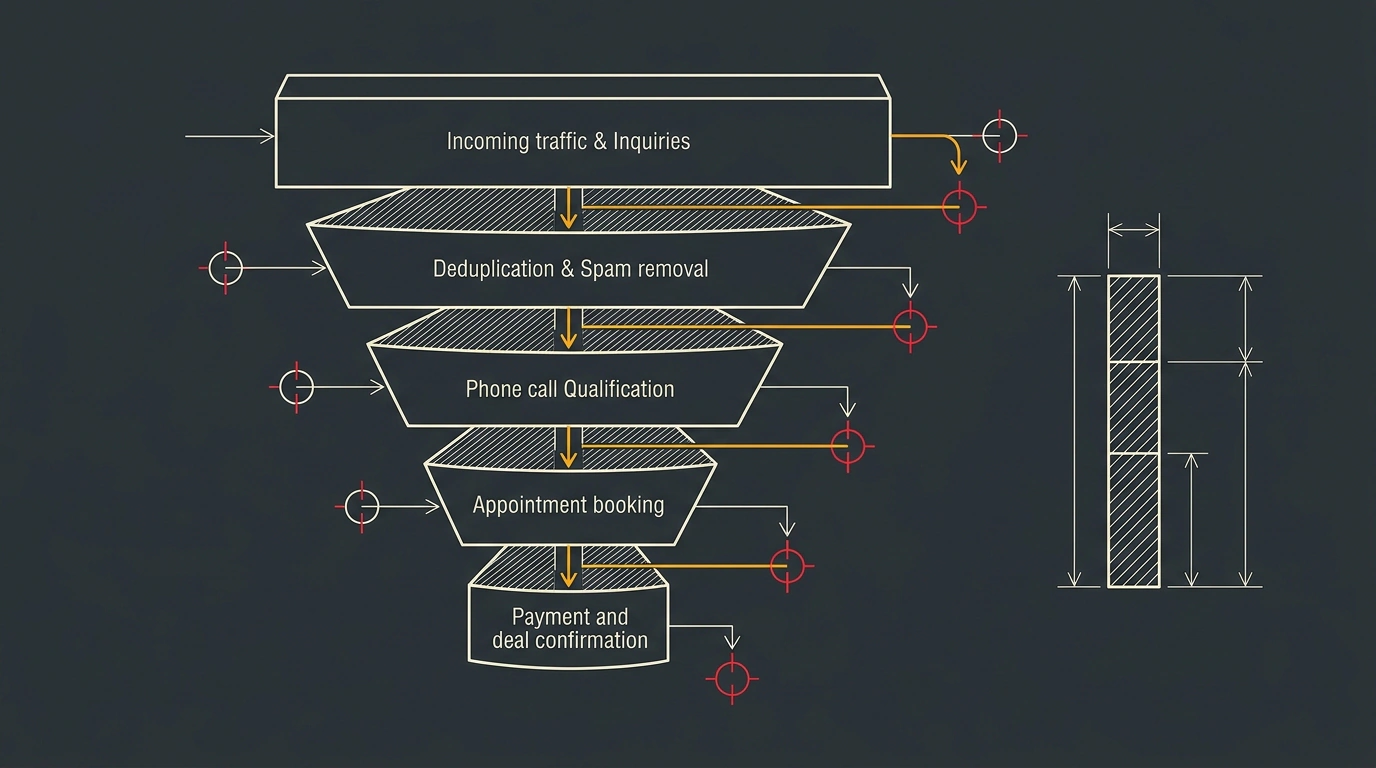
Almost nobody can tell at a glance why, with upbeat traffic reports, there is suddenly noticeably less money in the cash register—at this fork, service business owners, sales heads, and marketers alike get equally confused. When revenue sags where deals happen through a call and a consultation—at a law firm, clinic, car dealership, or real estate agency—your eyes involuntarily fall on the ad account. I completely understand this reflex: the traffic budget sits in plain sight on a single expense line, while the chain of callbacks, reschedules, visits, and prepayments is hidden behind dozens of statuses inside CRM.
Yet changing the media buyer or inflating the budget without checking the middle of the funnel only pours expensive fuel into a punctured tank. Katya Shpak, Marketing Director at a federal law firm, shared a revealing internal investigation on vc.ru: ads were bringing in inquiries almost strictly on schedule, yet there were not enough meetings, and the flow of prepayments was melting away. Instead of rebuilding the ads, her team exported the deal database, listened to operator and manager calls, and found five hidden leak points between the click and the cash register—let's break down together where clients get lost after advertising has honestly done its job.
The Illusion of a Fulfilled Plan: How CRM Averages Hid the Drop Since May
The first leak point surfaced as soon as the team put aside comforting summary reports and broke down the nine-month CRM export from January through September by stages and months. At the top of the funnel, marketing worked like clockwork: the call center received 8,227 inquiries, closing 95% of the plan. If you judge ad health solely by lead volume and cost per lead, the contractors deserve a bonus. Two steps lower, however, the picture broke down: against a plan of 2,116 consultations, lawyers held only 1,621—just 77% of the target.
Why didn't management notice the crack right away? The habit of relying on averages over a long period let them down. In February–April, the meeting plan was met at 97–100%, and spring momentum created the illusion that everything was fine. Starting in May, fulfillment dropped into the 58–85% corridor and failed to reach the bar even once for five months straight, leaving the company short 375 target consultations. The quarterly summary smoothed over this cliff just like an average hospital temperature masks a fever in half the ward: while a strong spring covered up the summer slump in the overall table, the business looked for the breakdown in the wrong place.
Garbage on the Line: How Spam and Duplicates Ate Up Operator Capacity
The monthly breakdown pinpointed when the failure started, but to understand why only a small fraction of thousands of cards reached the finish line, they had to open the second leak point—the actual composition of the incoming stream. Over nine months, 25% of inquiries turned out to be spam, and another 12% were duplicates from the same people. In January, spam spiked to 43%, dropping to 15–21% by autumn. What struck me most in this report were the third-quarter numbers: among leads that did not reach a meeting in July–September, 61% were technical garbage and duplicates, not clients who refused services.
Look at this through the eyes of an operator on shift. More than a third of their queue consists of silent bots, wrong numbers, or a person who clicked a button twice on the website and already spoke with the neighboring desk ten minutes ago. Each empty dial takes a couple of minutes: ringtones, logging a rejection, switching attention. By lunchtime, the employee is exhausted from fighting phantoms and answers a real client with a serious legal issue in a tired voice—or calls back too late. After filtering out duplicates, only 2,650 people (37%) passed qualification, of whom 2,194 (83%) booked a meeting. Cutting off spam and merging repeats at the CRM entry before dialing is the most direct way to give the call center back hours of live work without extra traffic spend.
An Empty Chair in the Meeting Room: Why Every Third Office Booking Burned Out
Even after clean qualification and calendar booking, the third leak point kicked in—the chasm between a scheduled slot and an actual conversation with a lawyer. Comparing formats revealed a sharp contrast: only 63% of booked clients made it to the office, whereas 81% showed up for an online meeting. Every third in-person booking burned out, and in May only 49% of those scheduled reached the meeting room. According to vc.ru industry analytics, the benchmark show-up rate for an initial legal consultation is 60–75%, while a drop toward 50% directly signals a lack of prior confirmation.
Listening to call recordings quickly explained why some clients vanish along the way while others reliably show up. A person stressed over debts or a dispute leaves a request on Tuesday evening; the operator books them into the office for Friday and says goodbye. Over two days, daily routine takes over: a crunch at work, traffic jams, anxiety—and without a single touchpoint, it is easier not to go anywhere. The call center's best operator acted differently, and their approach became the standard for everyone: confirming the visit with a call 24 hours ahead and a check-in message on the day of the meeting (by market benchmarks, this keeps attendance at 80–85%), and immediately offering a video call to busy clients.
Betting on online and a double reminder turned the stage's economics around on two fronts at once. The remote format not only removed travel friction, but also lifted meeting-to-contract conversion from 31% to 39% over the year: at home, a person feels calmer opening documents and showing them to a lawyer on screen. Instead of paying to buy new leads to replace burned bookings, the company recovered dozens of warm negotiations through simple follow-up discipline.
Small Advances, Relying on Three Stars, and Rebuilding the Funnel Without Extra Budget
On the home stretch, the fourth and fifth leak points surfaced, explaining the shortage of real cash. Over the year, the number of contracts grew by 15%, yet there was less money in the register: 7 out of 10 deals closed with a minimal first payment, dropping the average advance from 44,000 to 29,000 rubles. In my view, this is a classic incentive distortion: when salespeople are evaluated by contract count, they agree to a symbolic deposit for a quick checkmark. On paper the plan glows green, while in reality lawyers immediately get a full workload that the business funds out of pocket.
A name-by-name breakdown also exposed the fifth leak point: out of 8 operators, only 3 people were carrying the plan. In aggregate summaries, the top performers masked the slump of five colleagues, yet losing even one of the trio would instantly sink the entire department. Meanwhile, the partner channel converted 37.8% of leads into contracts versus 33.7% for a competitor. Ultimately, the fix required no new ad budget: the team reviewed 10–20 calls from strong and average operators, documented a unified qualification standard with mentoring for newcomers, put the average first payment under control, and baked a referral ask with a dedicated CRM category into the post-contract script.
Before running a similar audit in your own project, check out two adjacent traps from our past breakdowns: how discrepancies between Metrica and CRM goals train ads to bring empty clickers and why static kanban snapshots distort stage conversion. And before making any changes in your ad account, keep three guideposts in focus:
- Slice the funnel by months, stages, and people. A summary report hides both a third of spam and duplicates at the top and a dangerous dependence of the whole department on two or three strong employees.
- Insure the gap between booking and meeting. A call 24 hours ahead and a reminder on the day of the visit, paired with an online video call, protect your budget more reliably than buying new traffic.
- Cross-check deal count against the first advance size. Growth in contract volume alongside a falling initial deposit loads the team with work while draining live working capital.
Advertising is only responsible for getting a target customer to knock on your door. Whether that knock turns into revenue is decided by a clean CRM entry free of junk, careful meeting confirmation, and a unified conversation standard for every operator on shift.