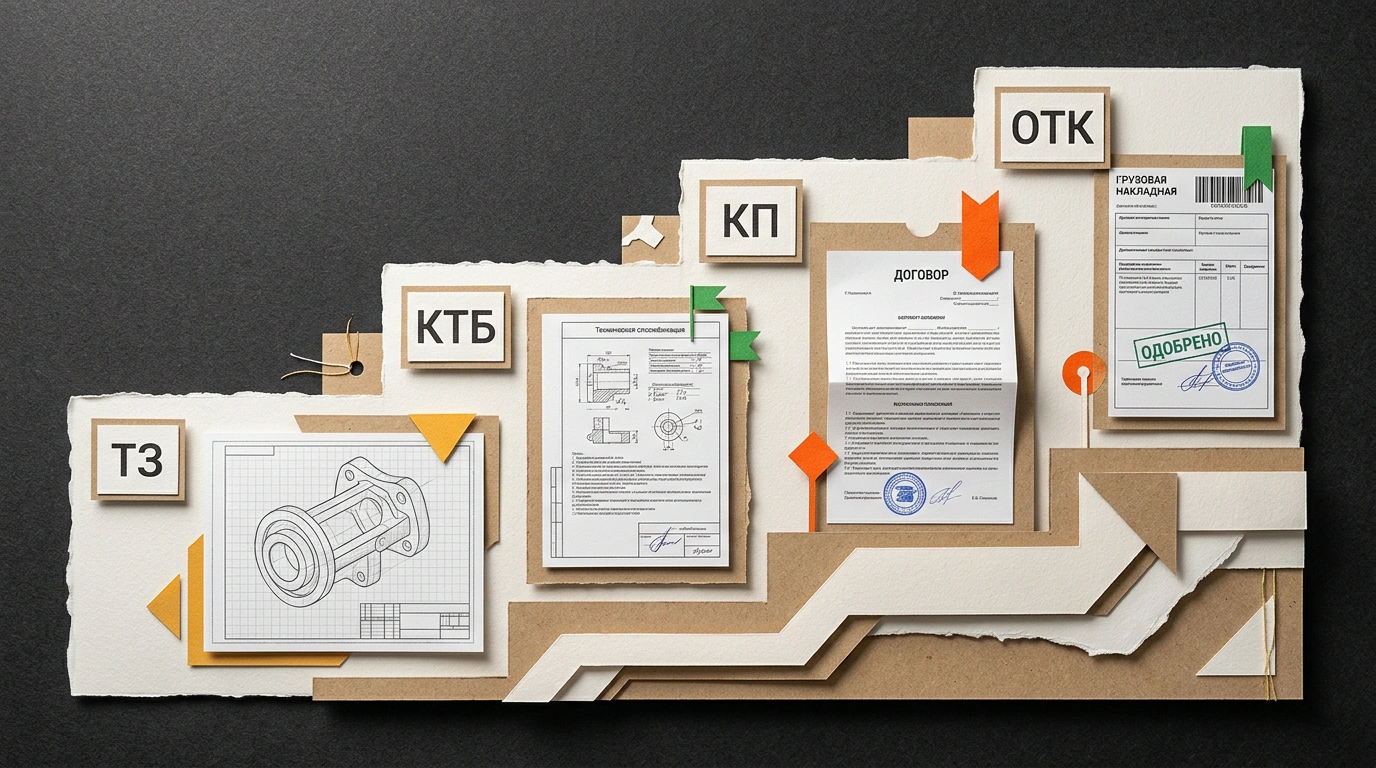
Open your company's or sales team's CRM right now and look at the column names reps drag deal cards across. If your screen shows the usual labels like "In Progress," "Quote Sent," "Thinking," and "Awaiting Signature," you aren't looking at a revenue-management tool—you're looking at a timesheet of rep busywork. A salesperson drags a card into the next column, checks the box for emailing a PDF, and moves on to the next call, while the buyer is already reviewing drawings and delivery schedules with your direct competitor.
In a manufacturing plant or wholesale B2B operation, running on a simple retail template—"lead, call, payment"—causes the business to lose the vast majority of incoming demand without even seeing where it went. To stop guessing where orders vanish and compress multi-week approvals into a few days, you have to flip the pipeline's logic: detach it from internal rep activity logs and anchor it strictly to completed actions by the buyer.
Why a Retail Template Breaks Factory Sales—and the 3 Rules That Stop Losing 90% of Leads
When revenue dips at a plant, the same chorus of excuses plays at every weekly meeting: reps complain that "prices are too high," marketing points at sales and hears back about "junk leads," and the commercial director shrugs that "the market is down." Pull the raw CRM export, however, and cold arithmetic tells a different story. Yekaterinburg-based sales consultant Nikita Dunaev—who built 13 sales departments over two years for B2B manufacturers with revenues up to 1.5 billion RUB—lays out a typical scenario in a vc.ru breakdown: a plant owner sees 120 monthly inquiries and only 9 signed contracts. Conversion sits below 8%, and nobody knows where the other 111 inquiries—more than 90% of the pipeline—disappeared.
The root cause is forcing a short retail funnel onto industrial manufacturing. In retail, one buyer decides fast. At a factory, a deal takes anywhere from two days to several months because a four-person buying committee signs off on it:
- Procurement manager (buyer) collects initial quotes and compares market pricing.
- Chief technologist (engineer) verifies drawings, GOST standards, steel grades, and tolerances.
- CFO evaluates payment terms, credit limits, and cash-flow gaps.
- CEO or owner approves the final contract and puts pen to paper.
To make a pipeline reflect that collective sign-off and expose where money leaks, I rely on three rules of industrial B2B:
- Anchor every stage to a completed buyer action. Statuses like "Quote Sent" or "Awaiting Signed Spec" only describe what your rep did or hopes will happen. A deal moves forward strictly on a past-tense milestone from the client: "Client confirmed receipt of quote and booked engineer call" or "Specification signed."
- Isolate different revenue streams into separate pipelines. Mixing cold first-time inquiries, repeat dealer reorders, and long-cycle tenders in one board is pointless—you'll drown in filters and distort your average conversion rate. As ELMA365's B2B sales architecture confirms, first-time orders, dealer networks, and tenders belong in separate pipelines with their own sales tracks.
- Enforce strict time limits on every step. Any deal sitting in "Estimate Calculation" for more than 7–14 days with no next scheduled task has over an 80% chance of already being lost to a faster competitor, even if it's still marked open.
The 8-Stage Manufacturing Deal Architecture: Cutting Approvals from 30 to 7 Days
Once you strip out process excuses and switch to buyer milestones, the path from first inquiry to shipment fits into 8 core stages:
- Inbound inquiry qualified — minimum batch size, geography, raw material availability, and line capacity confirmed.
- Technical specs and questionnaire received — client submitted drawings and requirements (with an NDA signed if needed).
- Engineering & cost calculation completed — the design and engineering bureau (KTB) calculated machine-hours, materials, and logistics against line load in ERP/1C.
- Commercial proposal presented — client opened the itemized quote and held a review call with the plant's specialists (for how to structure the quote itself, see our breakdown of a B2B commercial proposal builder).
- Contract and redlines agreed — legal teams aligned on liability, warranties, and dispute terms.
- Specification signed and invoice issued — first batch volume and payment schedule locked in.
- Prepayment received, order released to production — the financial trigger that puts the job on the shop floor.
- Batch passed QA, shipped, and paperwork closed — first deal completed and client moved into the repeat-order pipeline.
At this point, you're probably thinking: "Hold on—what if we do custom project sales that take six months to approve? How do we fit into eight steps? And who's on the hook when a deal stalls at step three because an engineer takes a week to price it?"
Let's take both in order. A corridor of 6–8 stages is the sweet spot for most factories: fewer stages hide bottlenecks, while more cause reps to skip columns. If you run complex project sales with 5–6-month cycles, your lead-to-deal chain naturally expands to 9–12 stages.
And internal calculation delays are your biggest speed reserve. A telling case from Nikita Dunaev involves an awards and custom merchandise manufacturer in Yekaterinburg. The company pulled 120 inquiries a month at under 8% conversion, while mockup and estimate approvals dragged up to 30 days. An audit showed orders getting bogged down in internal handoffs for non-standard items. Once redundant steps were cut, estimate turnaround was capped at 24 hours, and CRM stages were rebuilt around buyer actions, the deal cycle shrank from 30 days to 2–7 days and signed contracts tripled. One rule is non-negotiable: even if an engineer delays a quote, procurement hunts for a material for months, or accounting drags its feet on an invoice, the sales rep owns the deal—and is responsible for chasing internal deadlines.
5 Monthly Executive Metrics and Reviving a "Dead" CRM Without Hiring
To run this system, an owner doesn't need a dedicated data analyst or Friday status interrogations instead of pulling a 2–5 minute CRM report. Early on, you can track deals in spreadsheets (some companies nearing 1 billion RUB in revenue still run on online sheets), but once a team hits three or more reps, a real CRM is mandatory. For how warming up buyers speeds up the funnel, check our piece on how B2B marketing affects contract cycle length.
An executive only needs to review 5 end-to-end metrics once a month (checking weekly trends and revisiting stages every six months):
- Deals per stage — reveals pipeline density and exactly where bottlenecks pile up.
- Stage-to-stage conversion rate (CR) by rep — the share of deals advancing to the next milestone. If 40 out of 50 qualification calls reach a quote, yet only 8 of those 40 quotes (20%) reach negotiation, the diagnosis is obvious: either the proposal isn't compelling or it's going to the wrong buyers. Always calculate this per rep—team averages hide 2–3x gaps between top and bottom performers.
- Sales cycle length (Lead-to-Cash) — average days from first contact to payment.
- Average deal size — guards against reps handing out unnecessary discounts.
- Loss share by closed Loss Reasons — strict dropdown choices ("price too high," "lead time too long," "refused prepayment," "chose competitor," "volume mismatch," "missing certification," "unreachable") with zero free-text fields.
If half your open deals lack a dated next task, reps only use three out of twelve stages, and lost deals sit in "active" for years (see our audit of zombie deals in CRM), export the last 2–3 months of deals, pinpoint the failing stage, listen to call recordings, and test one fix over 1–1.5 weeks. In another case from Nikita Dunaev, a water-pipe manufacturer rebuilt its pipeline and SLAs—and grew 15% over a year when the broader market fell 33%, using the exact same six reps.
Checklist for Rebuilding a Manufacturing Pipeline in Your CRM
- Export 2–3 months of deals and calculate stage-by-stage conversion separately for each rep.
- Keep 6–8 real stages (9–12 for long project cycles) phrased in the past tense around completed buyer actions.
- Separate cold inbound leads, repeat dealer orders, and tenders into distinct pipelines.
- Lock in a closed dropdown of loss reasons and require a dated next task on every active deal.
Before you close your CRM tab or sign off on next month's ad budget, open any five active deals sitting in the middle of your pipeline and ask yourself one test question: does the stage name they're sitting in describe something your buyer has already confirmed and signed—or just something your sales rep promised to wait around for?