Every year when the first frost hits, city streets turn into a depressing parade: thousands of guys pull on shapeless, crinkly plastic sleeping-bag coats down to their shins, instantly turning their silhouette into a giant black sausage. Or they go the opposite route—shivering in paper-thin cropped jackets, hoping a light layer of fluff will somehow carry them through January.
Buying a proper down puffer is usually the biggest single investment in your winter wardrobe. And the main headache in the sub-50,000-ruble bracket is that mass-market racks are flooded with disposable polyester batting covered in loud patches, while luxury outerwear has blasted past 100,000–150,000 rubles. Men's stylist Denis Gavrilov audited the market and proved you can score a sharp, warm, durable winter jacket between 30,000 and 50,000 rubles—if you know which specs actually matter.
Let's strip away the marketing fluff and look at the engineering details that keep you warm at -20 °C while still looking sharp enough for a date.
The Insulation: Natural Down vs. Membrane Synthetics
The engine of any winter puffer is what's inside the baffles. Under 50,000 rubles, two very different technologies compete for your money.
Natural Down (Down / Feather)
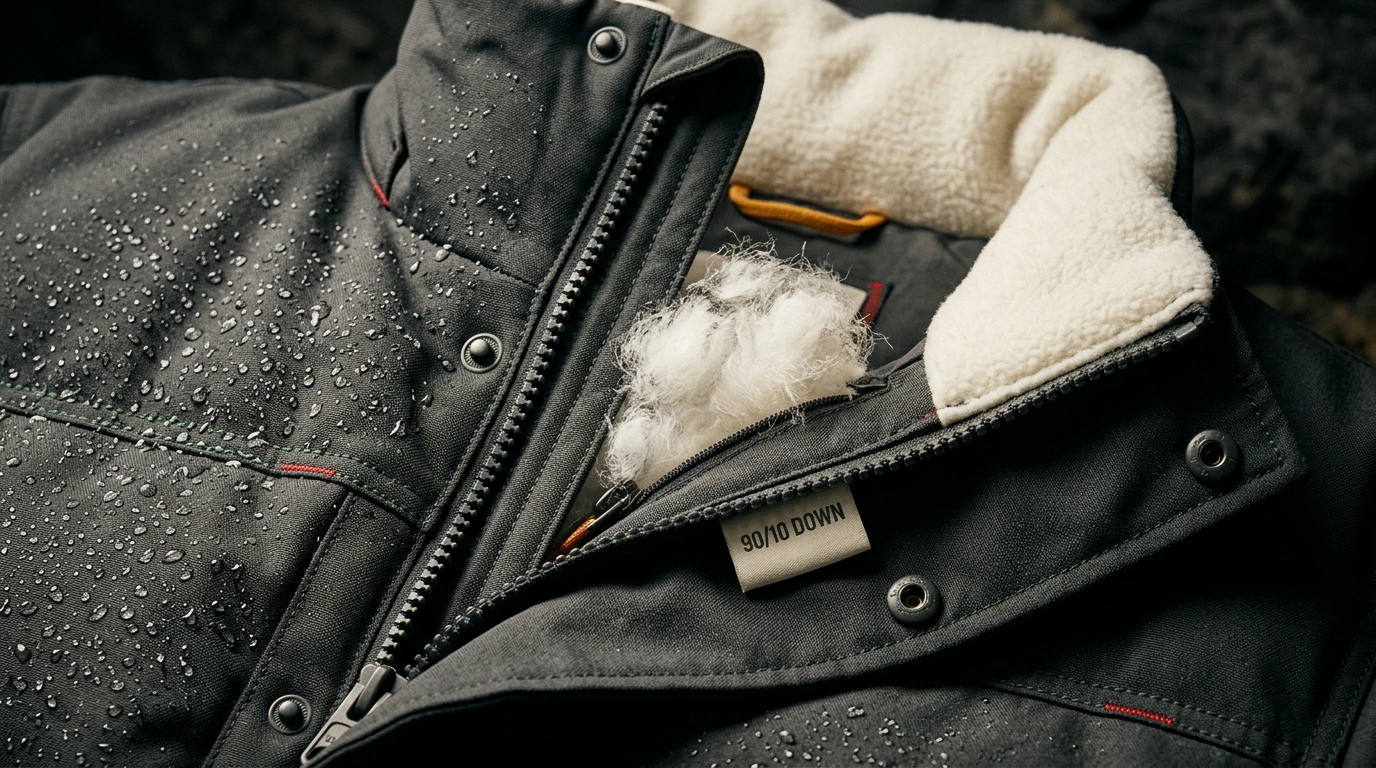
The gold standard for dry, biting cold. Check the down-to-feather ratio on the tag. The sweet spot for city wear is 90/10 or 80/20 (90% or 80% pure down clusters, 10–20% small feathers). Those feathers aren't filler—they act as a springy frame that keeps the down from clumping into flat pockets over time.
The second critical number is Fill Power (FP), which measures how well down bounces back after compression:
- For mild city winters (down to -10 °C), 550 FP gets the job done;
- For harsh winters swinging between 0 and -25 °C, aim for 600–750 FP. Jackets in this range weigh under a kilogram yet trap heat like a thermos.
Engineered Synthetics (DuPont Sorona, Thinsulate, Shelter)
If winter where you live means endless damp slush, wet snow, sleet, and 95% humidity, high-tech synthetic microfibers beat natural down. Wet down collapses instantly and loses its insulating air pockets, whereas quality synthetics hold their loft even when damp and dry out in a couple of hours on a regular hanger. We've already covered the basics in our cold-weather jacket buying rules.
Steer clear of puffers made from thin, mirror-shine polyester. They crinkle like trash bags with every step, tear on the slightest snag, and look cheap. Look for dense matte outer fabrics with a microporous membrane or heavy cotton treated with a DWR (Durable Water Repellent) finish.
Best Brands Under 50,000 Rubles: What the Stylist Recommends
Denis Gavrilov highlighted standout options across local retail and international storefronts:
- Massimo Dutti (~41,500 ₽): Clean urban minimalism. Concealed hardware, dense wool-blend outer shell, and a neat stand-up collar. Pairs effortlessly with jeans and Chelsea boots.
- Suitsupply (~45,000 ₽ / €449): The benchmark if you wear a blazer or heavy knitwear underneath. Italian Angelico fabrics, sharp shoulder structure, and a clean mid-thigh cut.
- Henderson (31,990 ₽): Reliable classic styling with an 80/20 down fill and understated baffling free of loud branding.
- Gate31 (29,990 ₽): Scandinavian cut, technical synthetic insulation, crisp matte tones, and solid neck protection.
- 12storeez (49,000 ₽): Quiet-luxury aesthetic. Rich blended shell fabrics, smart pocket geometry, and deep, structured hoods.
- Bjorn Larsen (47,970 ₽): Built for serious northern freezes. Reinforced windproof shell, taped seams, and heavy-duty two-way zippers.
Cut and Silhouette: Three Rules of Proper Fit
To avoid looking like the Michelin Man, stick to three non-negotiable fit laws:
- Mid-thigh length. Anything cropped like a bomber exposes your lower back when you sit in a car or bend down—and leaves your blazer hem sticking out. Anything down to your calves cuts your height in half and turns you into a shapeless column.
- One-fist air gap. A puffer doesn't warm you with fabric; it warms you with trapped air between the insulation and your body. Don't buy one stretched tight across your chest like a drum. Zip it up and slide your hand inside: if a closed fist fits comfortably, the size is right.
- Double storm flap. A zipper is always the weakest link against freezing wind. Make sure there's a snap or magnetic storm flap covering it.
60-Second Fitting Room Test
- Squeeze a down baffle in your fist for 5 seconds and let go: 650+ FP fill should loft right back in 2–3 seconds
- Raise both arms overhead: the jacket hem shouldn't ride up above your belt line
- Check the pockets: look for warm fleece lining inside for bare hands
- Test the hood: it should have drawcord adjusters so it doesn't blow off in headwinds
Stick to grounded, natural colors: deep charcoal, dark navy, olive, or rich chocolate. Flat black often looks generic and utilitarian, whereas muted earth and slate tones immediately set you apart from the gray crowd.

