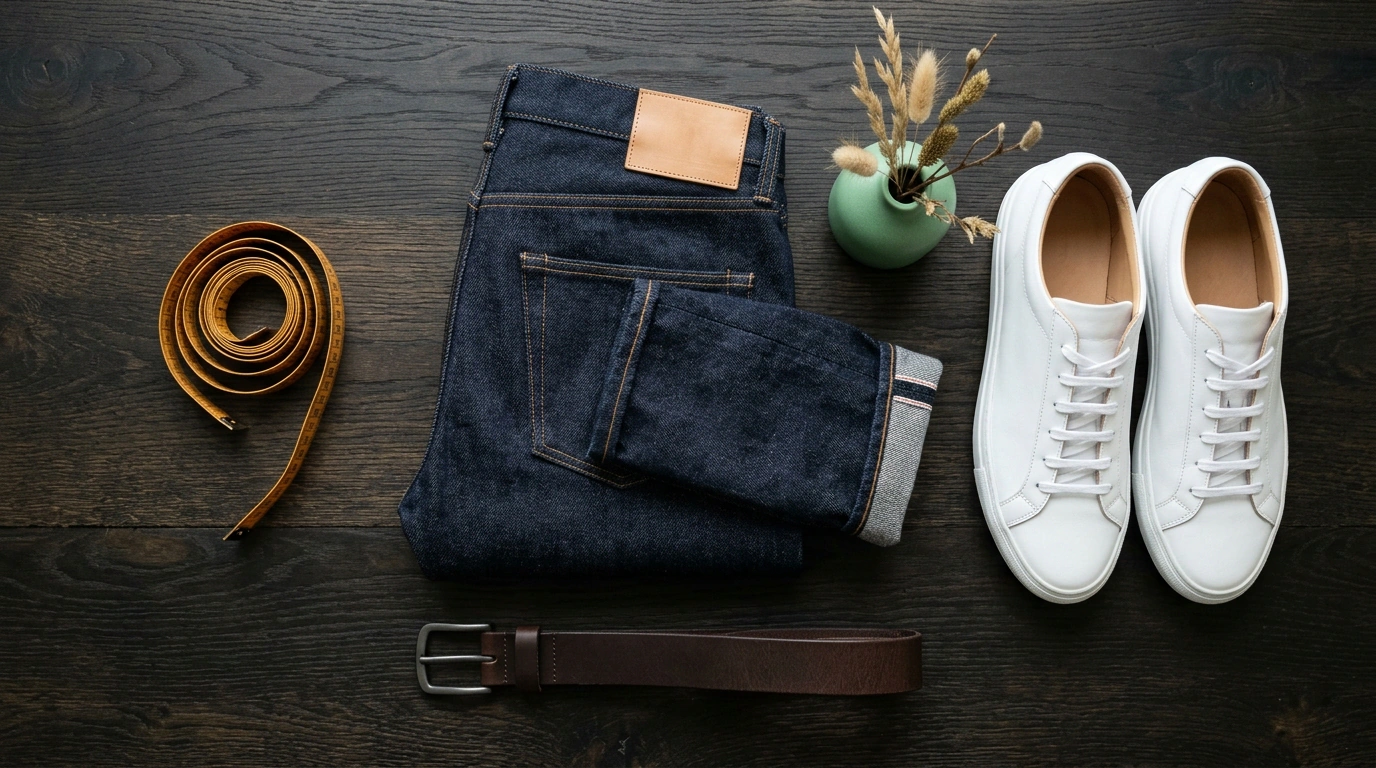
Every guy has a pair of jeans sitting on his shelf. It's the most straightforward, versatile piece in a man's wardrobe: you wear them to class, to the office, and on a first date. Yet denim is exactly where eight out of ten men make glaring style mistakes.
Some guys still wear painted-on "skinny" jeans that turn their legs into toothpicks and went out of style years ago. Others go for baggy, low-rise sacks that pool around their shoes and make their frame look like a squat rectangle. A third group buys jeans with factory rips and loud bleached patches that cheapen the entire outfit.
Men's stylist Denis Gavrilov, together with the experts at Denimhunters, breaks down the geometry of proper denim. Jeans are the foundation of your silhouette—they either build clean body proportions or wreck them completely.
Silhouette Architecture: Why the Wrong Jeans Break Your Proportions
The primary job of denim in a man's outfit is architectural. The right trousers elongate your vertical line, balance the ratio between legs and torso, and smooth out anatomical quirks.
When the fit or length is off, the geometry collapses:
- Overly tight cuts highlight every slight curve in your legs or extra bulk in your thighs.
- Excess length creates messy fabric bunching at the ankles, steals height, and makes your stride look heavy.
- Unnecessary distressing fractures the clean line of your silhouette.
In our breakdown on how to put together a sharp smart-casual men's look for work and dates without a suit, we noted a simple rule: a put-together appearance always starts with a clean, understated lower half.
Five Cuts, Rise Geometry, and the Mid-Rise Gold Standard
To navigate the fitting room with confidence, lock in the five core cuts:
- Skinny: clings tightly from hip to ankle. A hard anti-trend. The silhouette looks comical—clear these out of your closet.
- Slim: follows the contour of the leg while leaving breathing room. Works only for lean guys with straight legs.
- Regular (Classic Straight): the gold standard of men's style. A straight line from hip to hem with no abrupt tapering. A universal staple for any build.
- Relaxed: extra room through the seat and thighs. Ideal for athletic guys with built legs who value comfort.
- Loose / Wide: a statement cut for streetwear fans that requires chunky footwear to balance the volume.
The Rise (where the waistband sits) dictates your proportions:
- Low Rise: the waistband rests low on the hip bones. Visually shortens your legs and makes your torso look awkwardly long.
- Mid Rise: the waistband sits right on the hip bones, just below the navel. That's the golden-ratio sweet spot.
- High Rise: the waistband reaches up toward the navel. A great trick for shorter guys to visually lengthen their legs.
In our guide to men's fall wardrobes and pairing textures with layers, we emphasized that mid-rise jeans pair most naturally with jackets, coats, and knit sweaters.
Fabric Weight in Ounces, Denim Composition, and the Pant Break
Quality and drape come down to the fabric. Denim weight is measured in ounces per square yard (oz):
- Lightweight denim (under 12 oz): thin fabric for hot weather; loses its shape quickly and bags out at the knees.
- Midweight all-season denim (12–14 oz): the benchmark for daily wear, holding a crisp straight line for years.
- Heavyweight denim (15–20+ oz): stiff, authentic selvedge that molds to your body over time.
Fabric composition:
- The ideal choice is 100% long-staple cotton. It holds structure and ages with character.
- An acceptable compromise is cotton with 1–2% elastane for easier movement. Anything with more than 3% synthetics quickly stretches out into sweatpants.
How the hem meets your shoes (Pant Break):
- No Break: the hem barely kisses the top of your shoe. Ideal for white leather sneakers and loafers—clean and sharp.
- Slight Break: one neat fold across the instep. The universal standard for Chelsea boots and everyday sneakers.
- Full Break: heavy stacking at the ankle, acceptable only with chunky, lug-soled boots.
As we covered in how everyday outfits make a man more attractive, a clean hem without sloppy bunching immediately signals style awareness.
Checklist Before Buying Your Ideal Jeans
- Regular or Relaxed cut with zero pulling across the calves or thighs
- Mid Rise sitting squarely on your hip bones
- Denim weight of at least 12–14 oz (the fabric holds its own shape in your hands)
- 100% cotton or no more than 1–2% elastane
- Clean wash with no artificial fading streaks or rips (raw indigo or charcoal)
- Hem length creating at most one neat break over your shoes
Your foolproof color palette is dark raw indigo, charcoal gray, and matte black. One well-made pair of straight-cut, midweight jeans will handle almost any setting and anchor every outfit you wear out.