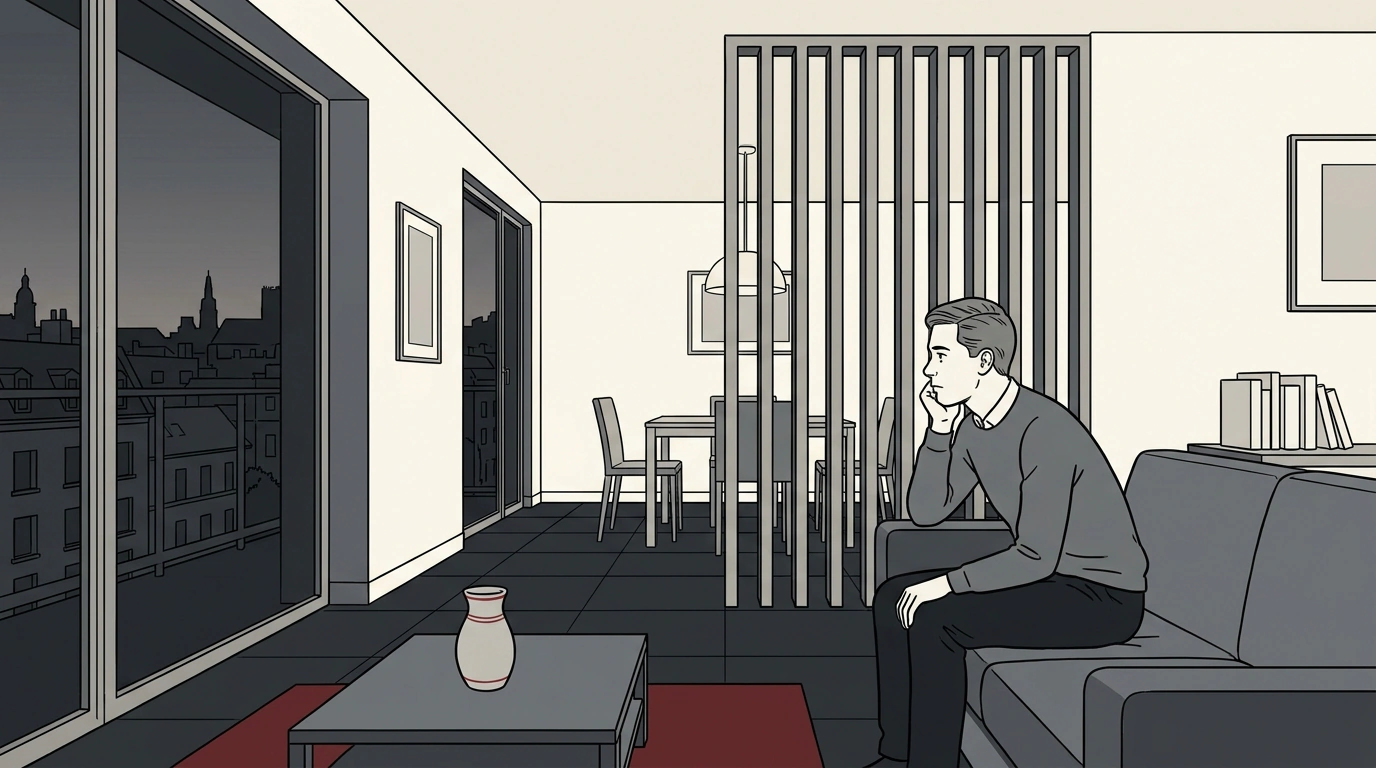
Most guys enter serious relationships genuinely wanting to open up. You want to find someone around whom you can finally drop the heavy social armor, stop playing the invincible gladiator, and talk honestly about what's weighing on you: career doubts, exhaustion, the pressure of responsibility, or old childhood wounds.
Yet a year or two later, that same guy turns into an impenetrable stone monolith. Whenever his partner asks "how are you?", he tosses out a dry "fine," and when she tries to start a deeper conversation, he just stares at his screen or nods in silence. Women often read this as emotional coldness, falling out of love, or typical "male cluelessness."
In reality, behind a thick wall of silence almost always lies a bitter past experience. Experts at The Modest Man analyzed why men shut down psychologically and uncovered a destructive pattern. A man doesn't go quiet because he has nothing to say. He goes quiet the moment he realizes that any truth he speaks out loud carries a direct threat to his safety.
The Evolution of Defense: From Honest Confession to Total Shutdown
Think about how this scenario usually plays out. During a moment of warmth, a late-night heart-to-heart, or after intimacy, a guy takes a brave step and shares a deeply personal vulnerability. For example, he admits he's terrified of failing at a new business venture, feels like an imposter among his colleagues, or struggled badly with bullying at school. In that moment, his girlfriend hugs him and promises unconditional support.
Now fast-forward three months. A trivial domestic argument: someone didn't wash the dishes, forgot to buy milk, or stayed out late with friends. Tempers flare, logical arguments run out, and suddenly his partner lands a targeted gut punch: "What do you know anyway? You're the one who whined that everyone at work thinks you're a loser!"
In that instant, something inside a man breaks for good. It's the classic shock of betrayed trust. Everything he confided to his partner as his closest ally inside a safe harbor was carefully archived, loaded into a live round, and fired straight into his face just to score a cheap win in a petty argument.
How Weaponized Vulnerability Works: When the Past Hits You in the Back
In applied relationship psychology, this phenomenon has an exact name: weaponized vulnerability. It's a manipulative tactic where one person's private confessions are used by the other to humiliate, dominate, or induce guilt.
Weaponized vulnerability doesn't always show up as open screaming. Micro-strikes are even more poisonous:
- Sarcastic chuckles and snide remarks ("Oh sure, our grand strategist got scared again");
- Ostentatious eye-rolling whenever he tries to share what's on his mind;
- Comparisons to other men ("Look at Lena's husband—he's confident, unlike some people").
Choosing a fragile peace instead of clearly setting boundaries only masks the emotional rift, accelerating the death of sexual attraction in the couple.
The male psyche is pragmatic. Once a guy steps on that rake and gets burned, his brain forms an instant conditioned link: "Openness = pain and loss of control." Self-preservation kicks in—choosing peace over honesty. A man decides it's safer to swallow his doubts and keep quiet than to light the fuse on another blowup.
The Roommate Phase: Quiet at the Cost of Passion
Once a guy shuts down, the relationship quietly slips into what's known as the roommate phase. From the outside, the couple's facade can look perfectly decent: they eat dinner together, split the bills, visit relatives, and go on vacation. But the emotional nerve of the connection has been completely severed.
The man stops arguing constructively. To any complaint, he hands out a robotic "yes, honey, you're right," just to end the conversation faster. He stops sharing plans, dreams, and worries. Communication shrinks to dry logistical updates: "what time are you back," "grab bread," "pick up the package."
Behind this surface stability lies a death sentence for romantic and sexual desire. A woman subconsciously senses that the man is emotionally checked out. She gets even more irritable, runs tests, and demands the old passion back, only to hit a blank stare. Attraction cannot survive behind a bunker wall.
The Biological Circuit: The Amygdala and the Freeze Response
Why can't a man physically stay open when his vulnerability comes under attack? It comes down to deep evolutionary wiring in the brain.
Neurobiology research shows that when a close partner mocks a man's vulnerability, the amygdala doesn't register it as a merely hurtful remark—it reads it as a fundamental social threat to rank and safety. In a primeval tribe, exile or losing status as a reliable protector meant physical death.
So the nervous system reacts instantly: the freeze response activates. A man literally loses the ability to formulate emotional thoughts. His brain cuts off access to feelings, leaving only a cold mode of stoic isolation. Boys are socialized from early childhood to suppress fear and pain, with only anger or silence treated as acceptable outlets. When an attempt to break that conditioning gets punished with a partner's mockery, a man retreats back into his cave for good.
The Frame-Holding Protocol: How to Stop Manipulation in Its Tracks
The main danger for a young guy in this situation is sliding into total cynicism. It's very easy to conclude that "all women are opportunistic and betray you," shut yourself off from people, and turn into a bitter loner. That's a weak position that punishes you more than anyone else.
If you run into an attempt to use your honesty as a weapon, you need to act firmly, calmly, and without delay. Don't raise your voice, don't start making excuses, and don't fire back with insults. An emotional explosion only proves the blow landed.
Use a proven boundary-setting protocol:
- Stop the dialogue immediately. Look her calmly in the eye and pause for 3–5 seconds.
- Call out the manipulation directly. In an even voice, say: "What you're bringing up right now is something I trusted you with in private, expecting mutual respect. Using my personal confessions as ammunition in a household argument is dirty and unacceptable."
- Break off contact until respect is restored: "We'll come back to talking about the dishes or our plans only when you're ready to discuss the issue itself without low blows." Turn around and leave the room.
If your partner is capable of emotional maturity, this cold shower will make her see the line she can't cross. If attacks on your vulnerability happen repeatedly, you're dealing with a toxic manipulator—and staying with her will erode your sense of self. When vulnerability is turned into a weapon, hidden resentment takes root in the relationship, quickly pushing it toward the point of no return. Your boundaries and self-respect are the foundation without which real closeness is impossible in principle.