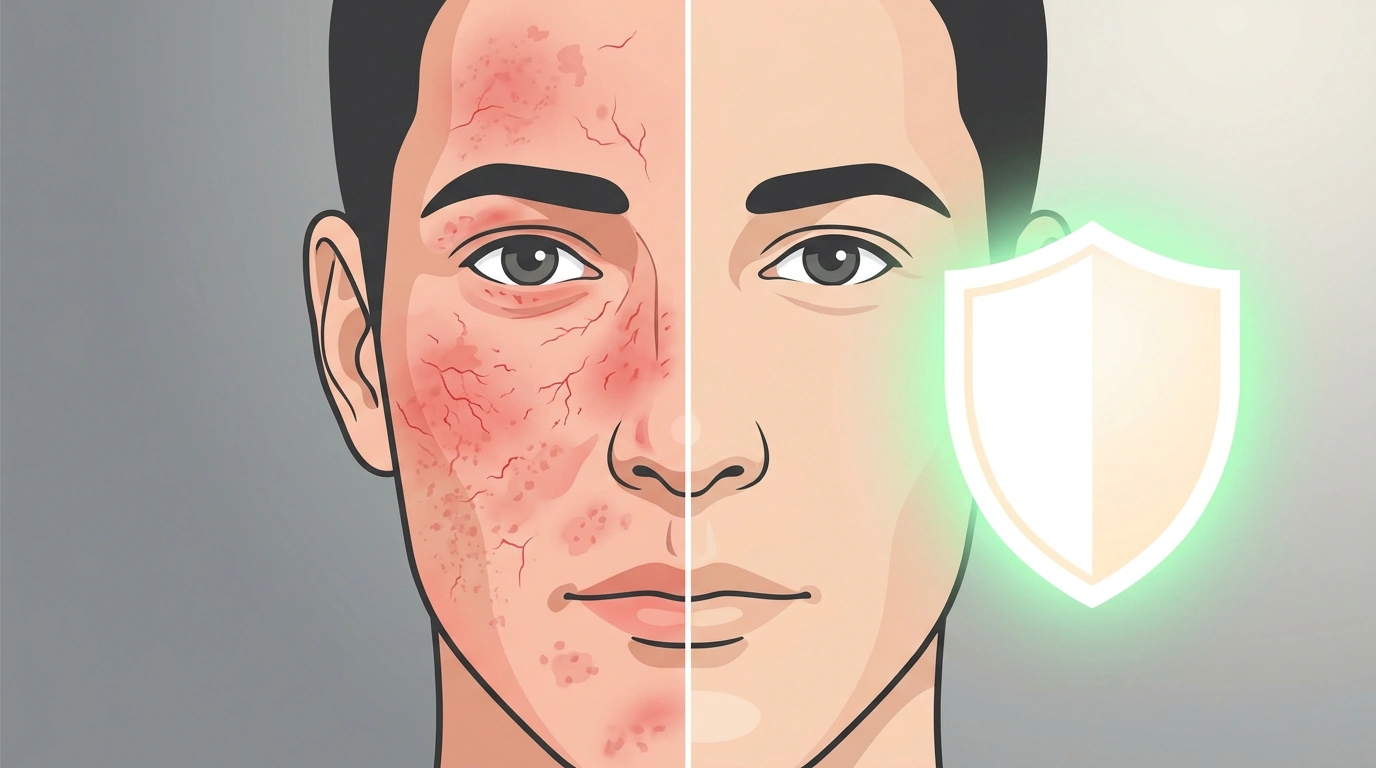
Every man who regularly picks up a razor knows this annoyance: red, itchy patches on the neck, tightness around the nasolabial folds, razor burn after swapping blades, or flaking in freezing weather.
Instead of figuring out what caused the flare-up, a guy walks into the nearest pharmacy, complains to the pharmacist about an "allergy," and buys a cheap tube of hydrocortisone ointment (1% hydrocortisone acetate). That night he slathers a thick layer onto his irritated face, and the next morning he steps up to the mirror and can't believe his eyes: the redness is completely gone, the itch has vanished, and his skin looks pale, smooth, and calm. "What a miracle cure!" he thinks. "Why overpay for pricey creams when a dirt-cheap pharmacy tube fixes everything overnight?"
And right there, he walks straight into one of the most dangerous traps in modern dermatology.
Well-known board-certified dermatologist Dr. Andrea Suarez (Dr. Dray) sounds the alarm: uncontrolled use of topical steroids on facial skin is a ticking time bomb that within weeks can disfigure a young man's face, causing irreversible dermal atrophy, vascular rosacea, and severe withdrawal syndrome.
The Pharmacological Trap: How Steroids Put Local Immunity to Sleep
To grasp the scale of the disaster, let's look under the microscope. How does hydrocortisone work?
Once inside epidermal cells, the synthetic glucocorticoid binds to cytoplasmic receptors and blocks production of key inflammatory mediators—interleukins (IL-1, IL-6) and tumor necrosis factor (TNF-alpha). At the same time, it triggers a sharp, intense spasm of superficial blood capillaries (vasoconstriction).
Blood drains away from the face, so redness disappears within a couple of hours. Inflammatory swelling subsides. Here's the devilish catch, though: the underlying cause of the inflammation hasn't gone anywhere! If the irritation came from a damaged protective lipid barrier, a bacterial infection of hair follicles after shaving, or a fungus, that pathological process keeps progressing. Worse still, the steroid paralyzes local phagocytosis and white blood cells, shutting down your skin's immune defense completely.
4 Clinical Nightmares: Atrophy, Broken Capillaries, and Perioral Dermatitis
Facial skin is 3–4 times thinner than skin on the body, and vascular permeability here is at its highest. Applying hydrocortisone regularly for more than seven days straight triggers a cascade of severe clinical complications:
- Dermal Atrophy (Skin Thinning): Steroids suppress keratinocyte cell division and shut down fibroblasts that produce type I and III collagen and elastin. Within three to four weeks, skin thins to the texture of cigarette paper, turning wrinkled, slack, and semi-translucent. Bluish veins begin showing clearly right through it.
- Telangiectasias (Broken Capillaries): Capillary spasm can't last forever. Sooner or later, vessel walls exhaust themselves and permanently dilate. The face becomes covered in stubborn bright-red spider veins and broken capillaries that no cream can erase—fixing it requires a course of expensive vascular laser sessions (Vbeam).
- Perioral Dermatitis and Steroid Rosacea: The sneakiest consequence. The moment you try to stop the ointment, a wildfire erupts around your mouth, nostrils, and chin: your face breaks out in hundreds of itchy small papules and pustules, and the skin burns like fire. A guy thinks, "My condition came back—I need to put it on again!", applies hydrocortisone, watches the symptoms calm down for a day, and then sees them explode back twice as hard. That's classic skin steroid addiction.
- Topical Steroid Withdrawal: A total collapse of the skin barrier where the face swells for months, weeps fluid, peels in sheets, and burns unbearably at contact with plain water.
If skipping hydrocortisone for even 24–48 hours causes facial redness and itching to rebound twice as hard alongside a sensation of red-hot needles pricking your skin, you've developed perioral dermatitis and topical corticosteroid dependence. Stop using the ointment immediately.
Special Case: Beard Dandruff and Malassezia Fungus
Guys often smear hydrocortisone onto the skin beneath their stubble, mistaking white flakes for simple dryness.
In 90% of cases, flaking under a beard is actually seborrheic dermatitis. It's caused by the lipophilic yeast Malassezia furfur, which feeds on sebum inside hair follicles. When you put a steroid on your stubble, it suppresses local immunity and the fungal colony multiplies at explosive speed. The moment you stop the ointment, dandruff and itching spread rapidly to your eyebrows, the sides of your nose, and your chest.
Seborrheic dermatitis shouldn't be treated with hormones—it needs medicated shampoos with 2% ketoconazole, zinc pyrithione, or selenium sulfide, leaving the lather on your skin for 3–5 minutes before rinsing. If you want to clean up your bathroom shelf, it's worth studying men's skincare mistakes that wreck your barrier and drain your wallet.
The "Zero Therapy" Protocol and Physiological Lipids
How do you get off the hydrocortisone hook if you've already done damage? Dr. Dray outlines a clear dermatological recovery protocol:
- Zero Therapy: Complete and permanent discontinuation of the steroid ointment. Be ready for the first 7–14 days, when your face will flush intensely and itch (rebound syndrome). Cut out all harsh actives: retinoids, acids, scrubs, and alcohol-based aftershaves.
- Physiological Lipid Repair: Wash with cool water and no soap. Apply barrier-repair creams containing physiological lipids in the golden 3:1:1 ratio:
- Ceramides (Ceramides NP, AP, EOP): the molecular mortar holding outer skin cells together.
- Cholesterol and fatty acids: restore membrane elasticity.
- D-Panthenol (5%) and Centella asiatica: speed up healing and calm burning inflammation without hormones.
- Medical Care: For severe flare-ups, see a physician: a dermatologist can prescribe non-steroidal calcineurin inhibitors (tacrolimus) or an anti-inflammatory course of antibiotics to clear the outbreak safely.
Remember: hydrocortisone on the face is an illusion of relief that your skin will pay for with years of difficult treatment. Male attractiveness starts with foundational health.