When you tilt your head toward a smartphone or laptop screen at a 60-degree angle, the load on your cervical vertebrae shoots up to 27 kilograms—the weight of an eight-year-old child hanging off the back of your neck. Even a slight 15-degree tilt presses down with 12 kilograms, and at 45 degrees your spine is already holding 22 kilograms. That biomechanical breakdown seriously woke me up when I first saw it: we train shoulders at the gym and buy tailored shirts, yet miss how an office chair twists our torso into a question mark over the day.
Professional physiotherapist Mariam Saad explains in a breakdown for men's outlet The Modest Man that posture almost never breaks in a single day from an injury—it gets quietly reshaped by everyday positions. Why do hours at a laptop steal centimeters of height and turn a man's confident presence on a date into the cramped stance of an exhausted clerk—and how do you restore an open silhouette without stiff military rigidity?
Desk Adaptation: Which Muscles Lock Tight and Which Ones Switch Off
Take a familiar scene: a guy sits at his laptop for 8 hours a day—writing code or crunching spreadsheets—and heads out on a date that evening. It feels like his body is resting in a padded chair. Under the hood, though, a quiet rewiring of his muscular frame is happening—what physiotherapists call upper and lower crossed syndrome.
Translated from clinical jargon into plain English, your spine works like a ship's mast held upright by front and back rigging cables. As long as opposing muscles pull with equal force, the mast stands vertical. When you sit in front of a monitor for hours, the front "cables" shorten and lock into spasm, while the back ones stretch out and fall asleep from disuse.
Mariam Saad highlights three links in this muscular desynchronization:
- Spasm of the front chain and hips: the pectoralis minor muscles shorten and pull the shoulder joints forward and inward, while the hip flexors (iliopsoas) and hamstrings lose elasticity, locking the pelvis in a tilted position.
- Shutdown of the extensors and core: the rhomboids and lower trapezius, which draw the shoulder blades back and down, weaken and lose the tug-of-war to the chest. At the same time, the deep core muscles—the natural corset around your waist—switch off.
- Disc wear and lower-back overload: without core support, load drops straight onto joints, ligaments, and intervertebral discs. Over time, discs lose hydration and shock-absorbing spring, while the lower back has to turn rock-hard from constant tension just to keep a pitched-forward torso from collapsing.
The sneakiest part is nervous-system adaptation. After 2–3 years of daily sitting, your brain rewrites its baseline norm: a slouched posture feels from the inside like the only comfortable position, and trying to stand straight quickly fatigues postural muscles that have forgotten how to work.
How Slouching and Pelvic Tilt Steal Height and Ruin Your Presence on a Date
Because the brain treats a rounded back as normal, a man is usually the last to notice the shift—others or a random reflection point it out first. Back to our guy: after work he closes his laptop, throws on a blazer, and on his way to the café catches his silhouette in a shop window. The picture is unforgiving: chin jutting forward, shoulders rolled inward, jacket flaring awkwardly off his back.
A woman reads that signal instantly, before your first sentence. Instead of calm strength and openness, a collapsed frame broadcasts fatigue and defensive tension. Physically, that visual hit comes from three distortions:
- Forward head posture, or tech neck (
forward head posture, ortech neck). The habit of craning your face toward a screen shifts your head forward past the line of your shoulders. In person, a jutting chin and tight neck create an anxious, needy, or guarded look. - Rounded upper back (
thoracic kyphosis). A shortened chest curls the shoulders into an arc. It's not only blazer fit that suffers: a compressed ribcage prevents the diaphragm from expanding to full depth. Breathing turns shallow, blood oxygen dips, sluggishness hits by evening, and your voice loses its chest resonance and sounds flat. - Anterior pelvic tilt (
anterior pelvic tilt). Tight hip flexors tip the pelvis forward, forcing the lower back to arch hard. As a result, the stomach pushes out even on a lean, athletic guy. At the same time, your center of gravity shifts, overloading hips, knees, and ankles—an easy stride turns into a heavy, shuffling walk.
Combined, thoracic kyphosis and pelvic tilt visually steal 2–4 centimeters of height. You literally look shorter, narrower across the shoulders, and stiffer in motion.
Spotting a slouch in a shop window, most guys make the exact same mistake: they force their shoulder blades together as hard as possible, puff their chest out, and over-arch their lower back (slipping into hyperlordosis). Don't do that. Trying to overpower tight chest muscles by hyperextending your spine only drives your paraspinal muscles into painful spasm—and from the outside you look like you swallowed a broomstick.
Quick Wall Calibration and Daily Habits to Open Up Your Frame
To pull your shoulders back without stiff tension, you need to release the tight front chain and wake up dormant back and neck muscles. Stepping into a quiet hallway before his date, our guy finds an open wall and runs a 3-minute express mobilization protocol based on Healthline physiotherapy guidelines and Mariam Saad's principles.
First, he brings his head back over its vertical axis with Chin Tucks. Standing tall, glide the back of your skull straight backward along a horizontal plane—as if a string is pulling the crown of your head toward the ceiling while your chin tucks inward without tilting your head up or down. Hold at the end range for 3 seconds, 10 reps total. This wakes up the deep neck flexors and unloads the suboccipital muscles. (To build strength in this area at the gym, check out our breakdown on safe neck training using Stanislav Lindover's method).
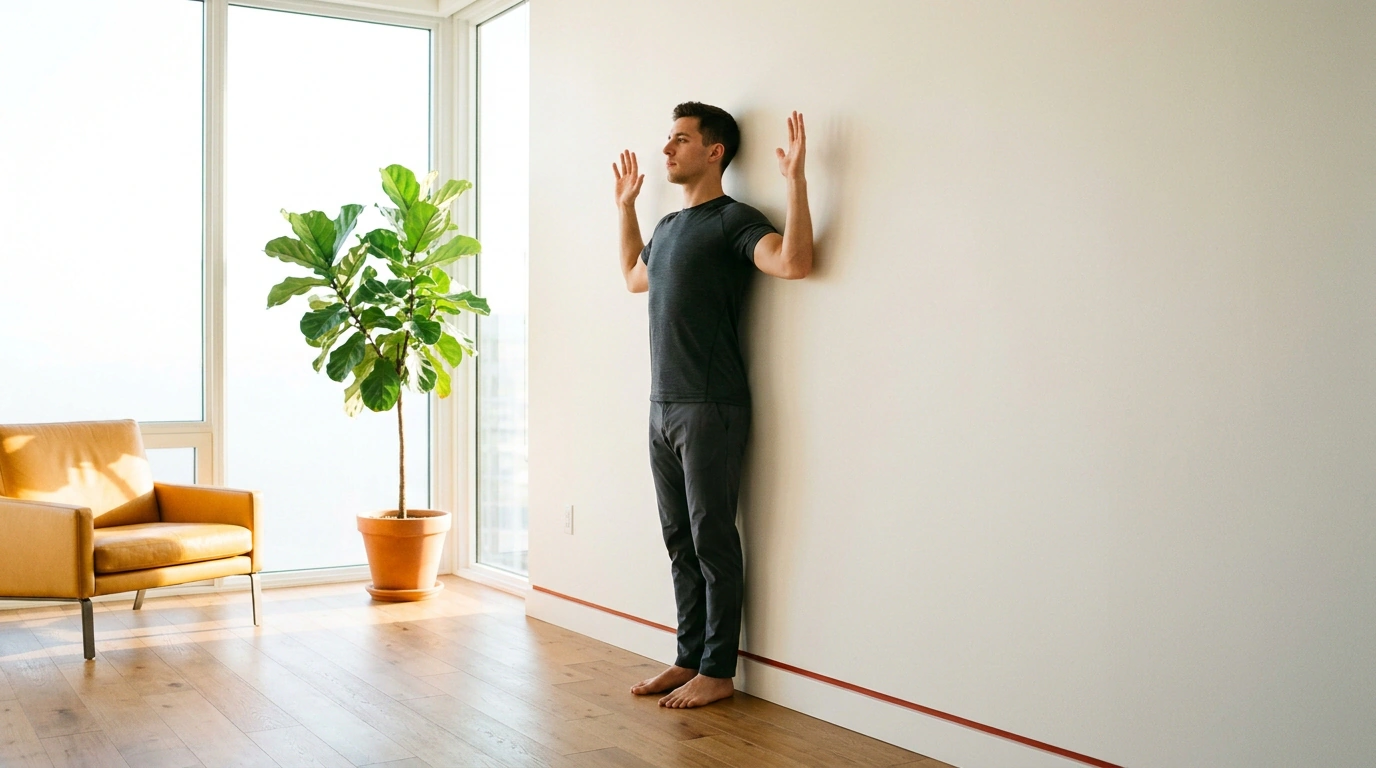
Next, he fires up the upper back with Wall Angels. He stands with his back to the wall, heels 10–15 centimeters from the baseboard, pressing his sacrum, shoulder blades, and the back of his head flat against the surface. Arms go out to the sides and bend at the elbows to 90 degrees (the "cactus" position). The goal is to slide the backs of your hands and elbows smoothly up and down the wall for 8–10 reps without letting your lower back peel off the wall. That movement targets the lower traps and rhomboids directly.
The finishing touch is a doorway chest stretch: brace your forearms against the doorframe, step gently forward, and stretch your pectoralis minor for 30 seconds while lightly tucking your pelvis under with glute and ab tension. The effect shows up immediately: shoulders drop back on their own without straining, your diaphragm opens freely, your blazer drapes cleanly, and the stacked spine-and-pelvis line gives back those stolen centimeters of height.
To keep that tone day to day, rely on basic movement hygiene:
- Regular micro-breaks: every 45–50 minutes of screen work, stand up for a brief hip-flexor mobility reset so they don't freeze short (at home, our ten-minute basic mobility routine for men works great).
- Cut out everyday asymmetry: drop the habit of leaning all your weight on one leg, sinking into a soft couch, or holding your phone down by your stomach—raise the screen closer to eye level.
- Medical safety: if you have structural spinal conditions (herniated discs or structural scoliosis), clear any exercise routine with a physical therapist or rehab doctor first.
Don't stress if half an hour back at your laptop or midway through a conversation you catch your shoulders drifting forward again. Your body adapted to a chair over years, so don't demand flawless posture every second from day one. Just calmly glide your head back, open your chest on a deep breath, and keep talking—with every small reset, muscle memory will hold a strong, confident silhouette more naturally.