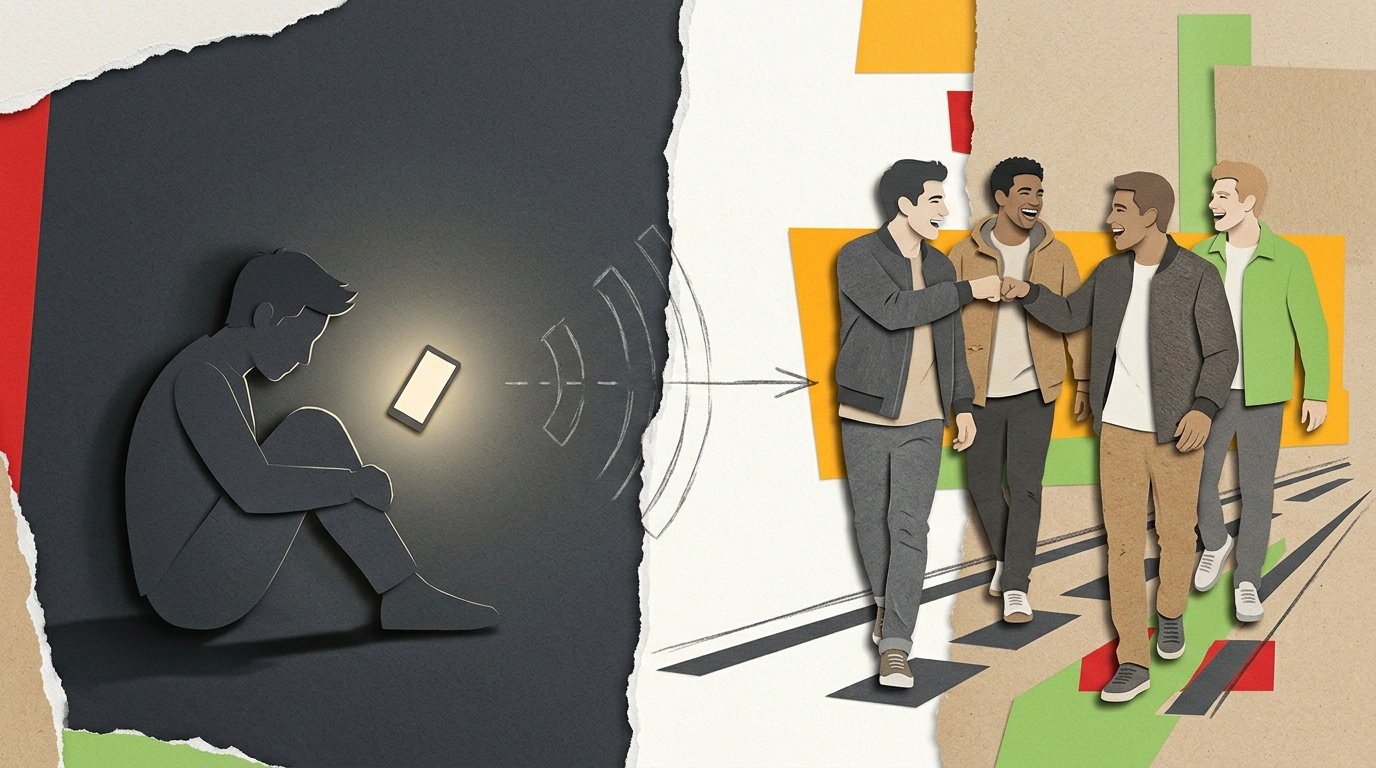
Your phone holds hundreds of contacts, three active group chats, and a couple of dating apps with an endless stream of profiles. It feels like anyone is just two taps away. Yet Friday night rolls around and a strange feeling hits: you have nobody to call for a spontaneous night out, and walking up to an attractive woman in a coffee shop feels almost heroic.
Sociologist Daniel Cox, director of the Survey Center on American Life and author of Generation Uncoupled, spent over a hundred hours interviewing young people about their love lives and paired those talks with large-scale surveys. On the Art of Manliness podcast, he summed up a blunt conclusion: the dating crisis grows straight out of a crisis in male friendship. The root problem sits much deeper than bad profile photos or picky algorithms.
The Illusion of Closeness: How Texting Replaced Showing Up in Person
Look at the numbers from the American Perspectives Survey run by Cox's center, and the picture is stark. Between 1990 and 2021, the share of men with at least six close friends was cut by more than half, dropping from 55% to 27%.
Over those same three decades, the share of guys with zero close friends jumped fivefold, from 3% to 15%. Single men get hit hardest: one in five unmarried men—20%—admits he has no close friends and no regular buddy support at all.
With that much emptiness around him, why doesn't a guy notice right away that he's alone? That's where a trap kicks in, one that The Modest Man unpacked in a list of 17 digital habits that erode real connection.
The first swap is mistaking access for closeness. A smartphone lets you reach an acquaintance in two seconds, and notifications ping from morning until night. Each alert feeds your brain a tiny hit of dopamine and creates the illusion of a busy social life. In reality, an entire week can pass without even half an hour of real face-to-face conversation.
The second problem is more text with less understanding. Chats strip away tone of voice, pauses, facial expressions, and physical touch. What used to be a human conversation shrinks into a dry exchange of data. Emojis stand in for emotion, causing misunderstandings and silent resentment to pile up out of nowhere.
Add to that highlight-reel culture and quiet ghosting. People post polished moments on social media while feed algorithms pit men and women against each other, warping expectations before a first meetup even happens. Whenever the slightest tension pops up in a chat, it's easier to vanish silently than to talk it through honestly. Ghosting has become a habit that dulled our ability to sort things out with words. Even quiet moments between tasks get filled with scrolling, yet calm pauses without a screen are precisely where genuine curiosity about another person grows.
Where Courage Went: How the 'Send' Button Broke Our Risk Muscle
At first glance, male friendships and meeting women seem unrelated—you don't go on dates with your buddies from the bar. A simple gym analogy helps here. Picture a guy who spends two years watching fight breakdowns on YouTube and landing combos on a game controller. In theory, he knows every move, but his body has never felt a real opponent step forward. Put him on the mat for his first real sparring session, and one hard stare from his partner makes his breath catch and his legs stiffen.
Socializing follows the exact same physics. Daniel Cox explains that ease in dating rests on being used to interpersonal risk—staying calm around awkwardness and possible rejection.
Dating apps and messaging built a soft cushion around your ego. Swiping a profile or sending a "hey" from your couch costs almost nothing. If she ignores it, nobody sees you blush, and no heavy silence hangs over a table. You simply lock your phone and keep scrolling.
Because of that comfort, your social muscle goes soft fast. Approaching a stranger at a cafe, catching her eye on the street, or tossing out a joke in line starts to feel like a disaster. On top of that, instant notifications trained us to expect replies at Wi-Fi speed, as The Modest Man editors rightly note. Any normal half-day pause instantly feels like being ignored, when in real life the other person just needs time to breathe and switch back to real conversation.
Male Circles and Social Capital: Why Loners Burn Out on Date One
Suppose a guy pushes past his hesitation and gets a woman out on a date. You might think having no friends wouldn't matter anymore. In practice, it's the exact opposite, and Daniel Cox offers a sharp comparison.
Picture a suspension bridge: it's engineered to hang from six thick cables, yet here only one cable is left. When a single guy from that 20% has nothing behind him, he unconsciously loads the entire weight of his life onto the first woman he likes. She has to be his conversation partner, emotional support, weekend plans, and main source of a good mood all at once.
No fresh spark can survive that kind of pressure. Because he lacks a life of his own, a guy slips into over-investing, clinginess, and jealous stress over every missed call. A woman reads that tension in ten minutes and quickly backs away.
Having an active circle of guys helps in three ways at once. First, it sharpens your confidence every single day. Friendly teasing, debates, group trips, and holding your own in banter train your humor and timing without rehearsed scripts. You walk into a date relaxed and grounded.
Second, a male circle takes the weight off your expectations of her. When you have training with the guys, a Saturday trip, or a side project ahead, you literally don't have time to refresh your chat every forty seconds waiting for her reply. That inner stability is exactly what makes a man calm and attractive.
Third, friends keep pulling you into real-world overlap with people. At birthdays, house parties, sports meetups, and hobby groups, you don't have to sell yourself in three seconds from one photo. A woman gets to see how you carry yourself in a group, how you treat others, and how people respond to you.
Stepping Off the Screen: Four Ways to Bring Back Real Contact
To break this inertia, you don't need to throw your phone in a river or turn into the life of every party in one weekend. You just need to rebuild a few daily habits that bring your social edge back.
First, put messaging on a short leash with one rule: chat is only for setting up a meetup. Stop texting for weeks trying to make someone fall for you through words on a screen. Trade a few light lines, catch a warm response, and invite her for coffee or a short walk right away. Real voice, eye contact, and natural pauses only work at the same table.
Second, find an offline activity with a regular group of people. Close friendships rarely start at a one-off party—people need repeated time shoulder to shoulder. Boxing, basketball, climbing, a running club, or any team sport knocks out two goals at once: it keeps you in shape and puts you around the same guys every week over a shared goal.
Third, clean up your digital habits without acting like a hermit. The Modest Man stresses that smartphones themselves aren't the villain; what breaks connection is scattering your attention and treating people around you like background noise. Place your phone face down during live talks, give yourself quiet breaks without endless short videos between tasks, and instead of sending a routine text to an old buddy, call him and meet up for half an hour.
Finally, rebuild your tolerance for small social risks every day. Start with low-stakes interactions with zero romance attached: chat briefly with the barista, crack a joke with a guy near the squat rack, or invite two acquaintances to train together instead of waiting to be asked. Once live, unpredictable conversation feels like a normal part of your day again, stiffness around an attractive woman fades away on its own.