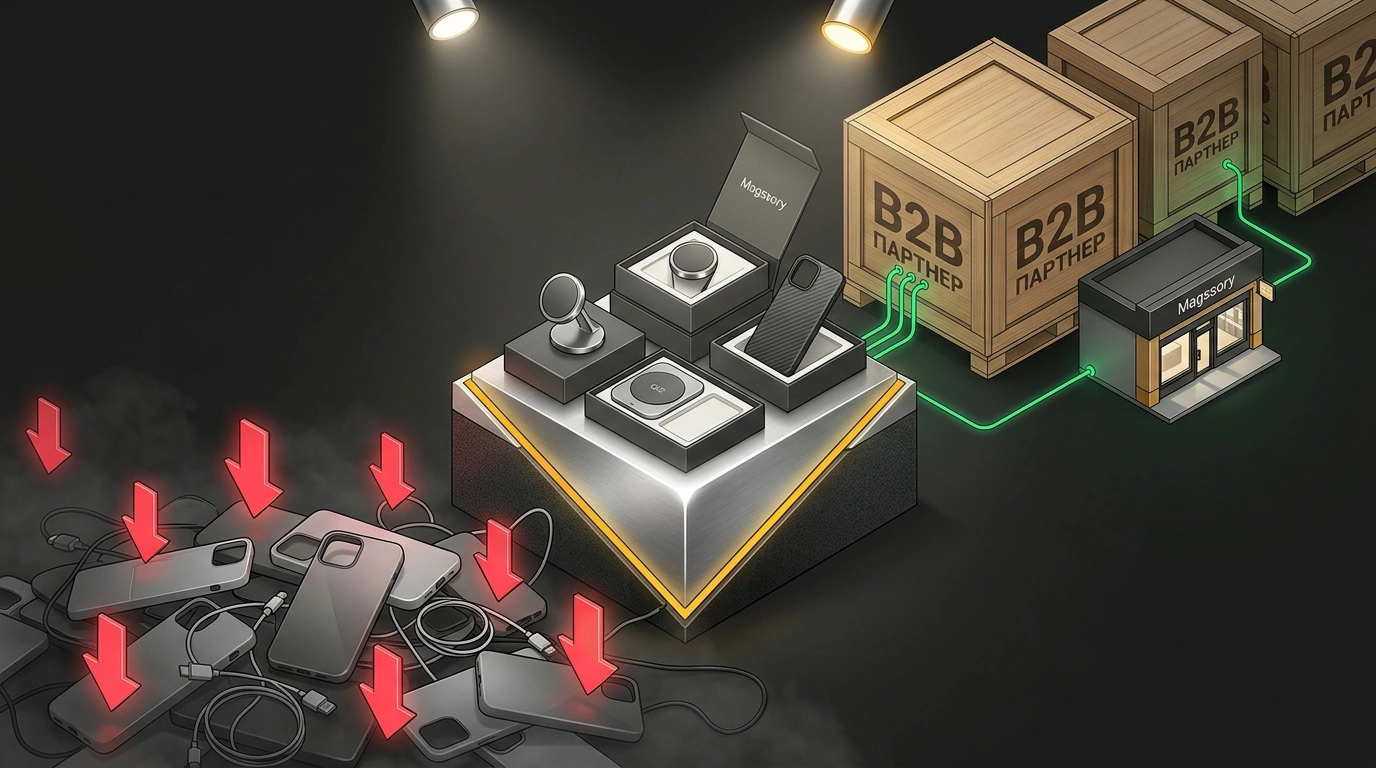
Every seller in a popular niche eventually hits a wall. Dozens of competitors buy identical products from the same factories, leaving discounts as their only weapon. Chasing buyouts, prices drop 10 RUB below rivals, automatic marketplace promos eat the remaining margin, and the ad-to-sales ratio (DRR) in internal auctions climbs past 25%. Business turns into shuffling revenue just to keep turnover moving.
The story of accessory brand Magssory, founded by Alexey Fedorov and Stanislav Zharsky in 2020 and featured on the Wildberries podcast, shows another way. The company grew from 67.4 million RUB in revenue in 2024 to over 1 billion RUB in turnover in 2026. Here are the four practical steps that helped the brand escape the price war.
The Endless Dumping Trap: Why Selling Generic Goods Leads to a Dead End
The old playbook—finding a trendy phone case or cable at a wholesale market, slapping on your sticker, and running ads—worked during the early marketplace boom. Today, in electronics, that approach guarantees financial burnout.
When a product offers no unique value, shoppers simply pick the cheapest listing with fast delivery. Sellers undercut each other, platform algorithms pull listings into discount marathons like 'Shopping Day' and 'Black Friday', and profitability drops below 8–10%. One logistics mistake or commission hike pushes the seller into the red. The only way to break this cycle is to create real added value.
Added Value and Aesthetics: How to Sell Accessories 40% Above Market Price
The Magssory team started by ditching generic factory mass-market items in favor of their own industrial design and strict spec control. They focused on Everyday Carry (EDC) accessories for Apple and Samsung users.
Instead of cheap plastic, they bet on premium materials: aircraft-grade aluminum, aramid fiber, tempered glass, and silicone. They also designed gift-style packaging with sturdy boxes, sharp printing, and protective inserts.
As a result, Magssory's retail prices sit 30–50% above average competitors on Wildberries. Customers aren't paying for a basic cable; they're paying for aesthetics, reliability, and status. That kept gross margins at 35–45% even when rivals launched aggressive price cuts.
A 300-SKU Ecosystem: How Cross-Selling and Defect Control Protect Margins
The team expanded their catalog through synergy, growing the lineup to 300 well-matched SKUs. Products complement each other: a buyer picking up a magnetic car mount often adds a case with a metal ring and a Qi2 portable power bank.
Incoming quality control at the factory became critical for protecting unit economics. They brought manufacturing defects down below 0.8%. In a tough category, that delivered a steady buyout rate of 92–95%. The brand virtually eliminated costly 'joyrides' of returned items bouncing between warehouses and pickup points.
Going Beyond the Marketplace: Corporate B2B and Premium Retail Shelves
To protect the business from marketplace algorithm swings, the brand diversified its sales channels. A major pillar became corporate B2B: branded accessories and VIP gifts for banks, IT holdings, and real estate developers. B2B brings 100% upfront payment, zero marketplace commission, pallet shipments, and predictable cash flow.
At the same time, Magssory entered electronics chains (Re:Store, M.Video, DNS) and beauty retail (Zolotoye Yabloko). Being in physical stores doesn't just generate direct revenue. It also creates organic demand on marketplaces when shoppers spot the brand in a store and order it on Wildberries.
Brand equity and strong added value protect your margin far better than automated ad bidders. Diversifying into B2B and offline retail turns a platform-dependent seller into an independent business.
External Traffic and Digital Protection: Holding the Top Spot
For platform promotion, the team shifted focus to external influencer marketing: native integrations with trusted tech bloggers on YouTube and Telegram. Wildberries' search algorithms reward external traffic, pushing those product cards to the top of search results.
To stop copycats, the brand registered trademarks with Rospatent and the international WIPO system. Using Wildberries' 'Digital Arbitration', their lawyers quickly block violators who steal content or sell counterfeits. Meanwhile, the company is expanding exports across EAEU countries with multilingual packaging and certificates.