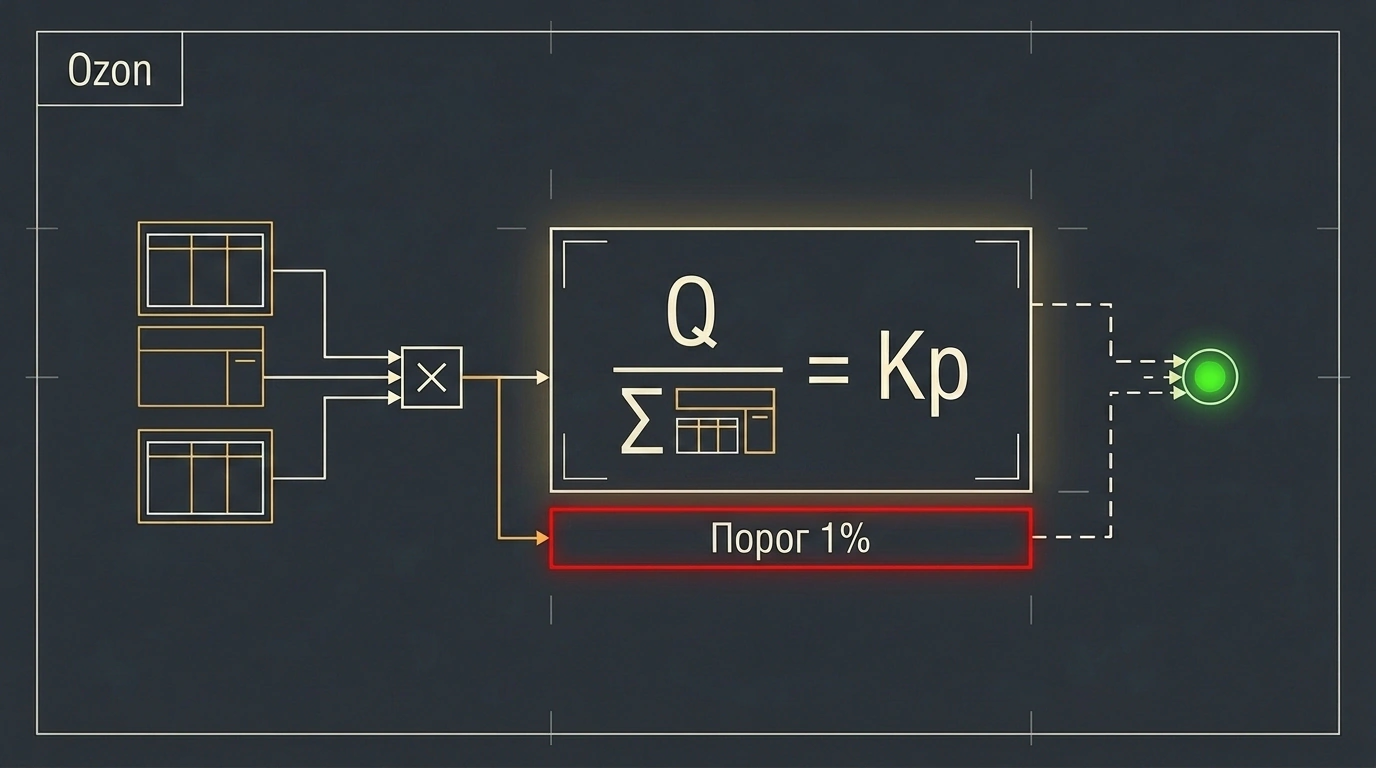
You probably remember the years of headaches and arguments caused by Ozon's virtual "discount points" in seller reports. The setup was notoriously clunky: the platform sold your product at a discount, credited points, and at the end of the month offset them against commission fees. Accountants pulled their hair out, and sellers struggled to reconcile the numbers. Starting December 1, 2026, the marketplace is burying discount points for good and rewriting the "Services and Penalties" section of its seller agreement.
In their place comes a completely new math mechanism — calculating service fees using a reduction coefficient (Kr). The platform insists that total seller earnings won't take a hit and that payouts will become clearer. As a practicing e-commerce seller, though, I know one rule by heart: whenever a platform rewrites its fee formula, you grab a calculator immediately and check what's under the hood.
How the Kr coefficient math works
The new system works in two steps. First, Ozon calculates the maximum (standard) cost of every service rendered to you at baseline rates — sales commission, trunk-line shipping, last-mile delivery, payment processing, and return handling. Then, the monthly Kr coefficient is applied to that baseline total.
The coefficient itself is calculated as the ratio of the aggregate $Q$ value to the sum of maximum service fees for the reporting period:
The $Q$ value is the difference between the sum of intermediate $TQ$ metrics across all sales and the sum of $TQ$ metrics across all returns for the month:
For each order, $TQ$ factors in your base price (or minimum marketing threshold), the actual checkout price paid by the buyer, loyalty program discounts, and the marketplace's standard commission rate. On paper, the formula looks neat — but there are critical strings attached.
The 1% protective floor and marketing payouts
The biggest detail most sellers will skim right past in the updated agreement is the fee floor. The contract explicitly states: Ozon's final service fee for a reporting period cannot drop below 1% of the total maximum service cost.
Even if the calculated Kr coefficient mathematically yields a zero or negative fee thanks to heavy platform co-funding, you still owe the marketplace at least one percent of the maximum tariff. For sellers operating on 5–8% margins, that single percent is a real chunk of net profit now guaranteed to go to the platform.
If the monthly Kr coefficient exceeds 0.99 (meaning buyer discounts exceeded the maximum service fees), the marketplace won't roll that difference over as a credit for future months. Instead, the platform calculates a $P$ metric: Ozon promises to transfer this amount to your bank account as a separate marketing bonus once a dedicated monthly statement is signed off.
Operational risks and losing real-time control
In earlier breakdowns, we noted how canceling discount points from December 1 was pitched as a move toward transparency. In practice, however, sellers run into three serious problems:
- You can't calculate unit economics in real time. Because Kr is calculated retroactively for the entire calendar month, you have no way of knowing at the moment of shipment exactly how much Ozon will deduct from a specific t-shirt or cookware set.
- End-of-month returns hit the whole month's margin. If buyers return a wave of orders to pickup points in the final days of the month, the subtracted $TQ$ values drag down $Q$ — which pushes up your final service fees for the entire month that just closed.
- Harder reconciliation. To audit your charges, you'll have to cross-check three separate documents: the "Sales Report," the "Financial Report," and the monthly "Marketing Program Payout Statement."
We also previously broke down hidden logistics charges and new tariffs, where shipping fees are split into separate legs. Combined with the new Kr formula, this calls for a full audit of your store's financial model.
Build a mandatory minimum fee floor of 1% of maximum service costs into your December financial plan for every SKU. And don't count on instant marketing payouts when Kr > 0.99: budget for a 2–3 week cash-flow lag while closing statements are signed.
