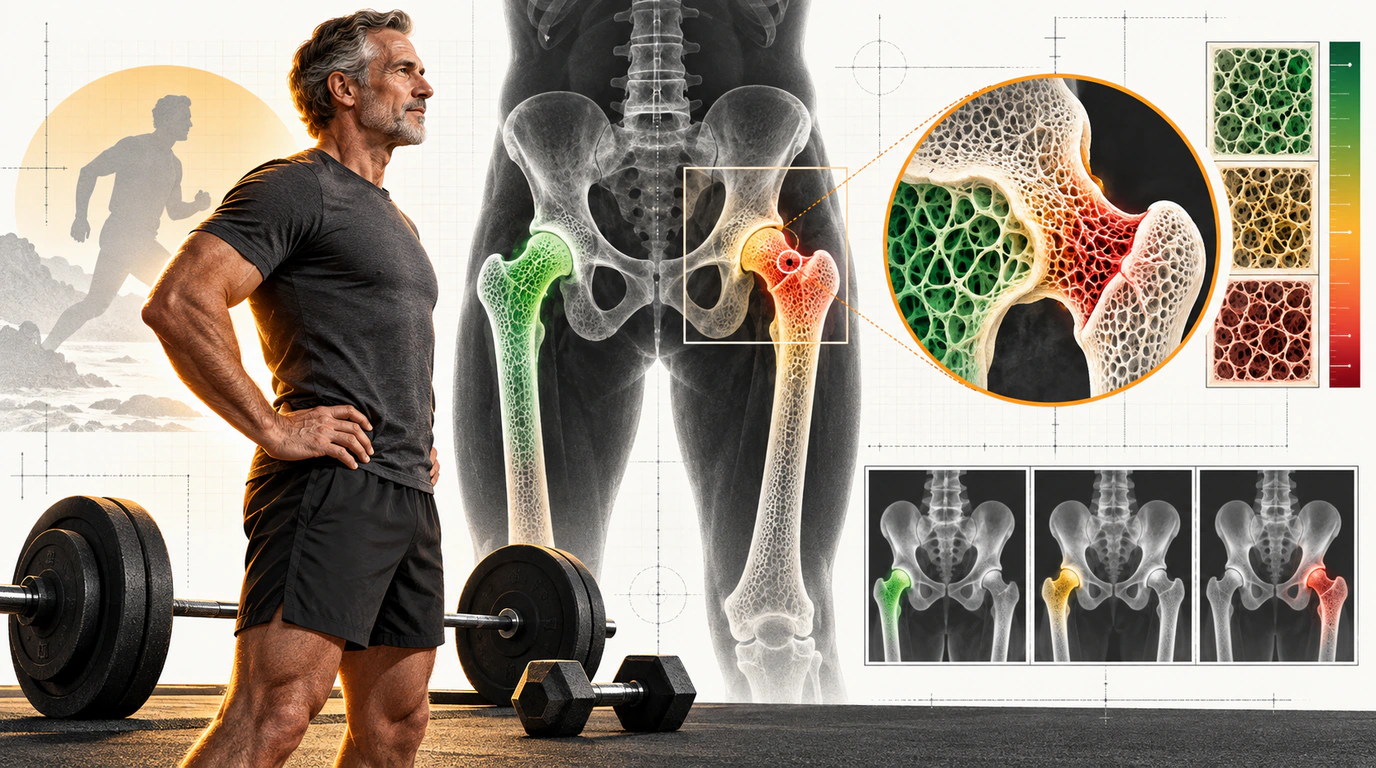
A stubborn stereotype says osteoporosis only affects women after menopause, when estrogen levels drop. Men rarely think about bone density, assuming their skeletons are built tough by default. We've already covered overlooked osteoporosis and vascular risks in women's health, yet the numbers for men are just as alarming.
Loss of bone mineral density in men develops silently for years—right up until a minor fall causes a break. When a fracture happens, the consequences for men are often far more severe and fatal than for women.
First-Year Tragedy: What Meta-Analyses Show
The greatest danger in male osteoporosis is a hip fracture. A major meta-analysis led by Cauley (Cauley et al., Annals of Internal Medicine), pooling 17 male cohorts and 22 female cohorts, uncovered a stark pattern:
- Sharp spike in death risk: In the first three months after a hip fracture, men face nearly an 8-fold higher risk of dying than healthy peers of the same age (for women, the risk rises 6-fold).
- One-year mortality: Between 30% and 35% of older men die within 12 months of a hip fracture.
- Why it turns fatal: Men tend to fracture their hips at an older average age, often alongside existing heart disease. Sudden bed rest rapidly triggers pneumonia, deep vein blood clots, pulmonary embolism, and heart failure flare-ups.
Why Male Osteoporosis Gets Missed
- No routine screening: Women over 65 are routinely offered bone density scans, whereas men are usually tested only after a bone has already broken.
- Secondary causes: Over half of bone loss cases in men stem from underlying triggers:
- Age-related testosterone decline;
- Long-term steroid medications (for asthma or rheumatoid arthritis);
- Toxic suppression of bone-building cells (osteoblasts) by alcohol and smoking;
- Poor gut absorption and chronic vitamin D deficiency.
Proven Treatment: The ADAMO Trial
Osteoporosis is a systemic metabolic condition. A cast or titanium rod fixes the break, not the underlying bone weakness. Bones need targeted medical support to restore the balance between breakdown and rebuilding.
In the ADAMO clinical trial (The Journal of Clinical Endocrinology & Metabolism), researchers tested denosumab—a monoclonal antibody targeting RANK ligand given as a 60 mg injection every six months—in men:
- At 12 months, lumbar spine bone density rose by 5.7%, and hip density increased by 2.1%.
- At 24 months, gains reached 8.0% in the spine and 3.4% in the hip.
Standard oral bisphosphonates (like alendronate) are also widely used, though they must be taken strictly on an empty stomach while staying upright to protect the esophagus.
Bone adapts through the piezoelectric effect: mechanical tension and muscle pull signal cells to lay down new bone. Without resistance exercise, calcium pills alone won't strengthen your skeleton.
How Men Can Protect Their Bones
- Get a gold-standard DEXA scan: Men over 70—and starting at age 50 if you have risk factors like smoking, heavy drinking, or steroid use—should get a dual-energy X-ray absorptiometry scan of the spine and hip.
- Lift weights and walk: Regular bodyweight or resistance training protects both bone density and muscle mass. We've previously explained why calcium alone isn't enough after 50 without protein and strength training.
- Eat calcium and check vitamin D: Aim for 1,000–1,200 mg of dietary calcium daily (cheese, yogurt, fish, sesame seeds) and keep blood vitamin D in the healthy range.
When to See a Doctor Right Away
Any wrist, rib, or hip fracture from a standing-height fall in a man over 50 is an urgent reason to see an endocrinologist for an osteoporosis workup. Losing 3–4 cm in height or developing a stooped posture is another red flag for silent spinal compression fractures.