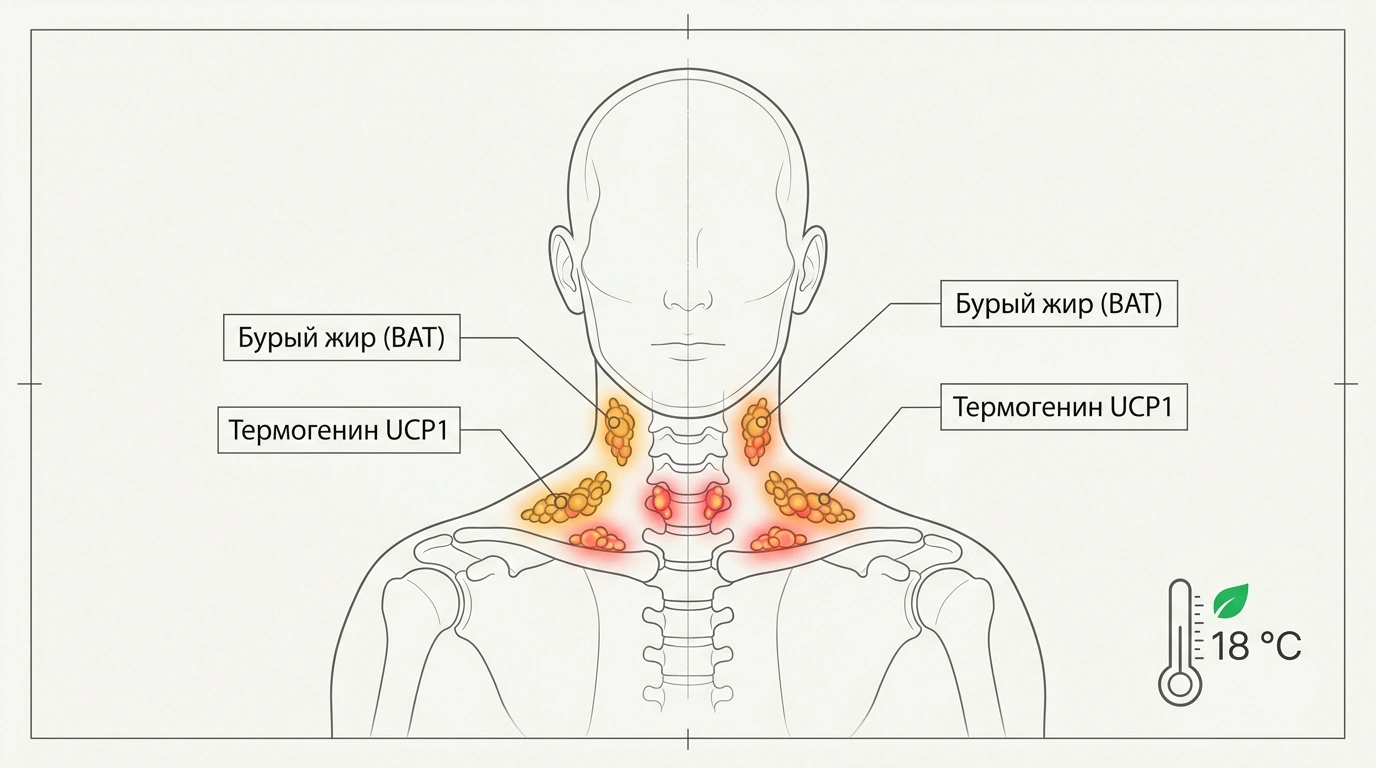
For most of us, the phrase 'body fat' brings up only negative images: extra inches around the waist, shortness of breath, and prediabetes. Yet the human body is far more interesting than that. We carry fundamentally different kinds of fat, and one of them acts not as a storage warehouse, but as a built-in electric heater.
The journal Nature published results from a massive study led by Paul Cohen's team at Rockefeller University and Memorial Sloan Kettering Cancer Center. Researchers trained AI algorithms to analyze more than 100,000 PET-CT scans and compared brown fat activity against hundreds of clinical diagnoses.
How brown fat differs from white fat
Regular white fat consists of large cells holding one giant droplet of lipids. Its job is to store excess calories for lean times.
Brown adipose tissue (BAT) is built completely differently:
- Its cells are packed with hundreds of iron-rich mitochondria, which give the tissue its brownish color.
- Those mitochondrial membranes express a unique protein called UCP1 (thermogenin).
- In normal cells, mitochondria store energy in ATP molecules. Thermogenin short-circuits that loop, forcing mitochondria to burn glucose and fatty acids straight into heat without muscle shivering.
For decades, physiology textbooks claimed brown fat belonged only to newborns—who can't shiver yet—and disappeared in adults. Only in 2009 did scientists confirm that adults keep active pockets of brown fat around major neck blood vessels, above the collarbones, and along the spine.
What the AI analysis uncovered
When researchers scanned 100,000 images, striking patterns emerged. People with active brown fat depots had far fewer cardiometabolic problems:
- Type 2 diabetes was nearly half as common in this group.
- Risks of coronary artery disease, atherosclerosis, and high blood pressure were significantly lower.
- Most surprisingly, active brown fat also correlated with lower rates of anxiety and depression.
Scientists suspect brown fat acts not just as a heater, but also as an endocrine organ. It releases signaling molecules called batokines into the bloodstream that help regulate appetite, inflammation, and mood.
You don't need freezing water to stimulate thermogenesis naturally. Research shows that sleeping in a well-ventilated room at 17–19 °C gently activates brown fat and improves insulin sensitivity.
How to wake up your inner thermostat
Naturally, you might wonder if you can boost brown fat to burn more calories. You can, just without extremes. Endocrinologists warn against jumping straight into ice water: sudden cold shock constricts blood vessels and spikes blood pressure, which can be dangerous for an unprepared heart.
The safest physiological protocol is mild cold adaptation. Spending about two hours a day at 16–18 °C for six weeks encourages regular fat cells to convert into 'beige' fat.
We've already looked at why bathroom scales mislead you during fat loss and how body composition changes. Make mild coolness your ally: skip wearing three sweaters indoors, open windows regularly, and take more walks outside.