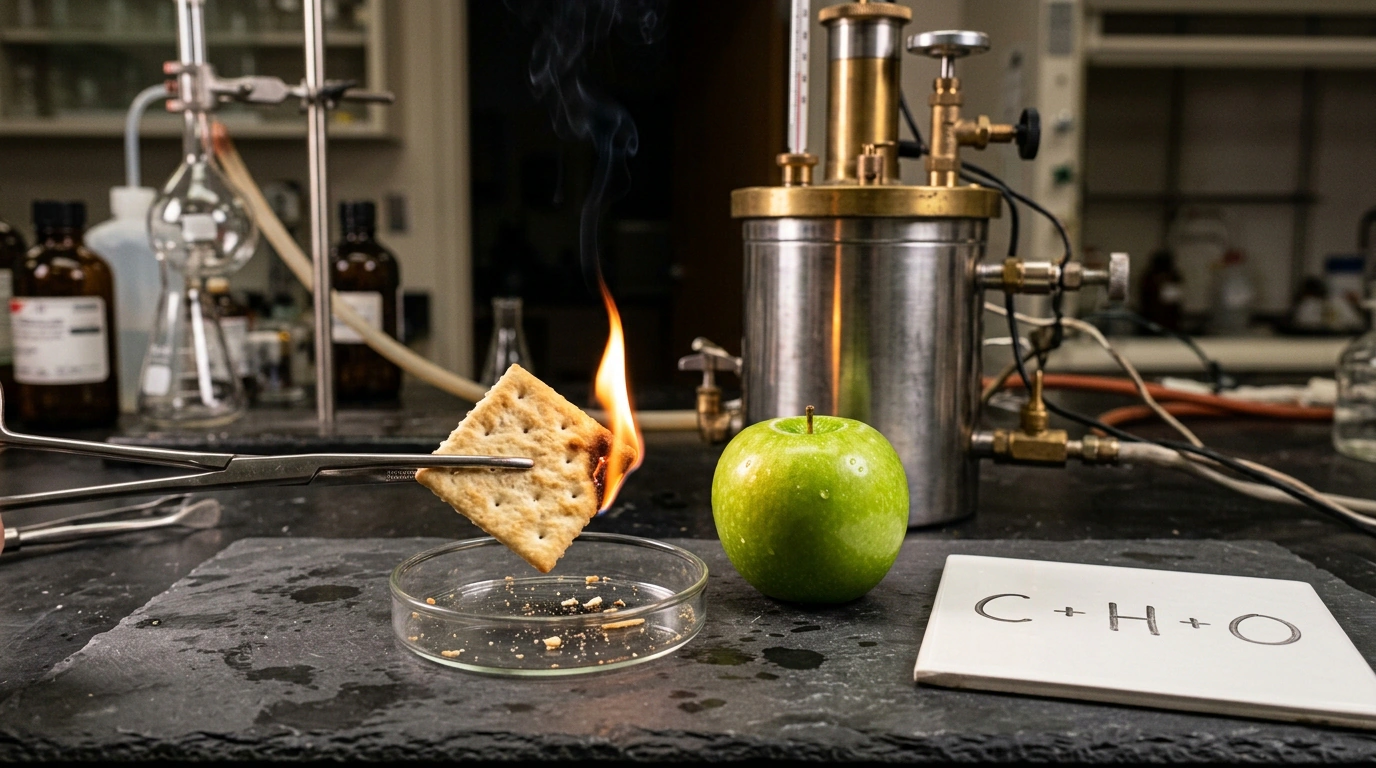
If you scroll short videos on social media, you've probably seen this dramatic clip. A stern-faced 'expert' pulls out store-bought cookies, chips, or dry cottage cheese and holds a lighter underneath. The snack catches fire, sends up black soot, and drips sizzling fat. The punchline never changes: 'Look! Pure chemicals, plastic, and toxic palm oil! They're poisoning us!'
Videos like that rack up hundreds of thousands of worried shares. Let's set emotions aside for a minute, revisit high-school organic chemistry, and see why this kitchen trick has nothing to do with science.
High-school chemistry: why food is supposed to burn
Fitness coach and nutritionist Artyom explains the physics in plain words. Every food on Earth—whether a farm-raised steak, fine Swiss cheese, rolled oats, or a cheap cracker—is made of organic molecules: proteins, fats, and carbohydrates.
All of those molecules are built on chains of carbon (C), hydrogen (H), and oxygen (O). What happens when you hold an open flame at several hundred degrees to dry organic matter?
- Hydrocarbons simply oxidize in oxygen from the air.
- Chemical bonds break, releasing heat, carbon dioxide, and water vapor.
- Unburned carbon particles form the exact black soot and smoke used to scare viewers.
When dry organic food burns, it proves just one thing: it holds stored chemical energy. If a cookie refused to burn, that would be the real reason to worry—it would mean you were holding a piece of brick or sand.
Where calories came from: Atwater's bomb calorimeter
In fact, the whole concept of food calories was born by burning food. In the late 19th century, American chemist Wilbur Atwater built a bomb calorimeter.
It was a sealed steel chamber ('bomb') submerged in a tank of water:
- Scientists placed a dried food sample inside and pumped in pure oxygen at 30 atmospheres.
- An electric spark lit the sample.
- The food burned completely, warming the surrounding water.
- By measuring the water's temperature rise, they calculated gross energy: 1 gram of carbs yields about 4.1 kcal, 1 gram of protein about 5.65 kcal, and 1 gram of fat a massive 9.4 kcal.
That's why oily chips and rich cheese burn so brightly: fat is dense, and fat is great fuel.
Moisture decides everything: why an apple won't light
Then why won't a fresh tomato or juicy apple catch fire from a lighter? The answer is simple: water content.
Water doesn't burn, and it absorbs huge amounts of heat. To ignite an apple, you'd first have to boil off all 85–90% of its water. Dry crackers and cookies hold only 3–5% moisture, so a lighter ignites them instantly. Slice an apple and dry it in a dehydrator until crisp, and it'll burn from a match just like a store-bought cookie.
Physics of a bomb calorimeter
Toxicologists never test food safety with a lighter. Real product quality is checked in accredited labs using high-performance liquid chromatography (HPLC), mass spectrometry, and microbiology testing.
Your stomach isn't a boiler furnace
The biggest sleight of hand in these clips is equating open-air fire with digestion. Your digestive tract isn't a furnace or a blowtorch.
Digestion is gentle, step-by-step enzymatic hydrolysis in water at 37 °C. Enzymes in saliva, stomach acid, and pancreatic juice neatly clip polymers into amino acids, fatty acids, and glucose—with no flames, charring, or smoke.
We've already covered why household cleaners pose a bigger risk than bacteria on produce and how to spot eco-myths. Next time you see someone on social media holding a match to a chip, just smile: you're watching a magician who skipped seventh-grade chemistry.