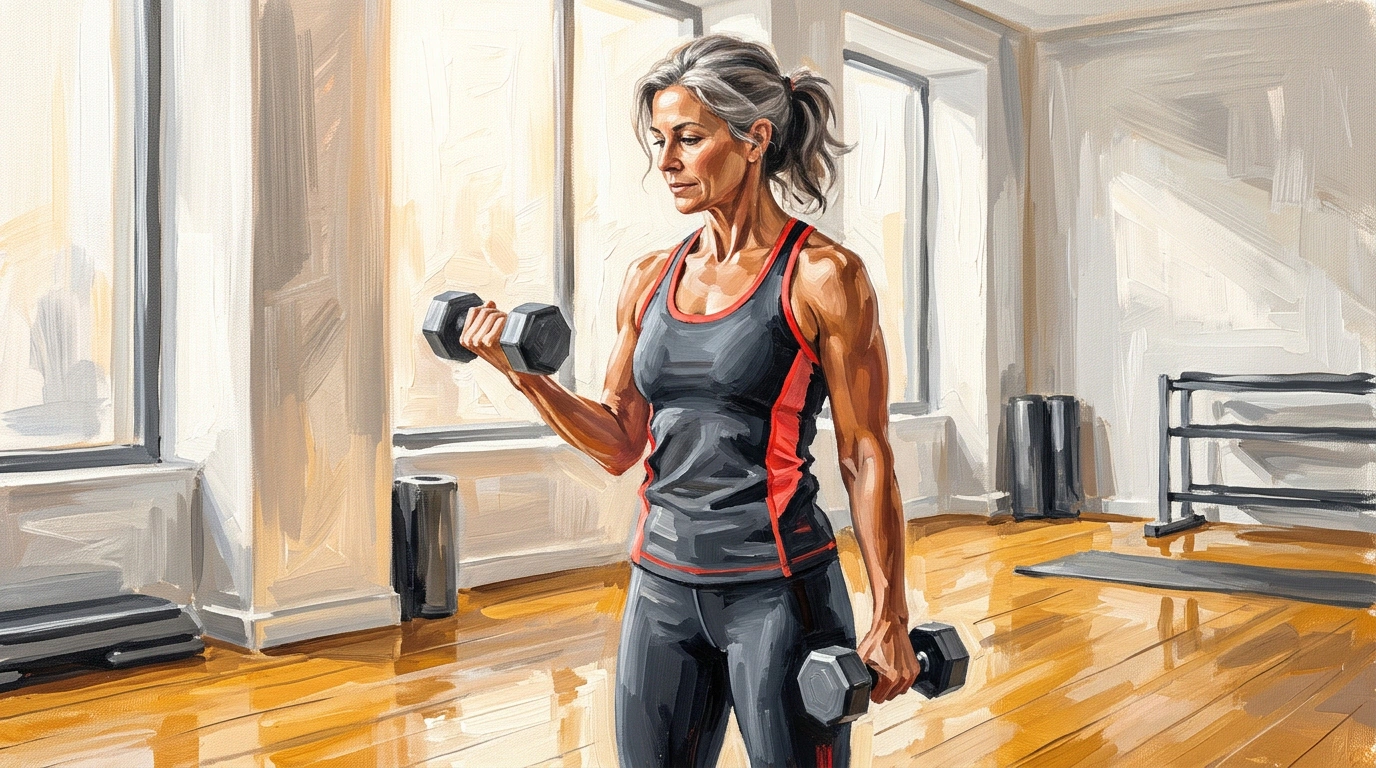
For years, the fitness world clung to a stubborn myth: that women's bodies come with a strict expiration date for lifting weights. Once you hit 35 or 40—and especially after menopause—picking up dumbbells was supposed to be pointless. Estrogen drops, hormones shift, and supposedly your muscles stop responding. Older women were politely steered toward stretching or Nordic walking instead.
That myth did real damage. Plenty of women noticed they were losing tone and strength, yet never stepped near a weight rack because they assumed their window had closed. Now a massive meta-analysis from sports scientists has put that idea to rest. Your muscles don't have a deadline: they keep their ability to grow, build strength, and reshape your body at 40, 55, or 70.
The "Hormonal Expiration Date" Myth
For a long time, sports science accidentally fed this misconception. Most classic strength-training studies were run on college-aged guys between 18 and 25. Researchers assumed those findings applied universally—that muscle growth required sky-high hormone levels, and age-related estrogen decline would stall progress.
But muscle fibers don't take orders from an abstract hormone chart; they respond to a direct physical signal—mechanical tension. To settle the debate for good, an international research team pooled the global data on women's resistance training.
126 Studies and 4,000 Women: What the Meta-Analysis Found
Published in the respected Journal of Science and Medicine in Sport, a systematic review led by Dr. Eduard Isenmann analyzed 126 controlled intervention trials covering 4,019 women.
The researchers split the data into two groups: one-third (33%) were younger women of reproductive age, and two-thirds (67%) were postmenopausal women. All of them followed structured strength-training programs.
The numbers spoke for themselves:
- Strength gains: The effect size (SMD) was 1.50 before menopause and 1.46 after menopause. Statistically, there was no difference at all between younger and older women (p = 0.459). Both groups got stronger at the exact same clip.
- Body composition: Resistance training produced steady gains in muscle mass (SMD = 0.27 premenopause vs. 0.30 postmenopause) alongside reductions in body fat (SMD = 0.23 vs. 0.17).
Skeletal muscle keeps its anabolic plasticity for life. We also covered how lifting supports healthy aging in our piece on why strength training after 40 protects your bones and extends your life.
Mechanotransduction: How Cells Build Protein Without Estrogen
Why doesn't lower estrogen stop your muscles from adapting? The answer comes down to mechanotransduction.
When a muscle stretches and contracts under load, tiny mechanoreceptors in the fiber (integrins and costameres) sense the tension. Inside the cell, that triggers phosphatidic acid, which flips on the mTORC1 building complex—the master switch that tells your cell to assemble new protein strands.
This sensor runs independently and doesn't wait around for high estradiol levels. Give the muscle mechanical effort, and protein synthesis kicks in. And you don't need heavy barbells to flip that switch: as testing shows, muscles grow just as well with moderate weights when you train close to fatigue.
The one real age-related tweak is anabolic resistance: your muscle receptors need a slightly bigger protein nudge per meal—around 2.5 to 3 g of leucine, or 30 to 35 g of protein from fish, poultry, or cottage cheese. For active women over 40, a solid daily target is 1.4 to 1.8 g of protein per kilogram of body weight. Meanwhile, the mechanical pull of tendons on bone gives you built-in protection against osteoporosis.
A Safe Start: From Machines to Everyday Confidence
If you've never lifted weights before, how should you begin?
- Start with guided machines: Leg presses and seated rows keep the movement on a fixed track and take axial load off your spine.
- Master everyday patterns: Sit-to-stands from a chair and glute bridges on the floor build the exact muscles that make walking briskly and climbing stairs feel effortless.
- Exhale on the effort: Breathing out smoothly as you push or pull keeps your blood pressure from spiking.
- Leave room to recover: Two or three 45-minute sessions a week, with a rest day in between, give your tendons and ligaments time to adapt.
Pick a weight that lets you complete 10 to 12 controlled reps while feeling like you still have 1 or 2 good reps left in the tank. That's plenty to stimulate mTORC1 without beating up your joints.
Your muscles can't read a birth certificate. They respond to steady tension and good care—and your body is ready to get stronger right now.