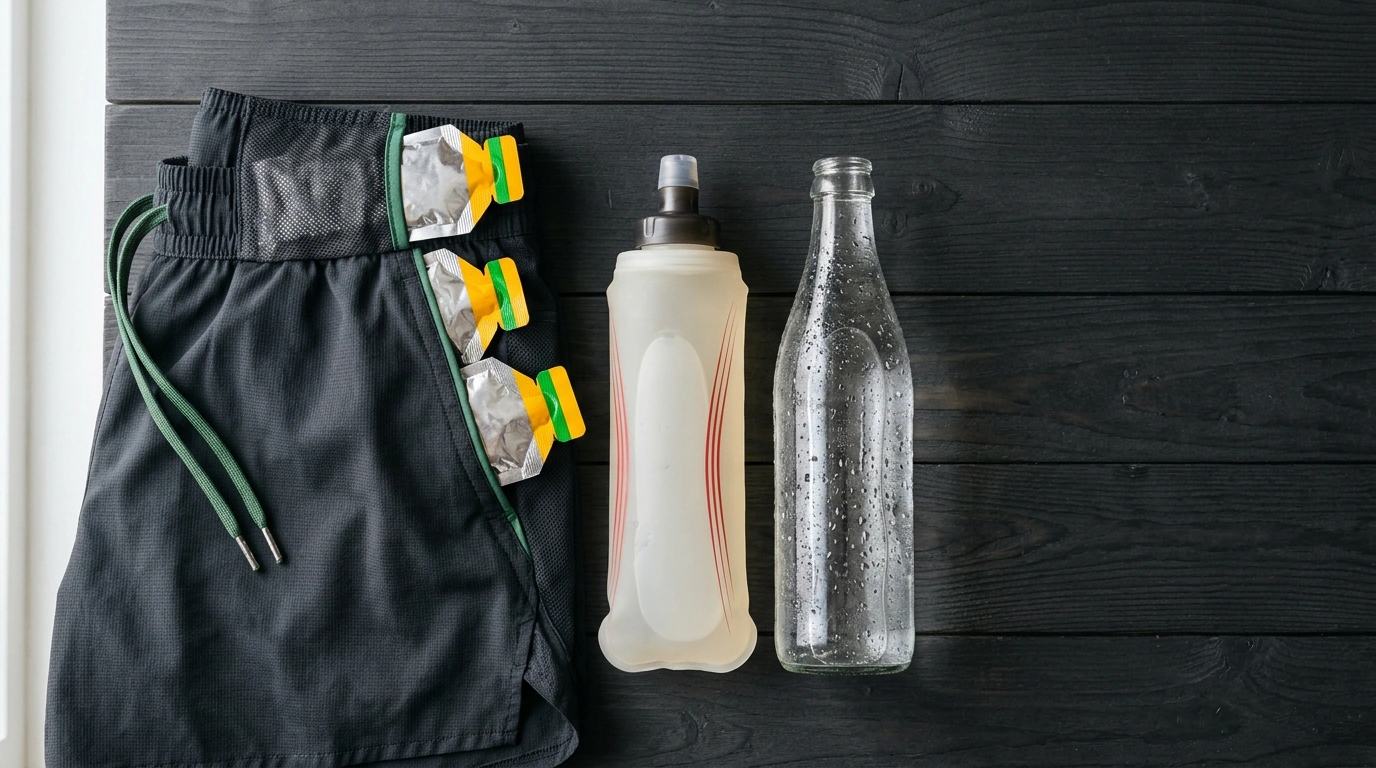
The morning before a long run always starts the same way: standing in the kitchen, drinking water, and stuffing bright race-expo packets into your shorts pockets. On a half marathon, a single tube gets you to the finish line, but before a marathon or an ultra, that handful turns into a puzzle: how do you pick your gels and build a race fueling plan without wrecking your stomach?
I went through the field notes of Renat Shagabutdinov, author of the "Бегать просто" channel, who tested five gels ahead of the Comrades ultramarathon (87–90 km), and cross-checked them against sports nutrition science. Success comes down to balancing liquid isotonics and thick syrups, accounting for osmolarity, and calculating caffeine by the kilometer.
Why a Half-Marathon Plan Breaks Down at Longer Distances
Your muscles and liver store 400–500 g of glycogen (1600–2000 kcal). That lasts for 80–100 minutes, and by kilometers 28–32 those reserves run dry. Your body switches to burning fat, which requires 10–12% more oxygen, your pace drops, and you hit the "marathon wall"—something we covered in our breakdown of Ingrid Kristiansen's pacing lessons.
You can't just eat more sweets on the run—digestion hits a hard ceiling. The intestinal glucose transporter (SGLT1) absorbs a maximum of 60 g of carbohydrates per hour, and anything extra sits in your gut and ferments. To absorb up to 90 g/h without GI distress, you need to tap into the separate fructose pathway (GLUT5) by choosing maltodextrin-and-fructose blends in a 1:0.8 or 2:1 ratio.
Liquid Isotonics vs. Thick Syrups: Road Test and the Osmolarity Trap
The next choice is between drinkable isotonics and thick syrups based on their osmolarity relative to blood plasma (280–300 mOsm/kg).
Isotonics are already diluted with water and don't need chasing. In Renat's test, liquid GU Liquid Energy Lemonade (60 g / ~55 ml packet, 23 g carbs, 75 mg sodium, 450 mg BCAA, 0 mg caffeine) went down easily before a 4 km tempo run at 3:30–3:40 min/km. The only downside is the bulky packet: carrying 15–20 servings in your pockets without race support is unrealistic.
Thick hypertonic syrups (>500 mOsm/kg) are compact, but without 150–200 ml of plain water they trigger reverse osmosis, pulling fluid out of your bloodstream into your gut and causing cramps and diarrhea:
- 226ERS High Fructose Gel Speculoos (80 g, 55 g carbs at 1:0.8, 300 mg sodium) restored energy on a 10.5 km run with no GI issues, though it was cloyingly sweet enough to make you thirsty. Plus, 15–20% of people are sensitive to fructose—see more in our article on hidden triggers of bloating.
- Nutrend Carbosnack in blue raspberry (50 g, 30.9 g carbs, 60 mg caffeine, 200 mg beta-alanine, 50 mg choline, 150 mg sodium) came through during 5×100/200 m strides and a 21 km half marathon at 4:04 min/km. It's the most viscous syrup in the lineup—chasing it with water is mandatory.
- Sponser Liquid Energy Salty (35 g, 20 g carbs, 155 mg sodium / 0.39 g salt) teaches you not to trust the word
Liquid: inside is a thick paste with a sharp salty taste that requires 200 ml of water, though alternating salty with sweet helps prevent flavor fatigue.
Caffeine and Nootropics: Precision Math Instead of Overdosing
The fifth gel highlights how stimulants work. According to the ISSN consensus (2021), an effective caffeine dose is 3–6 mg/kg of body weight (210–420 mg over a race for a 70 kg runner), peaking after 45–60 minutes. Doses of 9 mg/kg or higher won't add speed, but they will trigger tachycardia and GI cramps.
That's why SiS Beta Fuel + Nootropics (60 ml, 40 g carbs at 1:0.8, 200 mg caffeine, 250 mg Cognizin citicoline, 200 mg L-theanine, 1 g taurine) is limited to one serving per day. L-theanine takes the edge off the jitters, while citicoline keeps you locked in. Taking it without water 15–20 minutes before a 10K start, Renat ran an even 34:14 on modest mileage (60 km/month and 35 km/week). In an ultra, it's saved for the final 15–20 km.
How to Train Your Gut and Build a Race-Day Fueling Plan
Exercise physiologist Asker Jeukendrup (2017) showed that over 6–10 weeks the gut adapts, cutting the risk of cramps by 2–3 times:
Gut Training Protocol
- Weeks 1–3: 30–45 g of carbs per hour on runs of 90 minutes or longer + 150–200 ml of water every 15–20 minutes.
- Weeks 4–6: 60 g/h using maltodextrin-and-fructose blends.
- Weeks 7–10: test 70–90 g/h at goal race pace.
- Race-day lineup: caffeine-free gels (
GU Liquid,SiS,PowerBar) in the first half, alternating with chews and salt chased with water in the middle, andNutrend Carbosnackor a singleSiS Beta Fuel Nootropicsin the final stretch.
That's how the test turned into a reliable system with no guesswork on the starting line. Keep safety in mind: gels are only needed for efforts longer than 60–90 minutes, and if you have hypertension, arrhythmia, or GI conditions, check with a doctor before using stimulants.
After all, all this math with grams and osmolarity isn't about the numbers themselves. When your stomach is calm and your muscles get fuel on time, you stop fighting your own body—and you can simply lift your head, catch the morning breeze, and enjoy every kilometer of the road.