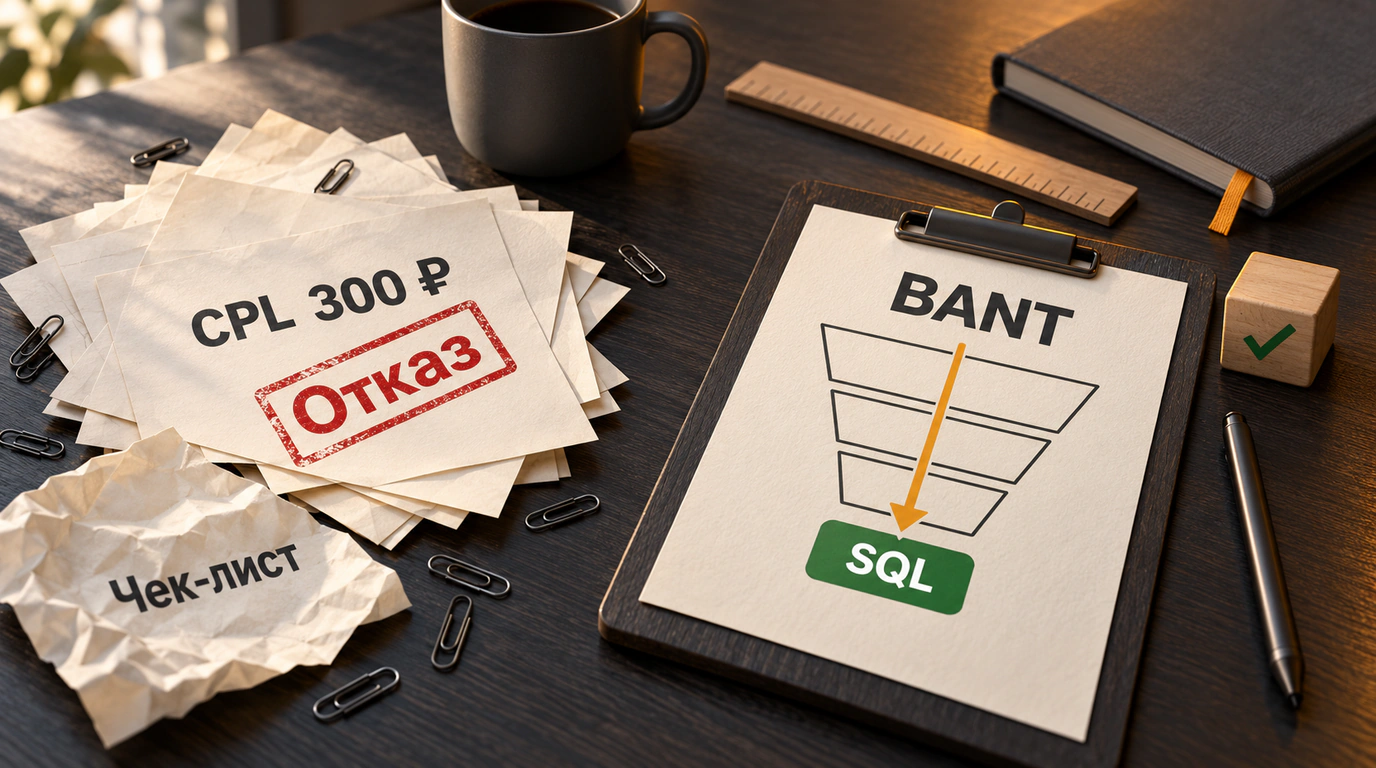
Here is a scene I run into constantly during marketing audits. At the Monday standup, the marketer proudly pulls up a dashboard: "Look, I cut our cost per lead in half! Leads are coming in at 300 rubles, and we're at 140% of our monthly target." The business owner nods happily, already thinking about scaling the ad spend.
Thirty minutes later, the head of sales walks in and drops a CRM report on the table with quiet fury: "Connect rate is 18%. Half the numbers are fake, and the other half snap at us: 'I didn't order anything, I just clicked to download a checklist!' Zero sales, flat revenue, and the reps are burned out and ready to quit."
This classic marketing-and-sales clash (the Smarketing gap) burns through millions of rubles in ad budgets every year. When we put together our guide for business owners on when hiring marketers turns into wasted ad spend, I stressed the same point: you can never judge marketing by raw clicks or abstract lead counts.
Let's pull this mechanism apart piece by piece: why optimizing for cost per lead (CPL) marches a business toward a cash crunch, where funnels quietly break, and how to build a system where marketing is accountable for net profit.
The Unit-Economics Paradox: Why a Pricier Lead Doubles Your Profit
The biggest mental trap for any founder is assuming that cheaper leads automatically mean a healthier business. Everyday logic sounds simple enough: if a 50,000-ruble budget buys 100 inquiries at 500 rubles instead of 50 at 1,000 rubles, statistically you should close more deals.
Comparative isometric unit-economics diagram showing two lead-cost scenarios and their resulting revenue.
Ad practitioner Igor Suvorov blew that myth apart with a clean side-by-side calculation of two campaigns running on the exact same budget:
| Campaign Metric | Campaign #1 (Cheap CPL) | Campaign #2 (Qualified Lead) |
|---|---|---|
| Ad Budget | 50,000 ₽ | 50,000 ₽ |
| Total Leads | 100 | 50 |
| Cost Per Lead (CPL) | 500 ₽ | 1,000 ₽ |
| Close Rate | 5% (5 closed deals) | 20% (10 closed deals) |
| Customer Acquisition Cost (CAC) | 10,000 ₽ | 5,000 ₽ |
| Sales Team Workload | 100 exhausting calls | 50 targeted consultations |
| Total Revenue (at 30,000 ₽ ticket) | 150,000 ₽ | 300,000 ₽ |
Inside the Direct dashboard, Campaign #2 looks twice as "bad": clicks cost more, and each lead runs 1,000 rubles instead of 500. A junior media buyer would pause it on the spot with the verdict: "Too expensive."
Now look at the actual business outcome:
- The campaign with pricier leads generated twice as much revenue (300,000 rubles vs. 150,000);
- True Customer Acquisition Cost (CAC) came out half as high (5,000 rubles vs. 10,000);
- The sales team handled half as many contacts, saving their energy for deep, high-value conversations.
By optimizing for a cheap CPL, a founder paints themselves into a corner: they save 500 rubles on the front end while burning hundreds of thousands on sales salaries to sift through junk traffic.
The Lead Magnet Trap: Three Mistakes That Kill Sales
Where does this flood of dead-end contacts come from? Most of the time, the culprit is a poorly thought-out freebie—your lead magnet.
Funnel expert Olesya Gladkikh points out three fundamental mistakes teams make when building freebies:
1. Audience Mismatch. A consultant sells 100,000-ruble 1-on-1 mentorship, yet runs ads offering a "100 Post Ideas" guide. Who downloads that file? Beginner bloggers and freelancers with no business, no budget, and no systemic pain. The freebie scratches a penny-ante itch ("what should I post today?"), filling your pipeline with people who will never buy a high-ticket offer.
2. The Button-at-the-End Illusion. The marketer hopes that once someone reads a helpful PDF, they'll reach the last page and book a call. In reality, there's a canyon between a free download and a paid engagement. The reader grabs the cheat sheet and forgets your company name five minutes later. It fails for the same reason bloated proposals do: when we examined how compact offers speed up agency sales cycles, we saw that clarity and focus beat volume every time.
3. Zero Diagnostic Value. A proper lead magnet shouldn't be entertainment—it should be a diagnostic tool. Its job is to expose the scale of the problem. When a checklist reveals to a business owner that their operation has seven critical leaks, reaching out for professional help becomes the obvious next step.
Multi-Tier CPL: The Value Ladder and Max-CPL Math
Another common blunder is comparing lead costs head-to-head across completely different rungs of the awareness ladder—a trap marketer Alexey Velchev warns against.
You can't compare 300 rubles for a webinar registration with 3,000 rubles for an intro strategy call. Those are actions with totally different commitment levels. Signing up for a webinar is a zero-risk, one-click impulse. Requesting a consultation means carving out 40 minutes to talk one-on-one with an expert.
Your ceiling CPL for any funnel stage comes down to a simple formula:
Max_CPL = (LTV × Gross Margin × Lead-to-Paid Conversion Rate) − Target Profit per Customer
If your LTV is 80,000 rubles at a 50% margin, and sales closes one in four leads (25% conversion), your break-even ceiling is 10,000 rubles per lead. Trying to squeeze that CPL down to 500 rubles by attracting tire-kickers only poisons the funnel.
Lead Qualification: BANT Scoring and Front-Door Filters
To align marketing and sales around the same goal, teams use BANT lead qualification:
- B (Budget): Can the prospect actually afford your price tier?
- A (Authority): Is your rep speaking with the decision-maker?
- N (Need): How urgent is the pain, and does your offer genuinely solve it?
- T (Timeline): Are they planning to start in the next few weeks, or window-shopping for next year?
Adding just one or two qualifying fields directly into your website form (company size or budget range) works wonders. Your page conversion rate will dip and your CPL will rise by 30–50%. Yet freebie hunters get filtered out at the door, reps receive Sales Qualified Leads (SQLs), and your final CAC drops because close rates climb.
Lead-Form Audit Checklist Before Scaling Ad Spend
- The form includes at least one qualifying question (budget, project scope, or timeline)
- The lead magnet topic tightly matches the buyer profile of your core paid offer
- The freebie acts as a diagnostic, surfacing hidden problems the buyer needs solved
- Your CRM separates MQLs (Marketing Qualified Leads) from SQLs (Sales Qualified Leads)
- Offline conversions flow back from your CRM to your ad account to retrain bidding algorithms
Closing the Loop: Training Automated Bidding on Real Money
Finally, there's one crucial technical step: feeding real revenue signals back to Yandex Direct's algorithms.
When you run an automated bidding strategy optimized for "Form Submit," Yandex's algorithm hunts for people who love clicking buttons. And who fills out forms most eagerly? People with too much free time—serial freebie collectors. Before long, the AI optimizes your impressions for an audience that never buys.
The fix is passing offline conversions from your CRM back into Direct via ClientID. The moment the algorithm starts receiving signals not for raw form fills, but for qualified SQL statuses or actual payments, auction behavior shifts. The bot stops chasing cheap clicks and starts buying impressions from people who actually bring in revenue.
Judge marketing by Return on Ad Spend (ROAS) and net profit. Only then will your ad budget stop slipping through the cracks.