Want to know what I see most often during marketing budget audits? A business owner proudly opens a slide deck and shows off "the works": we launched search ads, we run a blog, we shoot short videos, we hired an SEO agency, and we are prepping for an industry forum. When I ask why a wholesale concrete supplier needs vertical short-form videos, the director shrugs sheepishly: "Well, competitors are doing it—it's the trend."
The result is hundreds of thousands of rubles spread paper-thin across a dozen trendy channels, a burned-out team, and zero return at the cash register. Businesses buy tools before they even define a basic commercial goal.
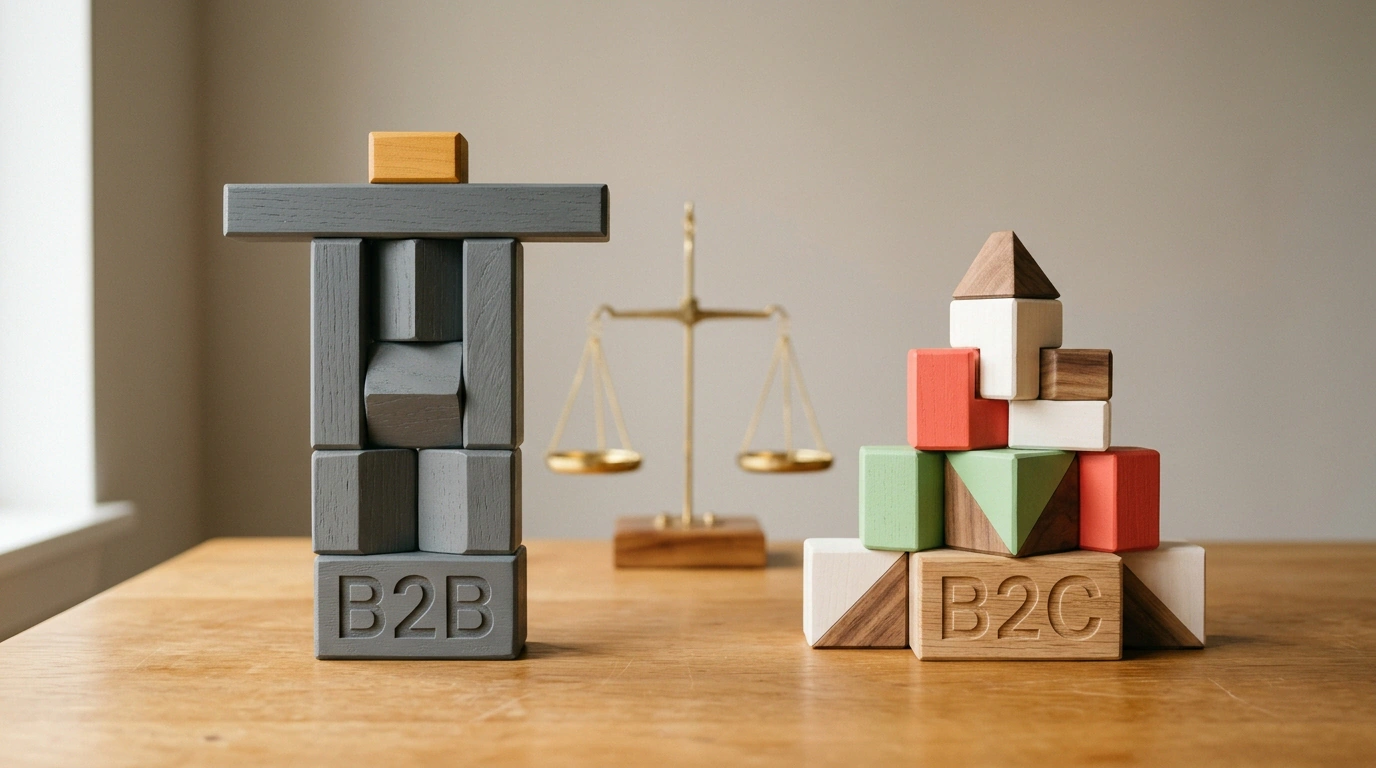
In 2026, that kind of scattershot spending is a guaranteed path to a cash crunch. You cannot evaluate channels in a vacuum: complex corporate sales (B2B) and consumer retail (B2C) obey opposite psychological laws and require completely different funnels. Let's look at this matrix through hard research numbers.
Anatomy of the Divide: Why What Explodes in B2C Buries Sales in B2B
Let's break down how buying decisions happen in plain terms.
In retail B2C, the buyer's journey is short and impulsive. Someone spots a jacket on a marketplace or a mouthwatering pizza in their feed, skims three reviews, and pays by card. The risk of a bad choice is tiny: if the pizza disappoints, the buyer loses 800 rubles and forgets about it an hour later. Emotion, checkout speed, and social proof call the shots here.
In complex B2B, the world works in the exact opposite way:
- Sales cycles stretch across months: going from first touch to a signed contract takes anywhere from 60 days to a year;
- A buying committee decides: the CEO checks ROI, the CFO demands payment terms, legal redlines the contract, and the chief engineer tests samples personally;
- The cost of a mistake is massive: if a manager orders defective parts or half-baked software, production halts and someone loses their job.
Trying to sell heavy equipment through entertaining social posts is doomed from day one. We previously explored how to align marketing and B2B sales, and when it comes to budgets, the divide is even sharper.
What the Numbers Say: Real Channel ROI Studies
Let's put guesswork aside and look at large-scale industry data:
- NWComm Study "Lead Generation in Russia — 2025" (survey of ~200 executives, 76% B2B): Channel popularity diverged sharply from financial return. Companies most often use events (75.3%), expert content (64.6%), and email/newsletters (60.1%). Yet when executives were asked which channel delivered the highest financial ROI, offline events (40.9%) won by a landslide—conferences, business breakfasts, and private roundtables. SEO and search ads were named top-performing by only 25.3% each. Face-to-face dialogue with decision-makers pays back faster than any click.
- Proizvoditel.rf Survey of 51 Industrial Plants (February 2026): The top deal sources were repeat sales to existing accounts (84% named them the backbone of revenue) and word of mouth (59%). Meanwhile, 29% of factories spent budget on social media, yet 0% could point to social media as a source of real leads.
- B2C Market Research (VCIOM and Data Insight): According to VCIOM data from March 2026, 43% of Russians name marketplaces their primary source of product information (search sits at 34%, social media at 28%), and 72% call reviews the decisive factor in buying. A Data Insight analysis of 13,000 Wildberries sellers showed that merchants using paid in-platform ads grew 75% year-over-year, compared to 49% for those who skimped on promotion.
Allocating a 300,000-Ruble Budget: B2B vs. B2C
If you run a B2B business with an average deal size of 500,000+ ₽: put 120,000 ₽ into two specialized trade shows with direct access to decision-makers, 100,000 ₽ into producing three deep case studies for trade media, and 80,000 ₽ into nurturing warm leads and tightly targeted search.
If you run B2C retail: put 180,000 ₽ into marketplace ads, 70,000 ₽ into review management and product infographics, and 50,000 ₽ into hyperlocal targeting for repeat purchases.
Step-by-Step Playbook: 4 Moves to Build a Sober Allocation Matrix
To stop burning cash on trendy experiments, run your budget through this four-step filter:
- Find the funnel bottleneck: Too few contacts? You need reach channels. Plenty of contacts, no meetings? Your offer is weak or sales is too slow (more traffic won't fix that). Meetings fall through? You have a trust and credibility problem.
- Calculate cost per closed contract (CAC): In B2B, cost per click is meaningless. Track cost per sales-qualified lead (SQL) and sales cycle length. If a search lead costs 12,000 rubles and closes 1 in 10 times, your contract costs 120,000 rubles. If a 200,000-ruble seminar brings in 4 contracts, each contract costs 50,000 rubles.
- Set testable hypotheses instead of "running channels": Drop vague line items like "social media budget." The only valid framing is: "Publishing two technical breakdowns will cut proposal approval time from 60 to 45 days."
- Benchmark against customer retention: In B2B, keeping an existing account is always the cheapest growth lever: structured account management pays off faster than any cold campaign.
Marketing is not a creativity contest; it is resource-allocation discipline. Put your money where customers actually make financial decisions, not where they just scroll past a screen.