It's easy to see why marketing teams are tempted: why spend two weeks negotiating a brief with a creator and paying hundreds of thousands of rubles when generative avatar and voice-cloning tools can spit out a video in fifteen minutes for a couple of bucks? On paper, it looks like a UGC revolution—spin up dozens of virtual spokespeople and flood ad accounts with tests.
Once the initial hype fades, however, businesses hit a wall in their sales reports. Let's look at why blindly swapping real humans for virtual avatars can tank conversion rates, and where the true boundary of AI effectiveness lies.
Marketer Yegor Khromov analyzed a massive dataset from Gartner, the Nuremberg Institute for Market Decisions (NIM), SuperScale, and the Journal of Interactive Advertising—covering roughly 100,000 ad integrations across Reels, TikTok, and YouTube Shorts. The findings from this cross-industry slice are enough to sober up any techno-optimist.
The Psychology of Trust: Why the Consumer Brain Rejects Avatars
The real bottleneck isn't rendering quality—it's deep evolutionary human psychology. According to the combined research:
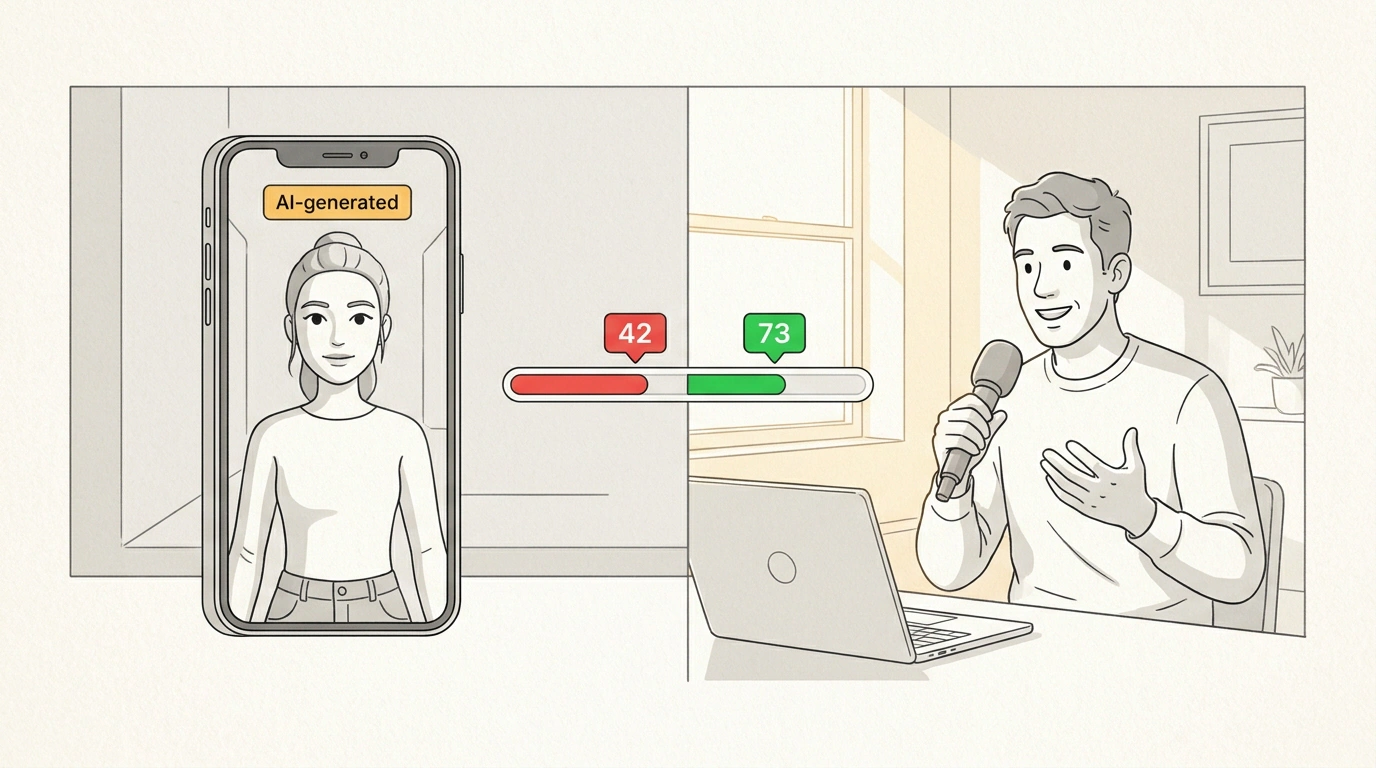
- Baseline trust score for digital avatars is just 42 out of 100, compared to 73 for real human creators;
- Purchase Intent lift after watching a real-creator UGC video averages +19%, versus only +12% for AI-generated content—a drop of more than a third in conversion momentum.
It comes down to the physical-experience barrier. Consumers subconsciously look for social proof. Your viewer knows full well that a synthetic talking head on screen cannot taste a protein bar, feel how a moisturizer absorbs, or break in a pair of running shoes. In any category tied to touch, taste, scent, or health safety, trust in AI recommendations drops toward zero.
NIM's "Transparency Dilemma" makes it even sharper: the moment an "AI-generated" label appears on a video, the viewer's brain flips from emotional trust to skeptical fault-finding. People start squinting at facial expressions, hunting for visual glitches, and tuning out the pitch.
In my piece on how to vet influencer profiles before launching, I stressed the same point: people don't buy from flawless renders—they buy from imperfect humans with real voices and lived experience.
Trying to pass off an AI avatar as a real customer in physical-goods retail carries huge reputational risk. Once your audience spots the fake, the brand gets hit with a wave of backlash and wiped-out loyalty.
Where AI Beats Humans: Testing Economics and Software
Does that mean generative video is useless? Not at all. Survey data shows 73% of forward-thinking brands actively use AI creatives—they just deploy them with surgical precision.
AI's biggest advantage is smashing the production bottleneck. Creative production costs drop by 38–58%, while hypothesis-testing speed jumps by an order of magnitude. In a single workday, a team can generate 30 offer variations and 50 different opening three-second hooks. Social algorithms reward high-frequency testing: thanks to sheer variety, AI creatives often pull 2.8x more organic impressions at the top of the funnel. Just be careful not to fall into the empty virality trap, where views hit millions while the cash register stays silent.
There are two niches where AI structurally outperforms human creators:
- SaaS, complex tools, and B2B software. SuperScale's research found that for interface tutorials and complex feature walkthroughs, AI avatars deliver 52% better information retention and 67% higher attention hold. Users don't need a host's personal lifestyle—they want a crisp, fast, error-free screen walkthrough without filler words.
- Low-commitment actions. Free sign-ups, utility downloads, calculators, and checklists. Wherever a viewer doesn't have to pull out a credit card or take financial risk, a virtual presenter performs remarkably well.
The Cohort Gap and the "70/30" Hybrid Funnel
The hidden cost of going all-in on AI shows up over time. Cohort analysis reveals that customers acquired through real creators demonstrate 23% higher retention and lifetime value (LTV). A human creator acts as a role model ("I want a bit of their lifestyle"), forging an emotional bond with the brand that an AI avatar simply cannot replicate.
The most pragmatic playbook for 2026 is a hybrid model:
- Top of funnel (70% of budget and time — AI): mass-testing dozens of angles, pain points, and hooks with generative videos to quickly and cheaply identify winners with the highest CTR.
- Bottom of funnel and retargeting (30% of budget — Real creators): handing the 2–3 winning scripts to human creators with a tight brief so they bring warmth, credibility, and authority to close the sale.
Use AI as a low-cost lab to weed out weak ideas, and deploy real creators as your heavy artillery to build trust and close deals.
AI didn't kill creator marketing—it forced it to grow up. Stop pitting algorithms against humans, and combine generative speed with the irreplaceable power of human trust.