Have you ever asked ChatGPT, Perplexity, or Yandex Neuro: "Which company should I hire for a manufacturing CRM rollout?" or "Recommend a reliable logistics partner in the Volga region"? If you haven't, go run that prompt right now. The answer will probably surprise you: either the model will confidently name your direct competitors, or it will admit it has never heard of your brand.
We've entered a tectonic shift: classic "ten blue links" search is rapidly giving way to generative answers—Generative Engine Optimization, or GEO. High-intent buyers, executives, and B2B procurement leads no longer want to click through twenty tabs; they ask an AI model a detailed question and get a curated shortlist. In my breakdown of how AI is replacing blue links and reshaping search visibility, I noted a blunt reality: if your company isn't on the first screen of AI answers, you simply don't exist for a growing slice of buyers.
Neil Patel's Six-Step Express Audit
Renowned marketer Neil Patel laid out a simple six-step checklist that lets you audit your company's AI visibility in under thirty minutes:
- Check your branded search foundation on Google and Yandex. If your site doesn't rank #1 for your own brand name, no RAG retrieval pipeline is going to surface it.
- Ask ChatGPT directly about your brand. Type in your company name. If the model replies "I'm not familiar with this organization," your brand is missing from both training weights and search indexes.
- Run a category prompt without your brand name. Phrase a pure commercial buyer query: "Best industrial cable supplier" or "Top PPC agencies for e-commerce." See who makes the top three.
- Test across five different models. Don't stop at one tool: query ChatGPT, Claude, Perplexity, Yandex Neuro, and GigaChat. Their knowledge bases and web-search pipelines differ—a brand can lead in one engine and be invisible in the other four.
- Test 50 prompt variations. Buyers phrase constraints differently: emphasizing speed ("same-day dispatch"), pricing ("transparent rate card"), or proof ("verified B2B case studies"). Each angle reshuffles the shortlist.
- Track weekly. LLM rankings shift dynamically as the web is re-indexed, so measurements need a weekly cadence.
Russian Market Stress Test: Why Brands Get Dropped Mid-Conversation
Researchers at Humanswith.ai ran a large-scale stress test of generative search in Russia. They fed 368 non-branded commercial prompts across 9 LLMs, simulating 32 five-turn buying conversations of a marketing director:
- Turn 1 (Broad sweep): the model outputs an initial list of 6–8 market players.
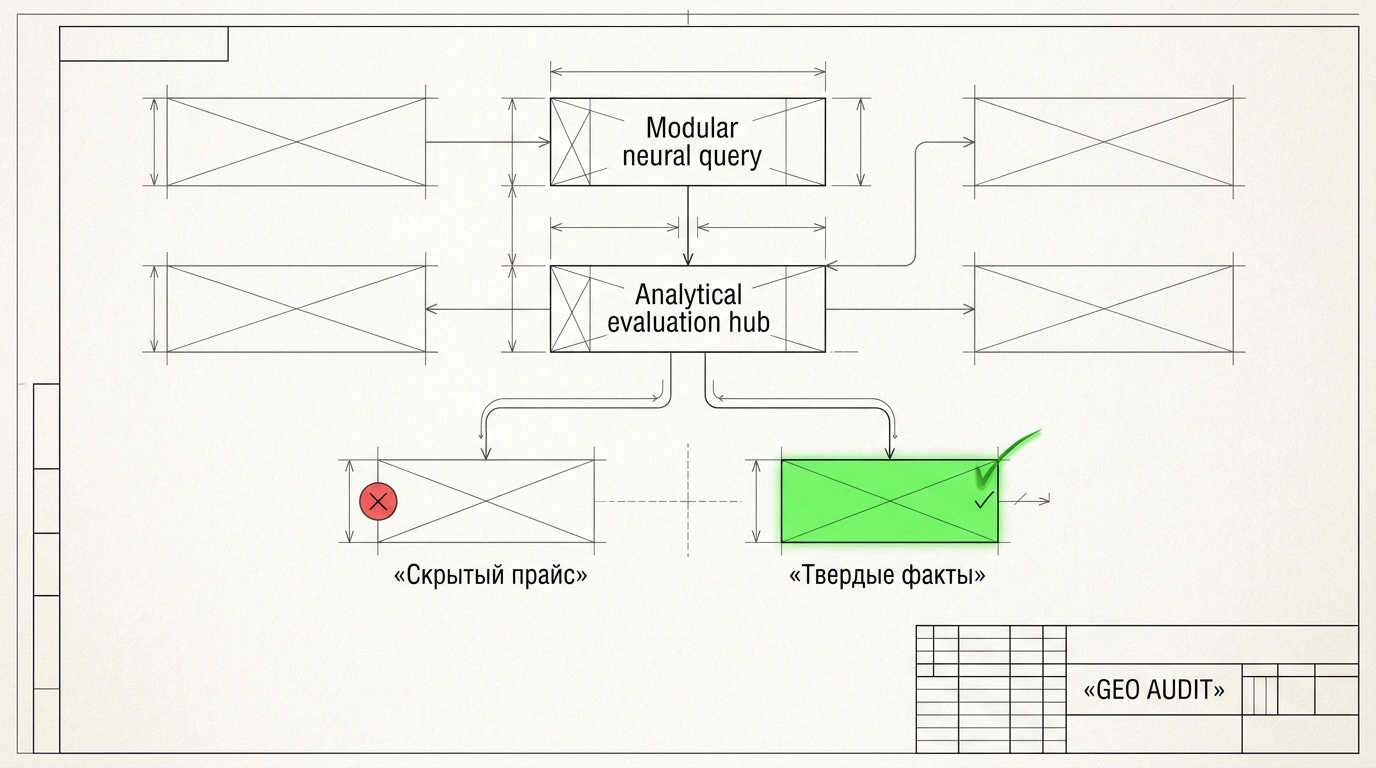
- Turn 2 (Budget filter): the user types: "Budget up to 200,000 rubles/month—show companies with transparent pricing." At this step, the AI ruthlessly cuts more than half the list—dropping any site hiding behind vague copy like "price upon request" or "custom quote." The model needs hard numbers to validate budget fit.
- Turn 3 (Proof check): "Keep only agencies with measurable before/after case studies and links." Only 2–3 finalists survive.
- Turns 4 and 5 (Final pick): the algorithm weighs direct citations and crowns a single winner.
Why do some sites get cited while others are ignored? A foundational study by researchers at Princeton and Georgia Tech (Aggarwal et al., KDD 2024) proved that adding authoritative expert quotes, bulleted lists, and hard numerical data boosts content visibility in LLMs by 40%. Meanwhile, old-school keyword stuffing actually penalizes a page in AI retrieval.
LLMs love structured tables packed with numbers. Yet if your brand name isn't anchored right next to those data rows, a RAG system will pull your numbers into its answer and hand the link—and the customer—to a competitor. Always brand your comparison matrices and implement FAQPage schema markup.
GEO Economics: A 15K Tracker or a 200K Agency?
Right now, the market has split into two models for managing AI visibility:
The first is pure SaaS monitoring platforms (Semantica AI, BrandFound, Peec AI). They cost 15,000 to 25,000 rubles a month and show where your brand is mentioned or omitted. Buying a tracker without an in-house editorial team, though, is money down the drain. Software only diagnoses the problem; it doesn't fix it. A tracker makes sense only if you have writers ready to publish 20+ deeply researched, fact-dense articles a month.
The second is turnkey GEO agencies and platforms. Retainers start at 150,000–300,000 rubles per month. The team handles prompt X-rays, position tracking, expert long-reads, technical schema markup, and placements on high-authority B2B hubs (vc.ru, Habr, trade media). Among category leaders, direct clickable links in AI answers account for 19–53% of citations.
As we discussed in getting into AI recommendations without illusions, a micro-business with a 1,000-ruble ticket doesn't need this. For high-ticket B2B companies with long sales cycles, however, GEO has become a baseline requirement for staying in the game.