You've probably watched this drama play out firsthand: the search ad auction heats up to a boil, national corporations bid CPCs up to 400–800 rubles, and a regional business's margins melt away in real time. One algorithm update or technical outage on the platform, and sales grind to a halt. Reps sit around waiting for the phone to ring, rent keeps ticking, and the owner scrambles for a backup plan.
In our piece on how businesses save leads during a Direct outage, we dug into just how fragile single-channel companies are. Relying on one traffic source in 2026 is walking a tightrope without a net. To protect your cash flow from media inflation, you need a diversified channel mix. Let's break down 5 proven alternatives to search ads and the rules for splitting your budget safely.
The Single-Channel Trap: Why One Traffic Source Is a Ticking Time Bomb
In marketing, there's a term called "monoplex risk"—when more than 80% of your leads come from a single ad account. It's tempting to think: "Why spread ourselves thin if Direct brings in steady inquiries?"
Here's what happens the moment you're locked into one monopoly platform:
- Auction inflation: Competitors raise venture or credit money, overbid across the board, and torch margins for the entire niche. In our research on surviving media inflation and performance-ad dominance, we showed that 20–30% annual CPC growth has become the new normal on the Russian ad market.
- Algorithmic recalibrations: Yandex regularly tweaks how automated bidding weighs signals. One shift in machine learning weights, and a campaign that fed your business for six months crashes into re-learning mode for two days.
- Sudden blocks and outages: Payment gateway hiccups, an automated moderation ban, or platform downtime can cut off new customer flow in an instant.
Diversification isn't a marketer's whim—it's basic business survival.
Five Working Channels: From Instant Lead Forms to Organic Search
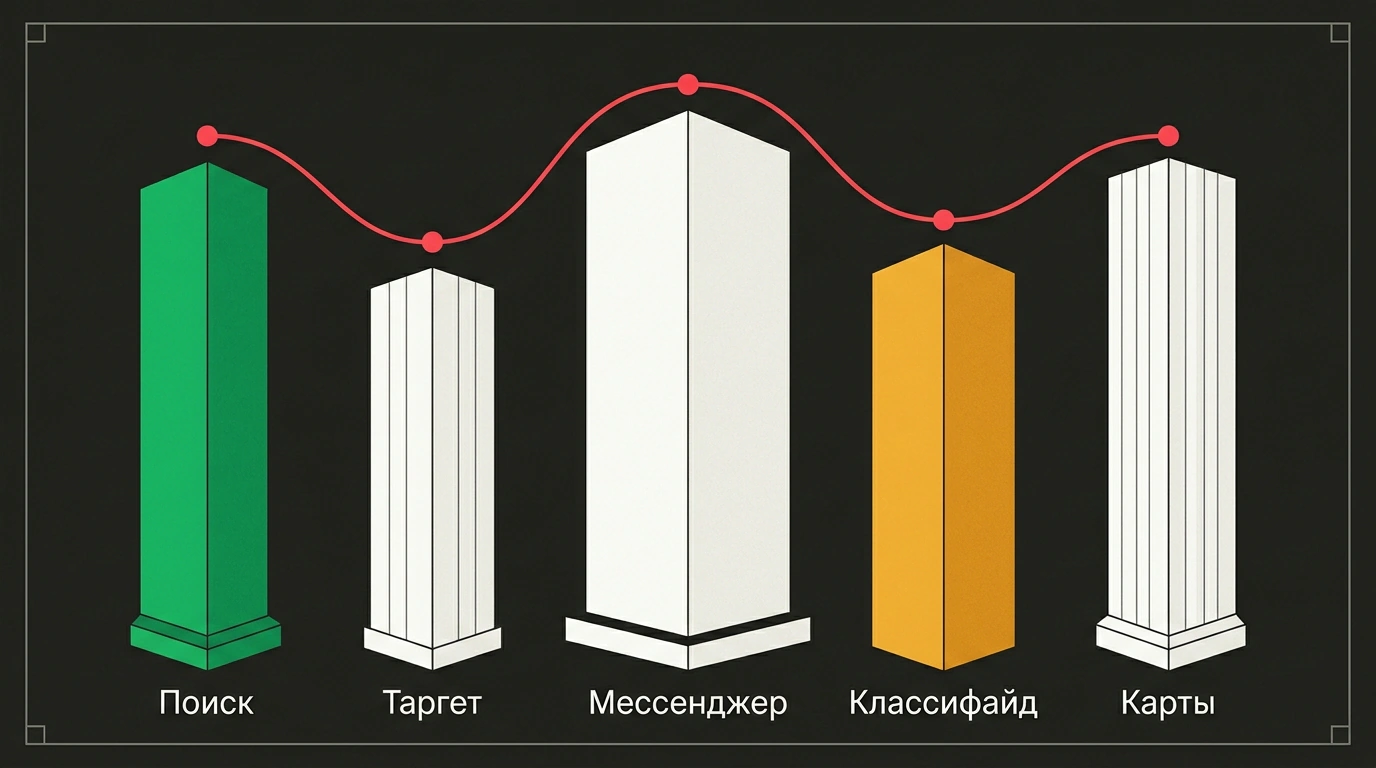
Take off the blinders and look around: the market offers at least five mature lead-generation channels:
- VK Ads (Next-Gen Targeting). Forget outdated stereotypes about a teenage audience. The new VK Ads platform unifies VKontakte, Odnoklassniki, Mail.ru properties, and a massive partner network. Its sharpest weapon is native Lead Ads. A user spots your offer in the feed, taps a button, and their name and phone number auto-fill from their profile. The lead drops into your CRM in two taps without ever leaving the app. Add surgical audience parsing—showing ads to people actively engaging in direct competitors' communities right now—and you get CPCs around 15–50 rubles with CPLs between 400 and 1,200 rubles.
- Telegram: Official Telegram Ads and Native Channel Placements.
The messenger has evolved into RuNet's primary business hub. Two mechanics work well here:
- Telegram Ads: Crisp text ads up to 160 characters pinned at the bottom of public channels. You can place your ad directly inside competitors' channels and intercept their loyal readers.
- Direct admin placements: Long-form sponsored posts featuring case studies, video, and links to chatbots. Expert content funnels in Telegram consistently deliver the highest average order values.
- Classifieds (Avito) for Services and B2B. Avito stopped being a secondhand flea market years ago. With over 60 million monthly users, it's the country's largest search engine for goods, wholesale, and local services. People go there with purchase intent already locked in—hiring repair contractors, renting heavy machinery, sourcing raw materials, or buying industrial equipment. Pricing ranges from classic CPC to paying strictly for qualified calls and messages (CPA).
- Geo-Services (Yandex Maps, 2GIS). If your business has a physical location, showroom, warehouse, or local service radius (dental clinics, auto repair, logistics, dining), map apps deliver the hottest traffic around. Users search for a service right near them ("lawyer nearby," "24-hour tire shop"). A branded map pin and priority placement in map search results convert into visits or calls at 8–15%—with zero per-click auction wars.
- SEO + GEO (Organic Search and AI Answer Optimization). Classic SEO for Yandex and Google now pairs with Generative Engine Optimization (GEO). More and more buyers ask AI assistants (GigaChat, Alice, ChatGPT) for recommendations. Getting your site listed in industry directories, expert media, and rankings puts your brand straight into AI-generated answers. Upfront costs are noticeable, but over a six-month horizon you build an evergreen stream of leads without paying for every click.
Comparison Matrix: Launch Timelines, Entry Budgets, and Real CPL
To compare these tools side by side, I put their key numbers into a single matrix:
| Traffic Channel | Launch Time | Entry Budget (RUB) | Average CPL (RUB) | Core Strength |
|---|---|---|---|---|
| VK Ads | 2–4 days | 15,000 – 30,000 | 400 – 1,200 | Fast hypothesis testing via Lead Ads |
| Telegram Ads | 3–7 days | 30,000 – 100,000 | 600 – 2,500 | Intercepting audiences in competitor channels |
| Avito (Services/B2B) | 1–2 days | 10,000 – 50,000 | 300 – 900 | Hot demand, instant inbound calls |
| Geo-Services (Maps) | 5–10 days | 20,000 – 60,000 | 250 – 800 | Local dominance in your neighborhood |
| SEO + GEO | 3–6 months | 100,000 / month | Drops to 100–300 | Compounding effect, zero per-click fees |
Don't try to launch all five channels in a single evening. If your budget is tight, pair one fast, high-intent channel (Avito or Maps) with one systematic nurturing channel (VK or Telegram).
The 70 / 20 / 10 Formula: How to Reallocate Your Ad Spend Safely
Diversifying doesn't mean pulling the plug on a working Direct account and dumping all your cash into unproven tests. Smart teams follow the ironclad 70 / 20 / 10 split:
- 70% of budget — Core Anchor. Your proven primary channel generating the bulk of predictable leads at a known cost. If that's Direct, keep 70% of your spend there to keep the sales team's pipeline full.
- 20% of budget — Scaling Channel. A second stable source that has already passed testing and proved profitable (for example, priority placement on Maps or VK Lead Ads). This buffer protects your business if the core anchor dips and lets you grow total volume.
- 10% of budget — Experimental Sandbox. Capital set aside to test fresh hypotheses without risking a cash crunch: sponsored posts in niche Telegram channels, display formats, or geo-campaigns in 2GIS. Every 3–4 months, one winner from this 10% bucket graduates into a full-fledged scaling channel.
Traffic Diversification Checklist
- Primary ad channel share is capped (no more than 70% of total budget)
- VK Ads Lead Forms tested using competitor community activity parsing
- Company profile on Avito is set up on a Pro plan
- Business listings on Yandex Maps and 2GIS are complete with a service showcase
- Ongoing customer review collection is active for organic SEO and map rankings
Marketing is financial risk management. Spread your bets across multiple channels, build a balanced traffic split, and stop dreading the next auction price hike.