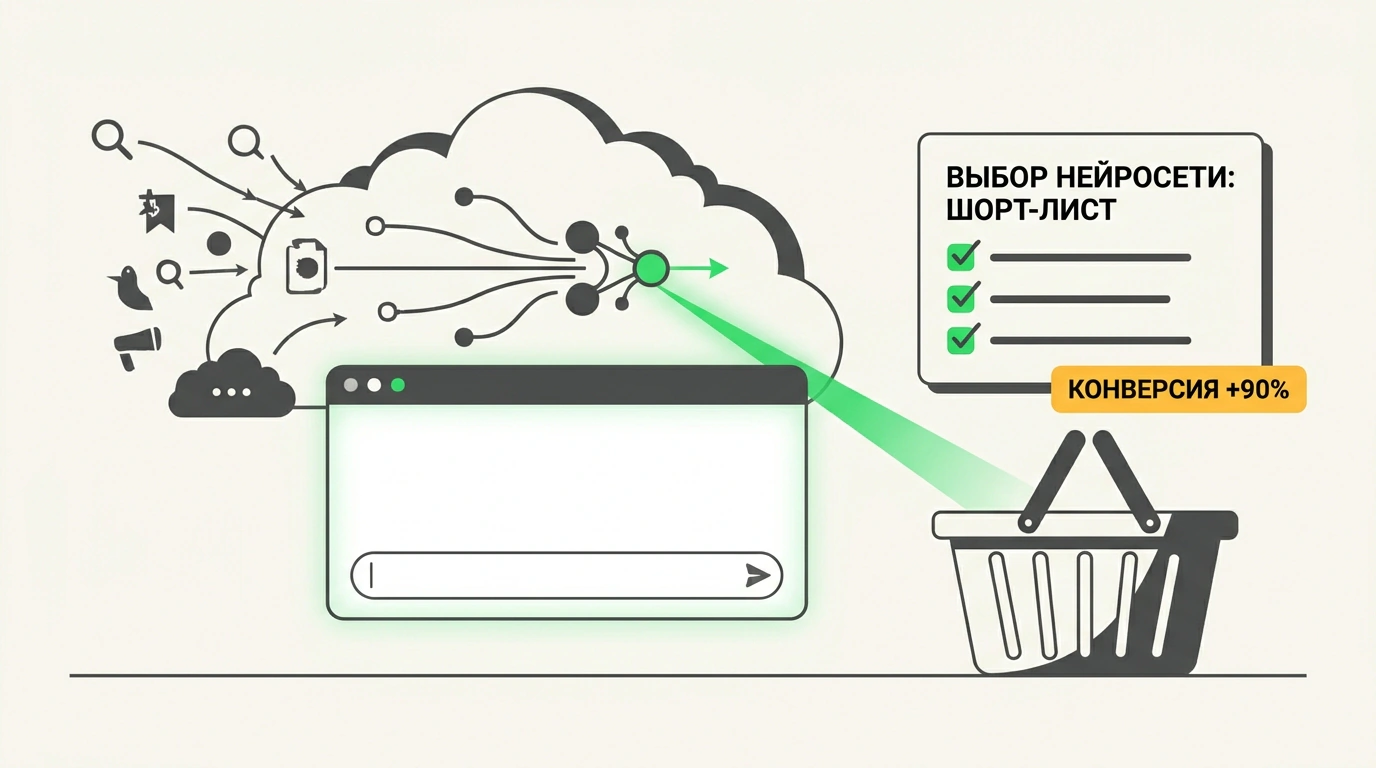
If you follow how search engines are evolving, you have surely noticed how rapidly user behavior is shifting. People are scrolling through pages of blue search-result links less and less, and increasingly asking complex questions to neural networks—Yandex Neuro, SearchGPT, and Perplexity.
Yet the most interesting shift is happening in commercial analytics. According to fresh research from Adobe Digital Insights, shoppers arriving at online stores via AI recommendations complete a purchase 90% more often than other users, and their revenue per visit is 83% higher. An Adobe Analytics report recorded that such customers spend 48–53% more time on sites and generate 37–53% more revenue per session. Russian data from end-to-end analytics platform UIS confirms the trend: visit-to-call-and-lead conversion from neural networks stands at 3.9% versus 2.3% for traditional search ads.
In a recent article on zero-click search and the shifting customer journey, we examined this fundamental habit shift in detail. Let's look at the mechanics: why a buyer coming from a chatbot converts twice as readily, and how businesses can adapt to generative optimization (GEO and AEO).
The Psychological Shift: How AI Removes the Chore of Comparison
In classic marketing, the customer journey consists of four stages: problem awareness, choosing a solution type, actively comparing alternatives on the market, and finally selecting a specific vendor.
Traditional search advertising catches a person at stage three: they click five ads, open five different tabs, drown in marketing promises, and try to reconcile specs in their head. This creates high psychological friction and doubt.
A neural network takes over the comparison stage entirely. The user types a prompt: "Recommend a reliable laser eye surgery clinic in Saint Petersburg with experienced surgeons and honest pricing." The language model cross-checks data, filters out clinics with poor reputations, and outputs a shortlist of two or three options with clear arguments. The person clicks a link already at stage four: their choice is practically made—they only need booking and payment. We covered practical steps for restructuring a website in our checklist for adapting a site to AI search engines.
Where AI Gets Its Arguments: Citation Analysis
Generative search researcher Alexander Krasnobaev ran a revealing experiment: he analyzed 631 citations in Yandex Neuro answers across 48 commercial queries from 15 different industries.
Here is the breakdown of sources:
- 36% of citations — publications in independent industry media and expert articles (VC.ru, Habr, Cossa, niche blogs).
- 34% of citations — official company websites (pages with licenses, price lists, and case studies).
- 19% of citations — map and geo-services with real reviews (Yandex Maps, 2GIS).
- 10% of citations — specialized directories and rankings.
The key takeaway: in two out of three cases, the argument on which a neural network convinces a buyer to choose your company is taken not from your own website, but from external authoritative resources. We explained how to build that visibility in our guide to adapting a business for generative AI and AI Overviews.
To make the generative shortlist, companies must stop relying solely on classic SEO. A real generative optimization strategy is built on placing structured, quantified facts (years of experience, exact warranty terms, percentage of successful cases) across external platforms and aggregators from which artificial intelligence draws its conclusions.