As the peak fourth quarter approaches—November sales, Black Friday, and the New Year rush—a familiar scramble begins in marketing departments. Brands urgently hunt for sales channels, and increasingly their gaze lands on micro- and nano-influencers (creators with audiences from 2,000 to 20,000 followers).
On paper, the logic looks appealing: mega-bloggers have become too expensive, their feeds are overloaded with sponsored deals, and audience trust has dropped. According to HypeAuditor, average Engagement Rate for nano-creators holds at 1.78%, whereas for mega-influencers it has fallen to a paltry 0.33%. Unsurprisingly, EMARKETER forecasts that in 2026 smaller content creators account for 45.5% of all direct industry ad budgets.
Yet when marketers try to scale work with a hundred micro-creators using traditional methods, the campaign turns into a nightmare. Let's examine the Influencer Marketing Hub study, see where the operational dead end lies, and look at how to shift from paying for useless posts to a manageable "UGC factory" model.
The Operational Hell of Manual Scaling
Working with five mega-bloggers is relatively simple: each has a manager, you sign five standard contracts, ship five samples, and track five posts.
Trying to get that same reach through a hundred micro-creators unleashes an avalanche of operational chaos:
- A hundred contracts and a hundred completion certificates.
- A hundred parcels with courier services and tracking numbers to monitor.
- Endless script approvals in messengers: one gets sick, another goes on vacation, a third forgets to mention the promo code, and a fourth shoots a horizontal video instead of vertical.
- Ad labeling bureaucracy: registering a hundred creatives in the ORD and collecting view-count reports.
In Later's holiday survey, twenty-seven percent of creators explicitly named delayed and chaotic communication from brands as the main barrier to a quality integration. And according to the Association of National Advertisers (ANA), 67% of marketers cite accurately measuring influencer impact as their hardest challenge. In a Linqia study, 79% of major brands admitted they cannot prove the ROI of one-off influencer posts.
And the cherry on top is social networks' algorithmic instability. Even if a creator makes a flawless review, the smart feed might show it to just three hundred users out of fifteen thousand followers. The brand paid the full integration fee and got zero return. In our piece on attribution models for influencer marketing, we detailed why one-off posts without end-to-end analytics turn into a blind spot for business.
The "UGC Factory + Whitelisting" Model: The New Economics of Collaboration
How do you break this vicious cycle? Market leaders have completely changed the paradigm. They stopped buying posts in micro-creators' feeds and started treating creators as a distributed factory for producing User Generated Content (UGC).
The mechanics are simple and elegant:
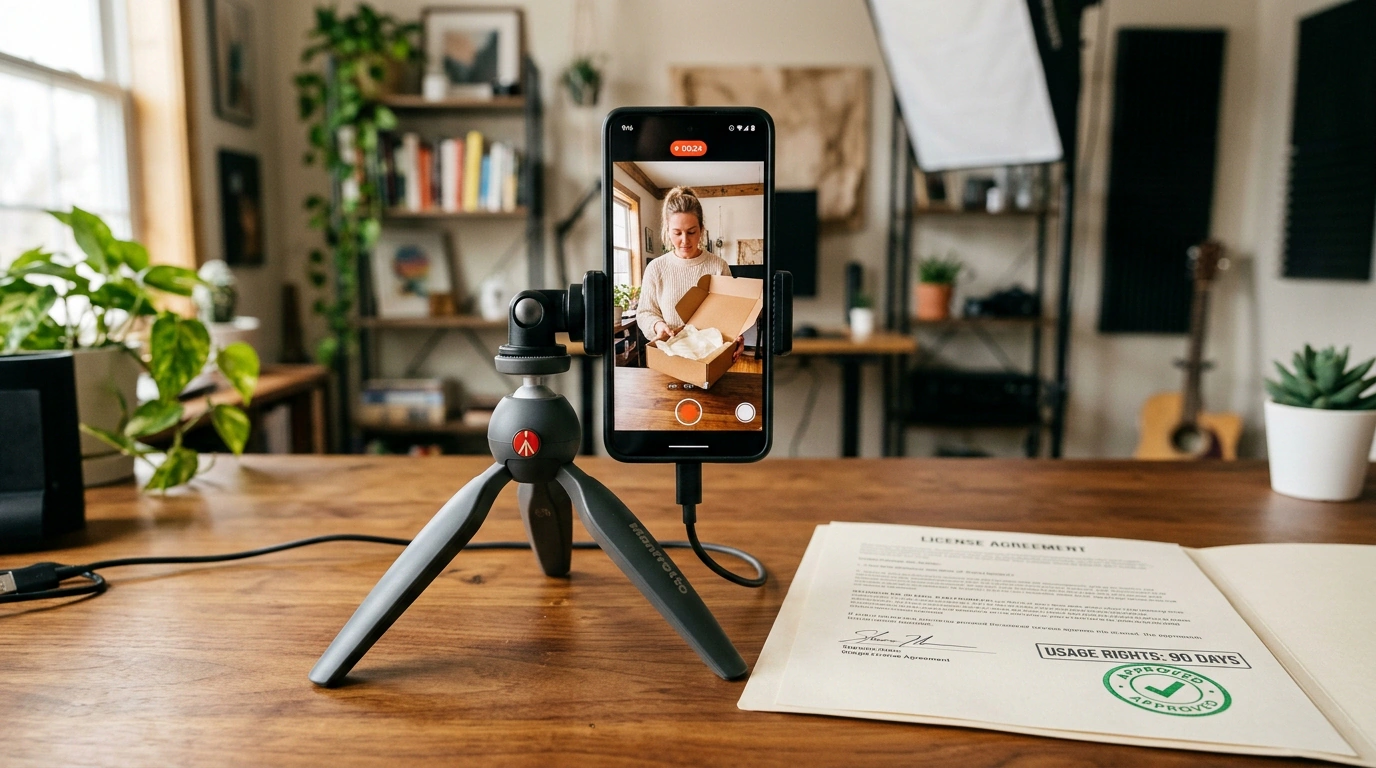
- The brand commissions a creator to produce a native video: an unboxing, an honest real-life test drive, a breakdown of an unobvious product feature, or a before-and-after comparison.
- The contract includes a clause buying commercial Usage Rights: the creator grants the brand a non-exclusive license to use their footage, likeness, and voice in targeted ads for 30–90 days.
- Whitelisting mechanics (in RuNet, running ads on behalf of the creator or the brand's official page in VK Ads and ad networks): the media buyer uploads the top-performing video into the ad account and runs it to a multi-million target audience using strict socio-demographic and behavioral targeting, paying per click and conversion.
Why does this approach beat studio shoots?
- Breaking through banner blindness. Users automatically scroll past glossy studio commercials, but linger on raw video shot on a smartphone front camera by an ordinary woman in a real kitchen or a guy in a garage. In our breakdown of AI-generated UGC vs. real creators, we noted that human authenticity remains the primary trust trigger.
- Production cost. Producing a native UGC video with a micro-creator costs a brand 5,000–15,000 rubles (versus 150,000–300,000 rubles for a custom production-studio shoot).
- Performance metrics. In targeted ads, CTR on raw creatives averages 40–80% higher, while cost per action (CPA) drops by 35–50% compared to standard banners.
Scaling work with micro-creators is only possible when processes are automated. In our analysis of influencer marketing at industrial scale based on L'Oréal's experience, we described how the beauty giant engages tens of thousands of creators using standardized public offers and automated payouts.
Process Standardization: Normal Path and Exception Path
An ANA survey showed that sixty percent of CMOs see standardizing creator onboarding and licensing agreements as the biggest lever for recovering wasted resources.
To keep the marketing team from drowning in chat threads, the workflow is split into two independent tracks:
- Normal Path. Work runs under a single standardized public offer agreement. The creator receives a strict technical brief: 9:16 vertical format, 20 to 45 seconds runtime, natural lighting, clean voiceover without background music, and a clear close-up of the product within the first three seconds. Payout triggers automatically once raw files are uploaded to cloud storage.
- Exception Path. A strict protocol for breakdowns: if a creator goes silent for more than 48 hours after receiving the product, the collaboration is automatically terminated and the slot goes to a backup creator from a reserve pool. Strictly one round of free revisions within the brief is allowed—endless creative debates are eliminated.
This systematic setup turns chaotic influencer buys into a controlled assembly line of high-converting ad creatives for peak sales season.