You have probably heard the tearful complaints in industry chats more than once: "Telegram is burning out, reach has collapsed, algorithms are throttling channels, nobody reads anything anymore." Sound familiar? Even I felt more than once over the summer that posts were disappearing into a void. But in marketing, there is an ironclad rule: if something feels off, open the numbers and check the methodology.
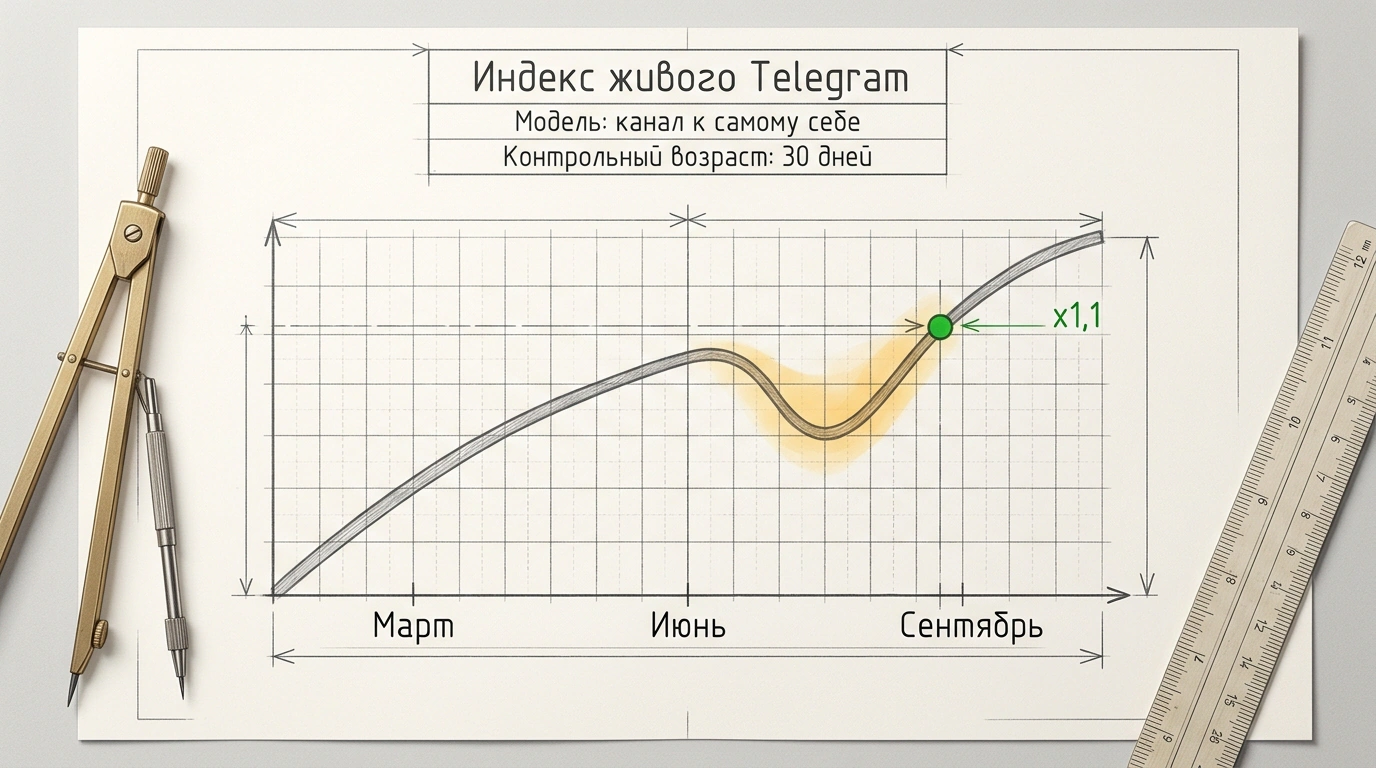
Analysts at the ad2sub service rolled out the pilot issue of the "Live Telegram Index" and methodically dissected this illusion. They took a dataset of 1,617 active Russian-language channels with audiences starting from 1,000 subscribers (2,301 resources were monitored in total) and compared identical posts from the first halves of March, June, and September 2026. The result was sobering for alarmists: a typical September post gathered 1.1 times more views than a comparable March post. The spread across different channel networks ranged from x1.03 to x1.18. There is no systemic degradation of the platform.
How False Panic Over Falling Reach Arises
Where, then, does this persistent sense of catastrophe among authors and ad buyers come from? The whole trick lies in a banal analytical mistake—comparing posts of different ages.
When a channel admin or media buyer opens a fresh post published 24 hours ago and compares it with a post from six months ago, the counter shows a drop to roughly x0.60. That makes it look as if the post lost 40% of its audience. Yet that calculation is fundamentally flawed. On Telegram, a post does not die after 24 hours. It has a long cumulative tail: posts keep accumulating views for weeks through internal search, forwards to private messages and closed work chats, reposts, and saved bookmarks.
To eliminate this distortion, ad2sub analysts normalized the sample and aligned every post to a 30-day benchmark age using a mathematical view-accumulation curve. They ran a "channel-to-itself" comparison, weighting metrics across a "posting frequency × audience size" matrix. Once the age factor was equalized, the myth of dying reach fell apart. Similar studies of engagement dynamics often overlook this cumulative tail, jumping to hasty conclusions from raw 48-hour snapshots.
Seasonal Swings and Contact Cost in Narrow Niches
That said, a drop in reach does exist, though it is purely seasonal. In summer, people go on vacation, check the messenger less often, and mute work notifications. In June, average reach across the sample dipped to x0.85 compared to March. Yet when business activity resumed in the fall, a strong rebound followed: in September, reach jumped by x1.26 over June, more than offsetting the summer slump.
At the same time, the depth of the summer dip varies dramatically by topic:
- Entertainment: x0.97 (196 channels). Entertainment content is always read—the dip was a negligible 3%.
- News: x0.88 (332 channels). A mild 12% decline in political and general news agendas.
- Education: x0.85 (160 channels). Traditional school and university breaks shaved off 15% of attention.
- Business and Marketing: x0.84 (116 channels). Business activity slows down, with the drop reaching 16%.
- Medicine and Health: x0.69 (111 channels). The steepest crash—minus 31% in reach.
For marketers and media buyers, this holds a critical practical takeaway: in niches like health, when a fixed post price stays unchanged, the effective cost per thousand impressions (CPM) and cost per view jumped by 45% in June. If you buy ads at a flat rate, evaluate your real CPL not two days after publication, but two weeks later, factoring in cohort-based catch-up reading. Telegram is alive; you just shouldn't confuse the audience's summer tan with a systemic crisis of the messenger.