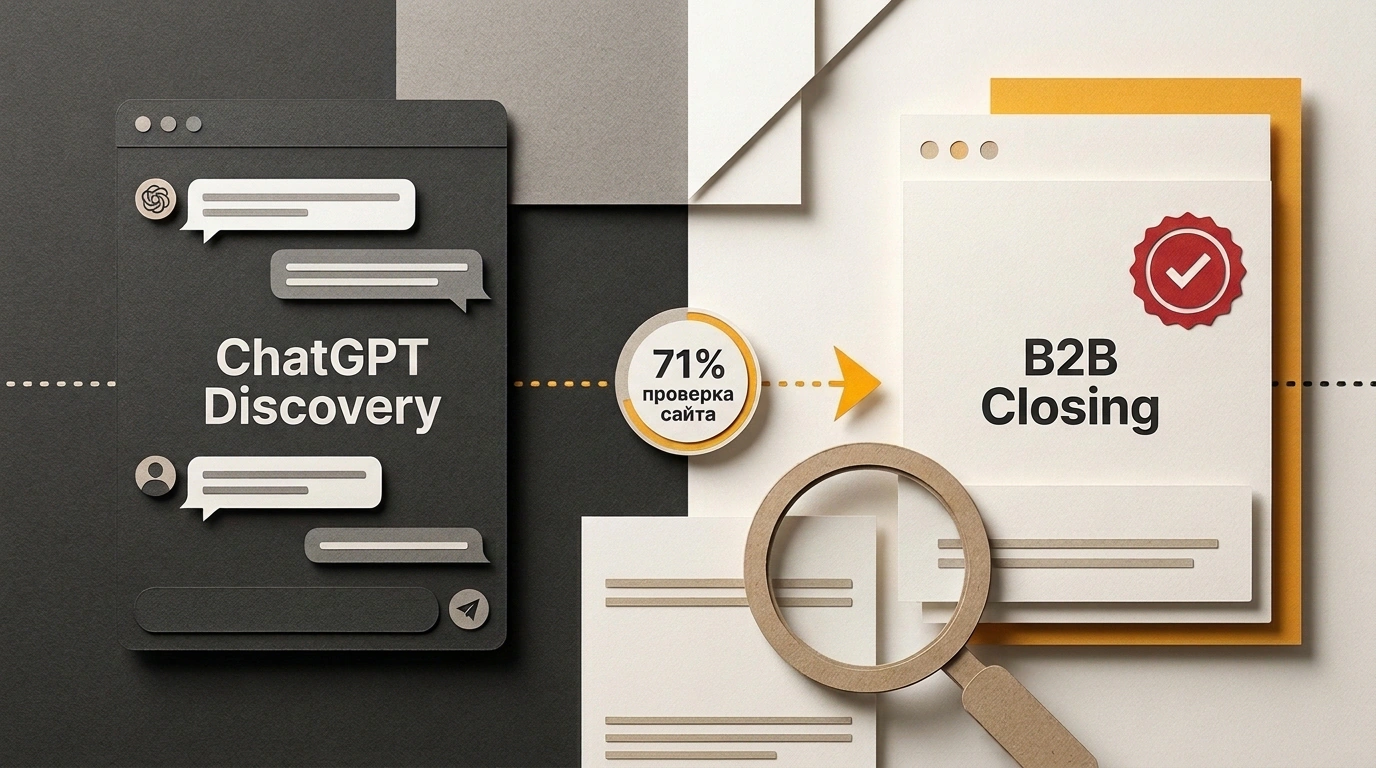
An apocalyptic forecast is growing louder in the marketing community: by 2027, traditional company websites will die out as a class. The logic of "zero-click" evangelists seems airtight: why would anyone click through to someone's website, wade through banners, and read promotional fluff when they can ask ChatGPT, Perplexity, or Claude and get a ready-made structured answer in three seconds?
In practice, however, this theory shatters to pieces. Neil Patel, founder of the global agency NP Digital, together with his research group, published a large-scale report based on real major-retail transactions and surveys of thousands of buyers. The study's conclusion is sobering: websites are not only not dying—their strategic value is growing. Yet their role is changing fundamentally: a website stops being a tool for initial discovery and becomes the decisive platform for trust validation and closing the deal (closing experience).
Let's break down the key data from the study and see what is actually happening with customer behavior.
The Walmart Experiment: Why Chatbots Make Poor Cash Registers
The main proving ground for testing purchases inside conversational AI was American retail giant Walmart. The retailer integrated around 200,000 products directly into the ChatGPT interface, allowing users to place orders right inside the chat window without leaving for an external website. It seemed like the long-awaited paradise of frictionless shopping.
Yet conversion measurements delivered a surprise:
- Purchase conversion inside ChatGPT turned out to be 3 times lower than with standard redirection of shoppers to Walmart's official website.
- Users happily browsed gift ideas or sports gear, but the final step of buying in chat triggered insurmountable resistance.
Retailer executives explained this phenomenon through UX specifics: in a chat window, a person is forced to buy strictly one item at a time. There is no familiar interactive cart where you can visually check the total, easily swap a color, toss in discounted add-ons, or apply accumulated loyalty points.
At the same time, generative AI showed fantastic efficiency in another area: new-audience inflow from ChatGPT conversations was 2 times higher than from classic Google search engines. In other words, AI proved to be a brilliant showroom consultant, yet a remarkably clumsy cashier. People discover products through a neural network, but prefer to buy in a familiar, controllable website interface.
Buyer Behavior: How B2B Vets AI Recommendations
While in the consumer segment a chat interface stumbles over the shopping cart, in the corporate sector (B2B) budget accountability enters the picture. NP Digital analysts measured the behavior of two control groups.
A survey of 2,084 generative search users revealed a clear pattern: when a neural network flatly names only one company, 49% of people take no action at all, suspecting paid placement or a hallucination. But when AI provides a comparative shortlist of three alternatives, 61% of users launch their own independent investigation. The neural network does not close the deal—it merely forms the initial shortlist.
Even more telling is a survey of over 500 American B2B buyers. When artificial intelligence recommends a specific contractor or vendor:
- 71% of buyers immediately go to the company's official website to double-check facts, review pricing, case studies, and technical documentation;
- 63% additionally cross-check the company in classic Google search;
- 38% deliberately look for independent reviews on external platforms.
In B2B, a company's website becomes the main safety filter. If a neural network praises your service, but a prospective client clicks through and sees an outdated design, missing prices, or an empty "About Us" page, trust evaporates in a second.
The Web Analytics Paradox and Hidden Branded Traffic
You might reasonably object: "I open Google Analytics or Yandex Metrica, and referrals from neural networks are fractions of a percent. What AI impact are we even talking about?"
That is a dangerous illusion. Wix analyzed a dataset of more than 300 million websites and confirmed: direct referral traffic from OpenAI domains and other AI services indeed does not exceed 1%. But the whole secret lies in a delayed effect. According to NP Digital, across 1,000 ChatGPT sessions, 31% of users examine the suggested brands in detail, yet only 18% click links inside the chat. Most people read the recommendation, close the chat, and a day or two later type the company name into a search bar or navigate directly to the site URL.
In analytics, these visits are mislabeled as Direct or Organic Search. Yet their nature has changed. Adobe Digital Insights recorded a tectonic shift: whereas a year ago traffic arriving after AI interaction converted 38% worse than site average, today those users buy 42% better than average. A customer coming from AI arrives maximally warmed up—they only need to confirm the terms and hit the pay button.
Answer Engine Optimization and a Two-Minute Express Audit
How do companies earn a spot in generative engine answers? A widespread myth claims AI recommends only globally famous brands. NP Digital survey numbers say the opposite:
- Only 7% of buyers pay attention to a recommendation because of brand awareness;
- 53% choose a company because its offering precisely matched their narrow use-case.
Traditional SEO is giving way to Answer Engine Optimization (AEO). To check where your business stands, Patel recommends running a quick test (2-Minute AI Audit):
- Type your ideal customer's question into ChatGPT, Claude, or Gemini: for example, "Best inventory accounting system for a 3-location shoe store."
- Check two things: whether your company appears in the answer, and how accurately the neural network states your pricing tiers and specialization.
- Check your site snippets via Google Rich Results Test for structured microdata.
- Build out pages on your site for narrow use-cases and gather at least 50 verified customer reviews—that threshold dramatically boosts a resource's authority for language models.
In our guide on preparing a B2B website for chatbot recommendations, we detailed the steps of a GEO audit, and in our piece on rebuilding business visibility in generative search, we unpacked the mechanics of search neural networks. Don't bury your website—turn it into a flawless deal-closing tool while algorithms bring new audiences to your door.