Promoting a technically complex, high-ticket service on social media is a task where even experienced entrepreneurs and marketers often stumble at first. When you sell an everyday product like food delivery or tire fitting, the customer journey fits into a single impulse: see the benefit, click, order. The moment you enter a market like serious training or specialized equipment, direct-response ads stop working. You launch upbeat ads telling people to sign up, and get silence—or questions from people who know nothing about the field.
I broke down a case study by targeting specialist Ivan Nemtsev, who was approached by a company in the unmanned aerial systems sector. The client sells drones and components, trains operators to fly unmanned aerial vehicles (UAVs) in Saint Petersburg and the Leningrad region, and implements business solutions. After unsuccessful runs with previous contractors, the challenge was clear: how to build manageable VKontakte ads for a complex product, break through skepticism, and cut cost per lead by more than half without hard selling?
Why Pilot Courses Don't Sell on the First Click and Where Competitors Burn Out
The main reason cookie-cutter launches stall here lies in the nature of demand. Neither drone pilot training nor equipment purchases close on the first touch. Before submitting a lead, a person needs to understand the subject, see the difference between training programs and aircraft types, compare prices, and trust the school's credibility.
On top of a long sales cycle come an overheated market and skepticism: people are cautious about expensive courses and buying gear from unfamiliar companies, and commercial schools also have to compete with free training options. If an ad doesn't immediately explain what the client is paying for and why an instructor-led course beats trying to learn alone, users scroll right past it.
When Ivan Nemtsev studied competitors' ads, it became clear where their budgets were burning. Most ads fell into one of two extremes:
- Generic slogans and hard-sell pitches. Players churned out promises like "training from scratch" and "quality drones," trying to sell with zero warm-up.
- Dry jargon overload. Other ads dumped technical specs while barely explaining the value of the offer.
Platform regulations add another layer on top of market barriers. Under VK Ads moderation rules, promoting drones and operator courses must stay within a peaceful, civilian, and engineering context—aerial photography, mapping, sports, or agricultural monitoring—without militarized imagery, and issuing certificates requires an educational license. That rules out flashy gimmicks and demands expert positioning.
Multi-Layer Segmentation on VKontakte: From FPV Enthusiasts to Corporate Buyers
When an audience is this diverse, running one broad regional campaign is a surefire way to collect expensive, off-target leads. In Saint Petersburg and the Leningrad region, very different people take an interest in drones: a beginner, an experienced pilot, and a company director are all solving different problems.
So the targeting specialist split prospects into four layers by interest level and readiness to inquire:
- Search keywords across frequency tiers. Users with formed demand searching to buy drones, parts, or UAV training.
- Subscribers of niche communities. Members of aerial photography and model aircraft groups, plus fans of first-person-view (FPV) drones flown through video goggles.
- Direct competitors' audiences. Followers of commercial flight schools and gear stores who are already comparing programs and pricing.
- B2B, NGOs, and startups. Organizations that need drones for business tasks: agricultural imaging, cadastral surveys, and facility monitoring.
Separate entry points were launched for different lines: community subscriptions, group messages, lead forms, product promotion, and website traffic. This made it possible to test which format prompted people to start a conversation more readily and where qualified demand was forming.
Real Graduates Instead of Plastic Renders: How Native Delivery Eases Beginner Anxiety
When testing visuals and copy, the client set one strict rule: no aggressive ads or provocative hooks. It was in testing lead forms and posts that the contrast emerged—the one that defined the campaign's economics.
Classic product creatives with drone renders and spec sheets underperformed. Look at the image through an ordinary person's eyes: a studio shot of the aircraft triggers not a desire to buy, but an internal brake. The gear looks fragile and expensive, and a beginner's biggest fear is simple: "What if I pay for the course and crash someone else's drone on day one, or can't handle the controller?"
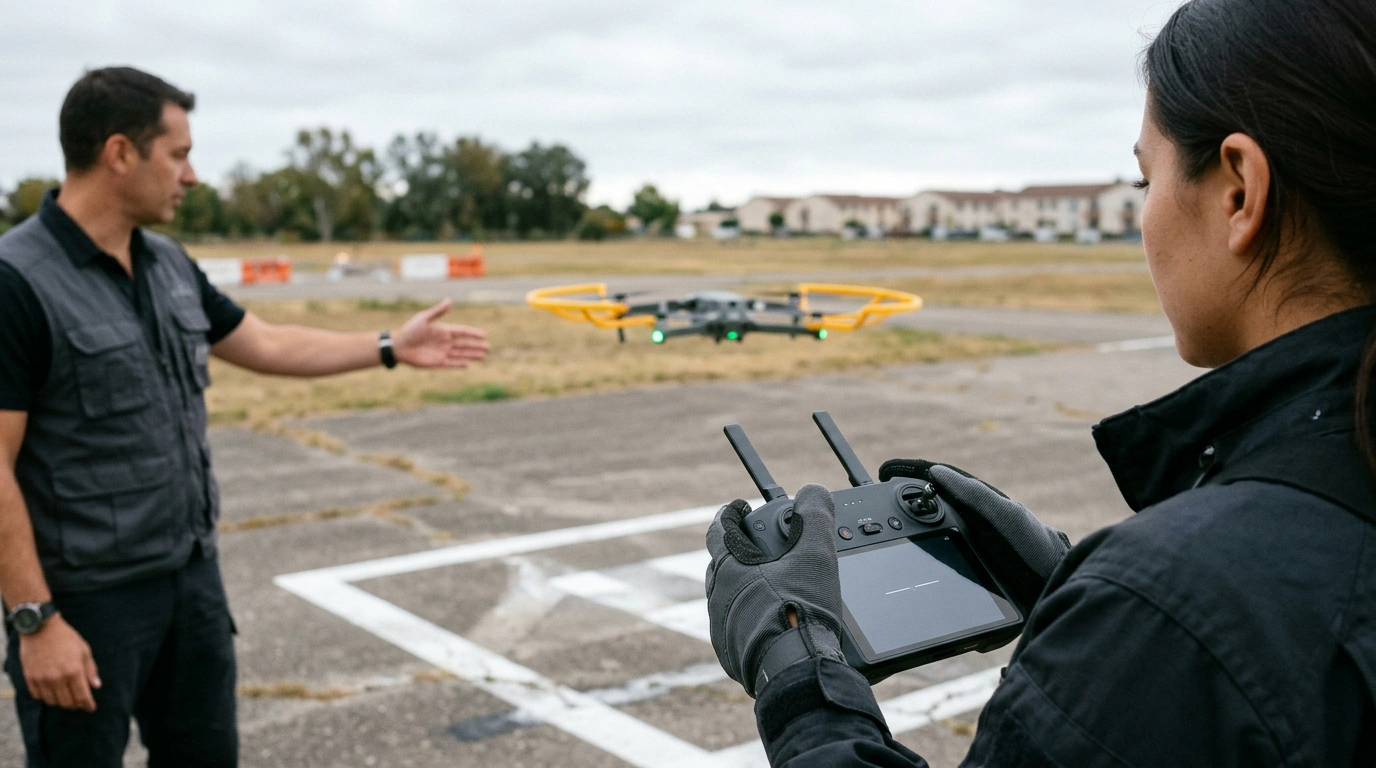
The strongest response came from photos of real graduates holding drones during hands-on training sessions, paired with calm, native copy. Clean visuals, a clear headline, and a useful offer looked like regular feed content on VKontakte rather than an ad—and complied with VK Ads' rule keeping text under 20% of the image area. In the copy, the specialist helped readers figure out which training format or product fit their skill level.
Why does this tactic from a Saint Petersburg UAV school work just as well for any complex service—from technical courses to B2B integrations? A product render only proves you have inventory in a warehouse. The face of a real graduate holding a drone provides social proof: someone just like you has already completed the training and holds the aircraft with confidence. When the visual eases the fear of failure and clear copy helps the reader orient themselves before clicking, empty inquiries drop off and cost per lead falls.
Campaign Economics in Numbers: How Cost Per Lead Dropped from 1,745 to 815 Rubles
Combining segmentation, graduate photos, and native entry formats showed up immediately in VK Ads metrics. Let's check the project math from Ivan Nemtsev's data:
- 53.3% drop in cost per lead (CPL). In training campaigns, the cost of a qualified lead fell from 1,745 ₽ to 815 ₽. On every ten leads, the business started saving over nine thousand rubles.
- Cost per click (CPC) optimized to 22–48 ₽. Depending on format and segment, click cost dropped by up to 64.7%, settling in the 22–48 ruble range.
- Steady click-through rate (CTR) at 0.48–0.52%. In a narrow niche geotargeted to Saint Petersburg and the region, a half-percent CTR confirms the creatives cut through banner blindness without burning out.
- Higher website engagement. Traffic campaigns with a 0.18% CTR improved behavioral metrics: average time on page grew from 30 seconds to 1 minute 20 seconds, and bounce rate fell to 24%.
The gap between lead forms and the website shows how a non-impulse funnel works: a site visitor spends a minute and a half studying the program, but needs extra nurturing to submit a form on the landing page, whereas VKontakte lead forms and messages lowered the entry barrier and delivered leads at 815 rubles. For the next phase, the team planned to reinforce the VK funnel with vertical videos, flight Stories, expert posts, and retargeting. A similar lift from ditching template banners for real-life visuals appears in the children's IT school case that cut lead costs by 40% and in a breakdown of rebuilding creatives for the ready-mix concrete niche.
If you promote a complex product, training program, or high-ticket service, open your ad dashboard in the next ten minutes and check your most expensive ad by cost per lead. If the banner shows a product render or a "training from scratch" slogan, pause it: swap the image for a live photo of a real client or graduate in action, and in the opening lines calmly explain who your format fits and what simple conversation in a lead form or chat starts the selection process.