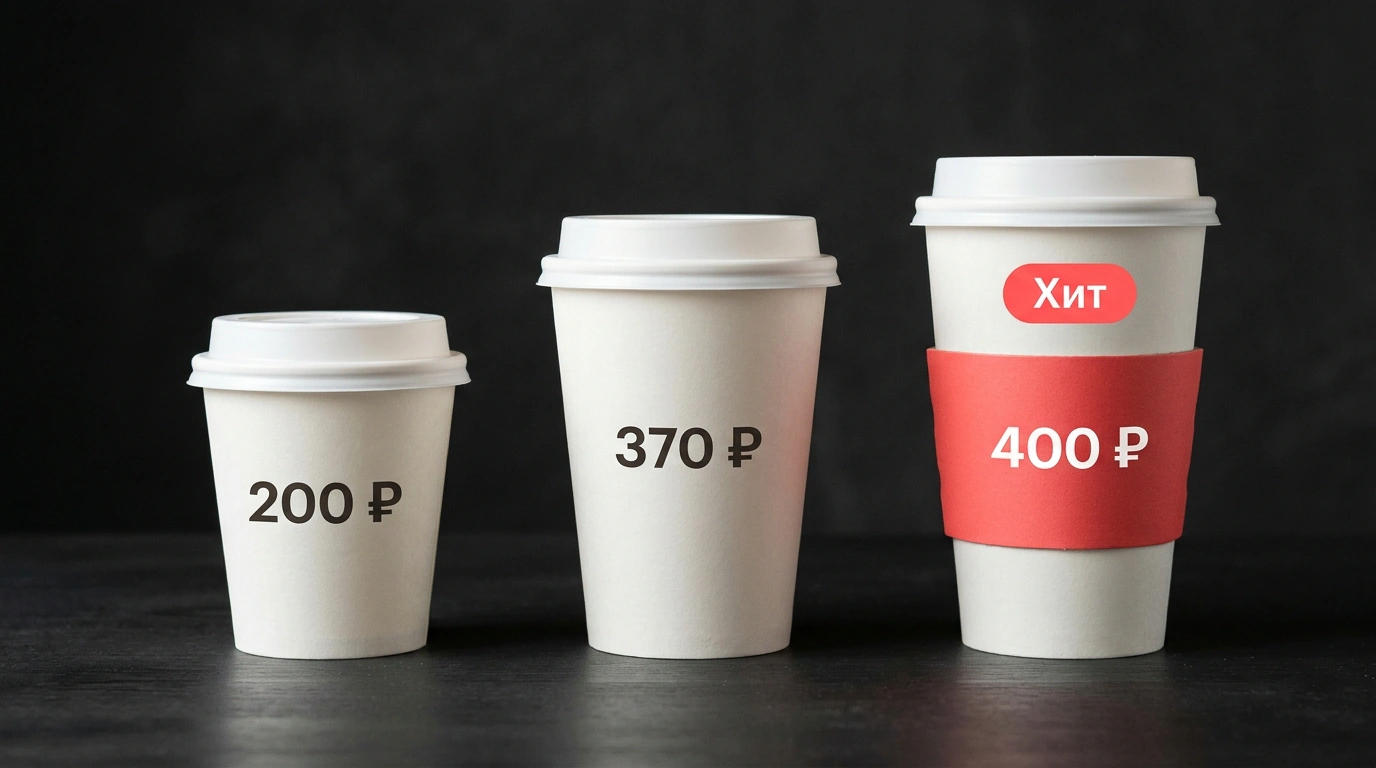
You add a clearly poor-value tier to your price list that almost nobody is meant to buy. Right away, your most expensive package starts selling noticeably more often, even though its price didn't drop by a single cent.
It sounds like a trick, yet behavioral economics drives the shift. Let's unpack where this mechanism comes from and why a standard two-option price list quietly caps your revenue.
Why a Two-Line Price List Squeezes Margins
Picture a simple software subscription: a basic plan for $50 and a premium plan for $100. The buyer sees a twofold jump and tries to judge the features in a vacuum. Is paying an extra $50 really worth it? It's hard to tell at a glance.
The brain dislikes that uncertainty and picks the lowest financial risk. In a breakdown on vc.ru, the author gives the example of a coffee shop with two sizes: a small 200 ml cappuccino for 200 rubles and a large 400 ml for 400 rubles. The price per milliliter is identical, yet 70% to 80% of guests order the small cup.
It seems like adding an obviously weak third option shouldn't change anything, because a rational buyer would just ignore it. In practice, the opposite happens.
Joel Huber, John Payne, and Christopher Puto first described this effect in 1982, and Dan Ariely later popularized it using The Economist subscription, as covered in The Decision Lab's overview. When students were offered two choices—web-only for $59 and a "print + web" bundle for $125—68% picked the cheap web plan, and only 32% paid extra for the full bundle. Then Ariely added a third line: print-only for the same $125. Next to that absurd alternative, the share choosing "print + web" jumped from 32% to 84%.
How the Decoy Works vs. the Compromise Effect
Let's sharpen the theory and use the same coffee shop to compare two different ways of nudging a guest off the cheap cup.
The first method is the compromise effect. You put three evenly spaced sizes on the menu: 200 ml for 200 rubles, 300 ml for 300 rubles, and 400 ml for 400 rubles. Guests gravitate toward the middle: ordering the smallest feels stingy, while paying for the largest feels excessive. Average ticket rises, yet the flagship stays on the sidelines.
The second method is the decoy effect, or asymmetric dominance. Here, the medium 300 ml cup costs 370 rubles, sitting right next to the large one at 400 rubles.
The comparison scale in the buyer's head resets instantly. They no longer compare the 400-ruble large cappuccino against the 200-ruble small one. The new reference point is the 370-ruble medium cup: getting an extra 100 ml costs just 30 rubles more. Picking the top option feels like a smart deal and brings satisfaction instead of buyer's remorse.
Going back to our subscription example, if you place a $95 decoy with stripped-down features between the $50 basic plan and $100 premium plan, that $5 gap makes the $100 package an obvious winner. Case studies on vc.ru show this pattern across niches:
- A car wash puts a "Standard" wash for 2,000 rubles (without tire dressing, wax, or interior glass cleaning) between a 1,000-ruble basic wash and a 2,200-ruble full package.
- An electronics store places a 256 GB smartphone without a charger for 53,000 rubles next to a 128 GB model at 45,000 rubles and a 256 GB bundle with fast charger and case at 55,000 rubles.
- An agency inserts a two-channel plan with infrequent reporting for 85,000 rubles between one channel at 50,000 rubles a month and three channels with a dedicated strategist at 95,000 rubles.
Pricing Grid Math and Where the Tactic Breaks
To push buyers toward your flagship without accidentally selling too many decoys, price the decoy at 85–92% of the target tier while keeping its value around 60–70%. Leave roughly a 2x gap between the basic plan and the decoy, and keep the step up to the flagship within 8–15%. For example, a beauty studio added a "Comfort" manicure at 2,500 rubles and an "All-Inclusive" spa and nail-art package at 2,800 rubles above its 1,800-ruble base option. That 300-ruble gap at the top doubled to tripled the share of top-tier bookings.
To speed up decisions on your pricing page, highlight the flagship with a "Best Value" or "Most Popular" badge, and keep the entire grid to three or four tiers. Five or more options trigger choice paralysis.
This tactic only works within clear boundaries. A cartoonish gap—like 200 ml of coffee for 200 rubles versus 210 ml for 390 rubles—reads as manipulation and destroys trust. In currency exchange or brokerage fees, decoys are completely off-limits: in finance, clients demand linear transparency without artificial steps. Finally, marketing case studies measure average ticket on the first purchase, not renewal churn, so your top package still has to earn its price tag.