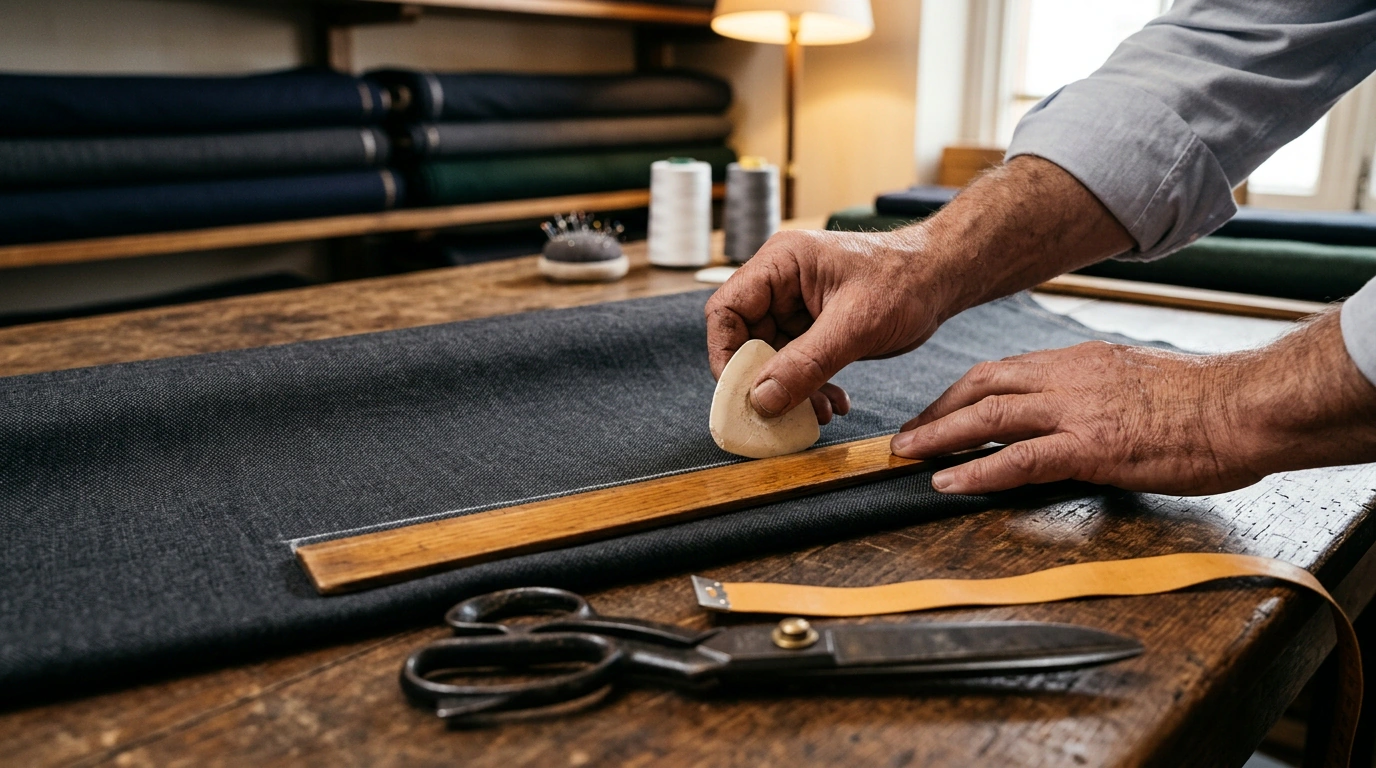
There's a stubborn myth floating around men's style: "Fit is everything in a suit; the fabric doesn't really matter." The idea is you can take a cheap polyester suit off a fast-fashion rack to a good tailor, have him slim the sleeves and take in the waist, and walk out looking like a million bucks.
Hate to break it to you, but that's a massive trap. A tailor can fix shoulder geometry and trouser length, sure—but he can't rewrite the physics of fabric. Cheap synthetics and low-grade blends simply cannot drape properly. They hang stiff, crease awkwardly, start pilling almost immediately, and develop a shiny, cheap sheen across the elbows and seat after one dry cleaning. A 10,000-ruble suit with razor-sharp alterations still screams "budget" from across the room.
Stylist Andrey Mayfair, in his breakdown of suiting mills, drives home the real foundation: wool quality is what determines depth of color, breathability, and how a suit moves with your body.
When you spot impeccably dressed men walking through Milan or London, their silhouette starts with cloth from historic European mills:
- Loro Piana (Italy): the global benchmark for cashmere, vicuña, and effortless "quiet luxury." The cloth breathes, feels unreal to the touch, and creates a soft, natural line.
- Ermenegildo Zegna (Italy): the textile powerhouse whose Trofeo line sources ultra-fine merino wool from top farms in Australia and New Zealand every year.
- Fox Brothers (Somerset, England): a legendary mill running since 1772—the people who practically defined heavy, authentic flannel and indestructible British tweed.
- Drapers and Vitale Barberis Canonico (VBC, Italy): famous for their Lady Sanfelice flannel and worsted wools, widely considered the sweet spot for durability, abrasion resistance, and fair pricing.
- Scabal and Dormeuil: elite Franco-British cloth houses offering rare patterns and heavyweight overcoat cashmeres.
Suit labels love tossing around numbers like Super 100s, Super 130s, or Super 150s. Plenty of guys assume that measures fabric thickness or durability. In reality, the International Wool Textile Organisation (IWTO) uses it to grade average wool fiber diameter in microns (µm):
- Super 100s: roughly 18.5 µm fiber. Tough, springy wool that shrugs off daily friction.
- Super 120s–130s: around 17.5 µm. The sweet spot of subtle matte luster, softness, and everyday practicality.
- Super 150s and up: ultra-fine fibers under 16.25 µm. Silky and luxurious, yes—but finicky: it wrinkles fast, wears out under heavy friction, and needs 24–48 hours of rest on a hanger between wears to recover. A Super 180s suit belongs on red carpets, not on the morning subway.
So what's the real difference between worsted wool and cheap polyester? Worsted yarn is spun from long fibers combed strictly parallel. The resulting thread is smooth and dense, which is why pure wool resists pilling. Polyester is built from short synthetic fibers that work loose with minor friction and twist into ugly little fuzz balls.
- Composition: 100% pure new wool. Up to 1–2% elastane for stretch comfort is fine. If the tag reads more than 10–15% polyester, walk away—you'll be wearing a portable sauna.
- Yarn grade: aim for Super 110s–130s from a respected mill (VBC, Reda, Drapers).
- Fabric weight: for a year-round all-rounder, look for 260–300 g/m². Anything below 220 g hangs like a bedsheet, while anything over 380 g is strictly for freezing winter weather.
If you're under 25, there's zero reason to go into debt for bespoke Loro Piana. The smart play is buying a well-made off-the-rack suit in pure mid-twist Italian wool and having a sharp tailor dial in the sleeves and trouser hem. That way, the fabric works for you—projecting taste and poise with every step.