Walk into any commercial gym at seven in the evening and just look around. You'll see dozens of strong young guys cinching stiff leather lifting belts as tight as they go, wrapping their knees in thick elastic bands, and between sets rubbing their aching shoulders or hanging from a pull-up bar trying to "decompress" a throbbing lower back.
Old-school gym culture still clings to a toxic slogan from bodybuilding's golden era: "Pain is just weakness leaving the body." Meaning if your lower back aches after deadlifts, you're supposed to grit your teeth, slap on a warming patch, and "strengthen" the area with even more load next set. By twenty-five, that same lifter is staring at an MRI report in shock: L4–L5 and L5–S1 disc protrusions, patellofemoral knee degeneration, and subacromial shoulder impingement.
European Classic Bodybuilding Champion Stanislav Lindover and sports neurologist and rehab specialist Dmitry Gorkovsky teamed up for a deep breakdown of how the gym turns from a health factory into an injury conveyor belt. Let's unpack the biggest biomechanical myths quietly wrecking your joints—and see how to train hard, build an aesthetic physique, and stay pain-free.
The 'textbook form' trap: why your own anatomy beats generic rules
The first trap beginners fall into is blind faith in one universal "golden form" pulled from dusty textbooks or viral fitness clips. You hear: "Feet strictly parallel, knees never pass your toes, squat rock-bottom, keep your spine straight as an arrow."
In real human anatomy, no universal template exists. The shape and depth of the hip socket (acetabulum) can differ dramatically between two guys of the exact same height. One guy has deep, forward-facing sockets—he physically cannot hit a deep narrow-stance squat without painfully pinching his femoral neck. Another has shallow, outward-facing sockets—he needs a wider stance with toes turned out.
Factor in femur length relative to torso length: a long-legged guy with a short torso who tries to squat "by the book" will inevitably pitch forward, overloading his sacrum and lower back. Forcing someone else's form onto your own skeleton is a fast track to chronic connective-tissue inflammation.
Myth #1. 'Strengthening' a sore lower back with hyperextensions: how facets and discs get crushed
What does the average floor trainer tell you when you mention lower-back soreness after squats? "Your spinal erectors are weak—hop on the Roman chair and knock out hyperextensions holding a plate."
Dmitry Gorkovsky calls that advice borderline malpractice. If your lower-back pain stems from facet joint syndrome (arthritis of the small posterior spinal joints) or a posterior disc bulge, arching your spine under load creates brutal compressive force across the facets and pinches nerve roots. Instead of relief, you trigger acute swelling and muscle spasm.
When lower-back pain flares up, loaded spinal extension is strictly off-limits. Your spine doesn't need motion—it needs isometric stability. Swap dynamic arching for drills that train neutral-spine bracing:
- Dead bug: stabilizing your lumbar spine flat on the floor while extending opposite arm and leg.
- Forearm plank: focusing on deep transverse abdominis and glute engagement with zero hip sag.
- Glute bridge: lifting your hips strictly to a straight shoulder-hip-knee line without hyperextending your lower back.
The real skill for spinal safety is generating intra-abdominal pressure (IAP). That doesn't mean sucking your stomach in; it means taking a diaphragmatic breath "into your sides and lower back" before each rep and bracing your core tight—like you're bracing to take a punch to the gut.
Myth #2. Never letting knees pass your toes: Andrew Fry's experiment and 1,000% more hip/back torque
"Watch your knees—don't let them cross your toes!" Practically everyone who's ever touched a barbell has heard that line. The fear of knees traveling forward has haunted gyms for decades.
Isometric biomechanical diagram showing spinal and knee load distribution during a barbell squat.
Let's look at the classic biomechanical study by Professor Andrew Fry (Fry, Smith, & Schilling), published in the Journal of Strength and Conditioning Research. Researchers compared two barbell squat styles in experienced lifters:
- Unrestricted natural squat: knees traveled freely past the toes. Knee joint torque measured 150.1 N·m, while hip/lumbar torque was just 28.2 N·m.
- Restricted squat: researchers placed a vertical wooden barrier in front of the lifters' shins to block forward knee travel.
What happened to the forces? Knee torque dropped by a modest 22%—down to 117.3 N·m. But to keep from falling backward, the lifters had to lean their torsos sharply forward. As a result, torque on the hips and lumbar spine exploded more than tenfold—skyrocketing to 302.7 N·m!
Trying to "save" your knees a couple dozen newton-meters ends up hammering your lower back with shear forces ten times higher than normal. For anyone with long femurs, letting the knees travel past the toes is the only way to keep the torso upright.
Myth #3. Deadlifts and spinal neutral: why conventional pulls aren't for everyone
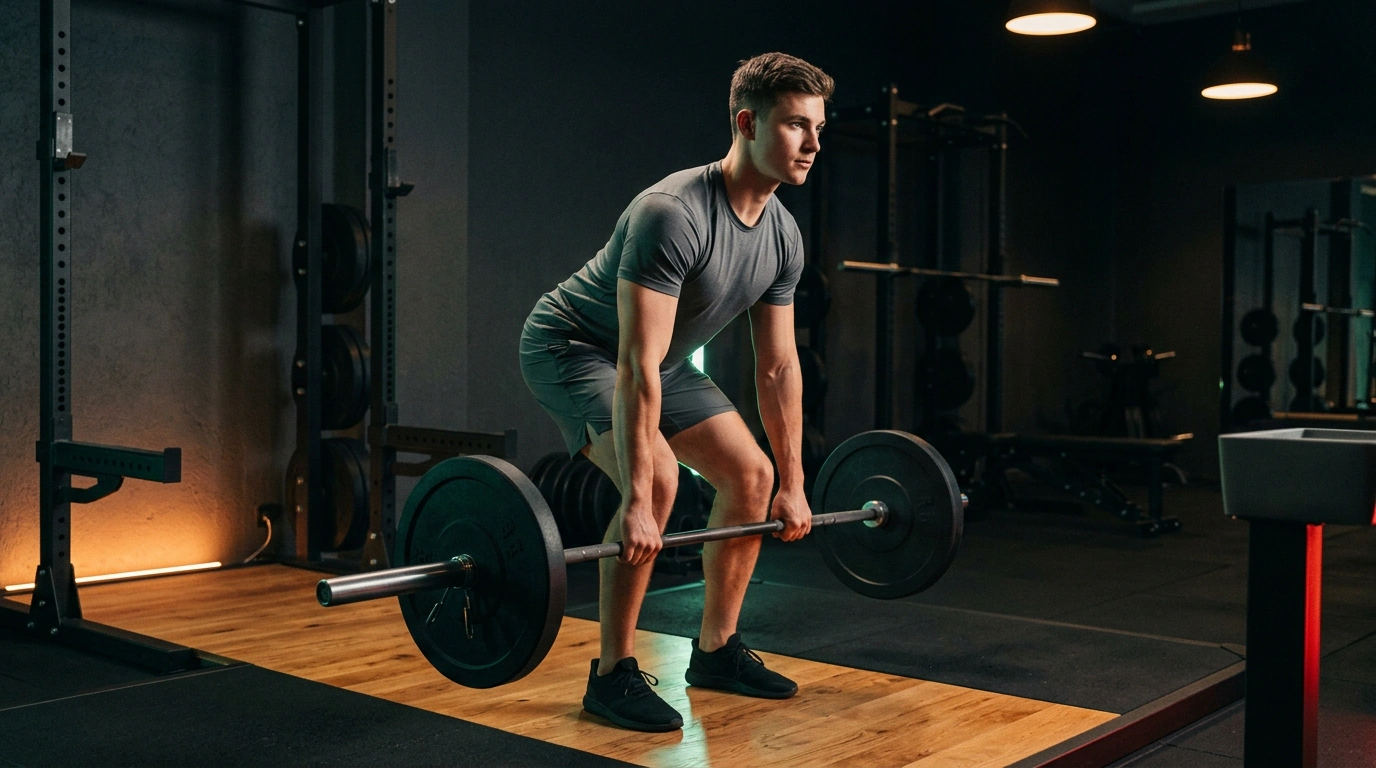
Spinal neutral means preserving your spine's natural S-curve (cervical and lumbar lordosis, thoracic kyphosis) from the first inch of the pull to lockout. Herniated discs don't happen because of bar weight alone—they happen when the lower back rounds under load, squeezing the front edges of the vertebrae together and pushing the gel-like disc nucleus backward toward the spinal cord.
If long femurs and tight hips prevent you from reaching a bar on the floor with a flat back in a conventional stance, ditch conventional deadlifts. Switch to sumo deadlifts (wider stance, toes turned out) or use a trap bar (hex bar). With a trap bar, the handles sit at your sides, the load's center of gravity aligns directly with your body's center of mass, and axial shear on your lower back drops dramatically while your legs and back still get a massive stimulus.
Your shoulders on the bench press: dodging subacromial impingement
The second most common gym injury after a blown-out lower back is shoulder pain from bench pressing or dumbbell flyes. A guy lowers the bar with his elbows flared out at 90° to his torso (forming a "T" shape), and within a couple of months he can't raise his arm overhead without a sharp, stabbing pain.
The mechanics are brutally simple: at a 90° flare, the head of the humerus jams the supraspinatus tendon and subacromial bursa directly into the acromion of the shoulder blade. That creates subacromial impingement syndrome—chronic micro-tearing and inflammation of the rotator cuff.
Lock down these three rules to protect your shoulders for life:
- Retract and depress your shoulder blades: before unracking the bar, pinch your shoulder blades together and pull them down toward your back pockets. That opens the subacromial space and gives you a rock-solid base.
- Use the arrow angle (45–60°): tuck your elbows at roughly 45–60° relative to your torso. Viewed from above, your upper body should look like an arrowhead, not the letter "T."
- Skip extreme ranges: cut out heavy behind-the-neck presses and behind-the-neck lat pulldowns. Human shoulder joints aren't built for heavy loading in extreme rear planes.
The illusion of passive fixes: why massage and tape won't work without fixing movement
When a joint starts hurting, most lifters run for a deep-tissue massage, slap on colorful kinesiology tape, or get cracked by a chiropractor. The next day the ache fades, you feel "cured," you walk back under the bar... and three sets later the exact same spasm hits again.
Dmitry Gorkovsky points out that passive treatments work primarily through Gate Control Theory. Kneading tight muscle or pulling skin with tape floods the brain with sensory touch signals that temporarily drown out pain signals. It masks the symptom—it never fixes the cause. If your movement pattern is still broken, the joint keeps taking the same destructive beatdown.
No. A belt belongs only on near-maximal lifts (above 85–90% of your one-rep max) as tactile feedback for your core brace. Wearing a belt on warm-ups and light sets weakens your deep abdominal stabilizers over time.
Don't make a permanent habit of standing on weight plates. Invest in proper weightlifting shoes with a raised, solid heel, and work on soleus and ankle-joint mobility with consistent soft-tissue release and stretching.
Yes. Leg presses at a safe depth (without your lower back curling off the pad), leg curls, leg extensions, and dumbbell Bulgarian split squats hammer your quads and hamstrings with virtually zero axial spinal compression.
Lifting iron is supposed to build a strong, resilient, long-lasting body—not prove to your trainer how reckless you can be. Respect your anatomy, protect spinal neutral, match angles to your own bone structure, and your joints will stay bulletproof for decades.