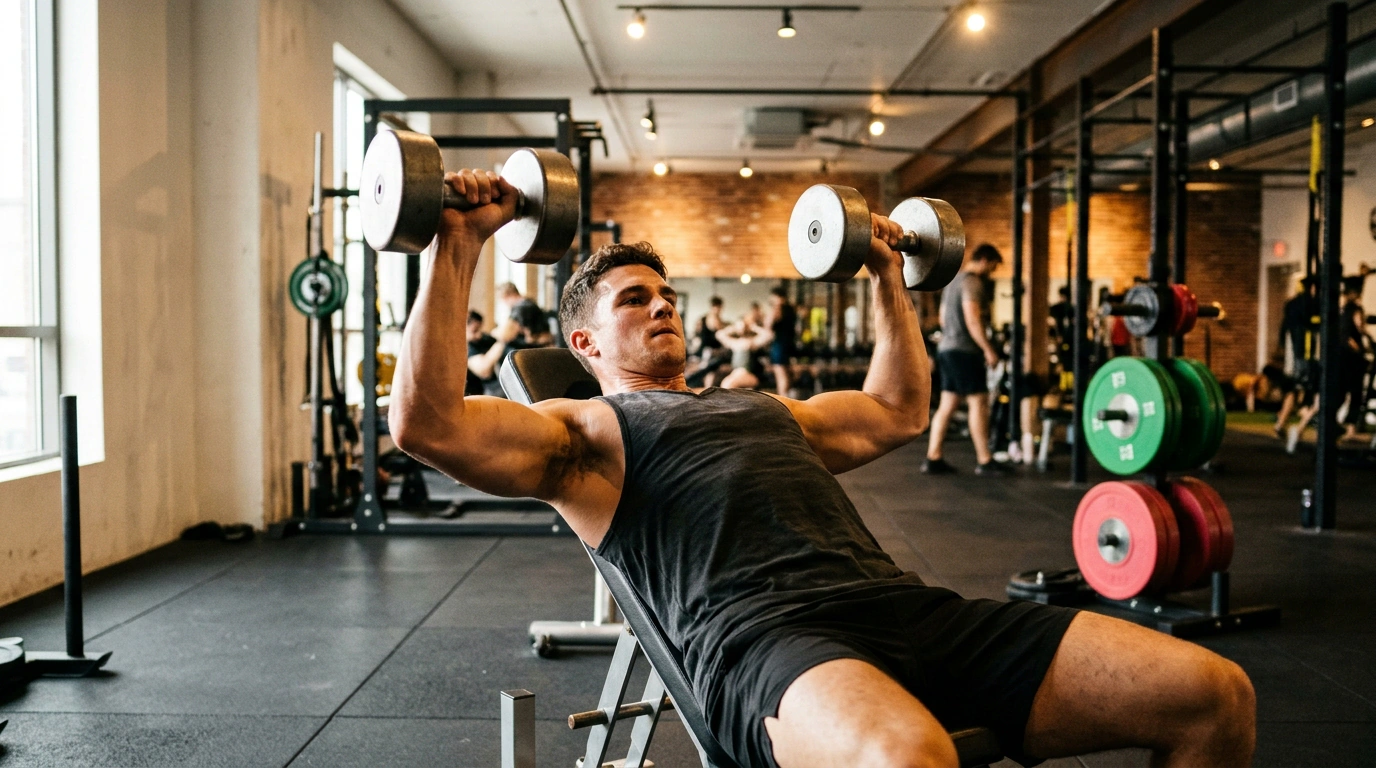
When Reacher hit screens, Alan Ritchson's build landed like a bombshell. He didn't look like the typical dried-out fitness influencer sporting paper-thin skin and vascular abs at 70 kilograms. On screen, Jack Reacher looks like an unstoppable tank: a massive V-taper, cannonball delts, and an upper chest so thick it pushes right out against any heavy T-shirt.
Most guys' first instinct is to jump straight into a search bar and type: "Alan Ritchson workout routine." Yet blindly copying celebrity splits is the fastest shortcut to tweaked joints and burnout. Sports scientist and Renaissance Periodization co-founder Dr. Mike Israetel put Ritchson's physique under an anatomical microscope. His verdict is refreshingly blunt: Reacher looks imposing not because of "secret special-forces drills," but thanks to targeted hypertrophy in two specific muscle zones.
Let's strip away the myths and break down the biomechanics: which muscles actually create that powerhouse upper-body frame, how to dial in smart training volume, and why real growth comes from managing fatigue—not punishing yourself into the ground.
Anatomical X-Ray: Genetics vs. What You Can Actually Build
Israetel starts by separating genetic luck from real gym work. Ritchson naturally stands 191 cm tall with a broad, heavy bone structure and long clavicles. As an adult man, no amount of squats is going to lengthen your bones or narrow your pelvis.
What creates that unmistakable illusion of sheer power, though, comes down to specific muscle groups any natural lifter can build:
- The Clavicular (Upper) Chest: Most guys in the gym have unevenly built pecs. Endless flat barbell benching overloads the front delts and lower chest, creating a droopy, bottom-heavy look. Reacher's upper chest is packed so densely that it forms a solid plate of armor running straight down from his collarbones.
- Lateral (Side) Delts: Your side delts are what create dramatic shoulder width from both the front and back. Even with huge arms—Ritchson's upper arms measure around 46–48 cm—his arms never overpower his frame because his shoulder girdle sits even wider and thicker.
- Lats and Mid-Back Thickness: That classic V-taper lives on contrast. Wide, flaring lats paired with thick rhomboids make your waist look noticeably narrower, even if the scale reads well over 90 kilograms.
In our breakdown of Yukio Mishima's Sun and Steel, we explored how physical discipline shapes character. And in our article on the McConaughey effect, we noted how real physical presence directly boosts a man's body language and quiet confidence.
Why Hollywood Routines Wreck Regular Guys
Actors prepping for a shoot train under brutal deadlines: two grueling sessions a day, puke-inducing supersets, severe carb depletion, and heavy pharmaceutical support supervised by studio doctors.
If a natural college student or office worker tries to copy that chaos, two weeks in he'll be nursing an inflamed rotator cuff, insomnia, and crashed testosterone. Israetel's science-backed system relies on Volume Landmarks:
- MEV (Minimum Effective Volume): 6–8 hard working sets per muscle group per week—the baseline threshold where growth kicks in.
- MAV (Maximum Adaptive Volume): 12–20 quality working sets per week—the sweet spot for maximum hypertrophy without burying your recovery.
- MRV (Maximum Recoverable Volume): 20–25 sets per week—the ceiling beyond which your muscle fibers and nervous system simply cannot recover.
Your job is to live inside the MAV zone, adding load or reps gradually from week to week.
Top Hypertrophy Exercises with High Stimulus-to-Fatigue Ratios
Israetel grades every lift by its SFR (Stimulus-to-Fatigue Ratio). The higher the local tension on the target muscle—and the lower the beatdown on your joints and spine—the better the exercise:
- Incline Dumbbell Press (30–45 Degrees): Unlike a straight barbell, dumbbells let you pin your shoulder blades back, sink deeper at the bottom for an intense upper-pec stretch, and press up along your natural joint arc.
- Incline Smith Machine Press: Lets you push safely right up near failure without worrying about dropping a bar on your neck. Lower the bar under strict control for 2–3 seconds with a crisp one-second pause at the bottom.
- Slightly Leaned-Forward Dumbbell Lateral Raises: Hinge your torso forward just 10–15 degrees and raise the weights out in the scapular plane. This locks the tension squarely onto the side delts and takes your upper traps out of the equation.
- Cable Lateral Raises (Low Pulley): A cable delivers smooth, constant mechanical tension across the entire rep, including the stretched bottom position where dumbbells go slack.
- Chest-Supported T-Bar or Dumbbell Rows: Bracing your chest against a bench eliminates lower-back fatigue completely, locking your torso down so every ounce of effort goes into squeezing your shoulder blades for slab-thick back density.
Don't try to slap new plates on the bar every single workout at the expense of sloppy form. Israetel recommends training by Reps in Reserve (RIR). In week one of a mesocycle, stop with 3 reps left in the tank (3 RIR); in weeks two and three, push to 2–1 RIR; in week four, take sets right to the edge (0–1 RIR). Then make week five a mandatory deload.
Israetel's 5-Day Training Split
To let both your muscles and central nervous system bounce back properly, the workload spreads across five training days per week:
- Day 1: Upper Body (Side Delts & Upper Chest Focus) Incline dumbbell press (3–4 sets of 8–12 reps, 2 RIR), cable lateral raises (4 sets of 10–15 reps), lat pulldowns to the chest (3 sets of 10–12 reps), dumbbell skull crushers (3 sets of 10–15 reps).
- Day 2: Lower Body (Quads & Calves) Barbell squats or hack squats (3–4 sets of 8–10 reps), leg extensions (3 sets of 12–15 reps), standing calf raises (4 sets of 12–15 reps with a pause at the bottom).
- Day 3: Active Recovery Easy outdoor walk (8,000–10,000 steps).
- Day 4: Push / Pull (Back & Arm Volume) Chest-supported rows (4 sets of 8–12 reps), weighted dips or seated Hammer Strength chest press (3 sets of 8–10 reps), incline dumbbell curls (3 sets of 10–12 reps), reverse pec-deck flyes for rear delts (4 sets of 12–15 reps).
- Day 5: Shoulder & Upper-Torso Specialization Standing barbell overhead press or seated dumbbell shoulder press (3 sets of 6–8 reps), dumbbell lateral raises (4–5 sets of 12–15 reps), low-to-high cable chest flyes for upper pecs (3 sets of 12–15 reps).
- Day 6: Lower Body (Hamstrings & Back) Dumbbell Romanian deadlifts (3–4 sets of 8–10 reps), lying leg curls (4 sets of 10–12 reps).
- Day 7: Complete Rest.
Hypertrophy Fuel: Calories, Protein, and Sleep
Without raw building materials, even the sharpest program just leaves you run-down.
To pack on lean muscle without spilling fat over your waistband, run a modest calorie surplus: just 250–350 kcal above maintenance. That yields a steady 1–1.5 kg of quality weight gain per month. Keep protein locked at 1.8–2.2 grams per kilogram of bodyweight, spread across 3–5 meals a day.
And above all: sleep at least 8 hours a night. Peak growth hormone release and nervous-system repair happen exclusively during deep sleep. Discipline in your bed and kitchen builds a Reacher-level frame faster than any trendy supplement ever will.