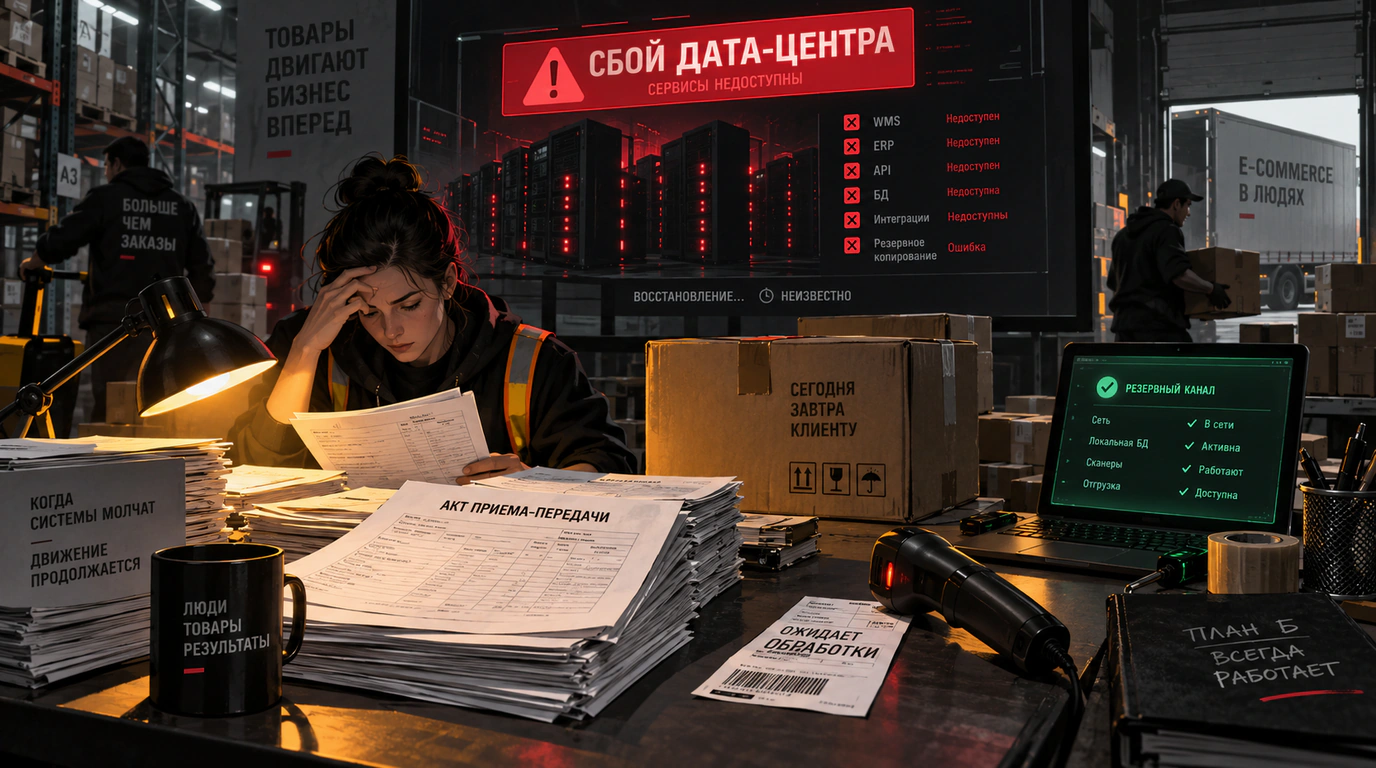
When shipping labels stop downloading in your seller dashboard on a Saturday evening, your first instinct is to blame a buggy interface. Yet the disruptions over the past weekend stemmed from a much larger disaster: a blackout knocked out three core Yandex data centers at once, in Sasovo, Kaluga, and Vladimir.
The Vladimir facility, with a design capacity of 2,880 server racks, was the company's flagship hub. Ripples from the outage hit the entire Russian internet. Wildberries, Lamoda, Magnit services, Dodo Pizza couriers, and even the state Mercury system experienced glitches. For marketplace sellers, however, this tech storm immediately turned into a direct threat of cash gaps and missed shipments.
FBS Paralysis: When a Label Costs More Than the Product
The hardest hit fell on sellers using the FBS (Fulfillment by Seller) model. On October 11 and 12, label generation froze completely in the Yandex Market dashboard. In warehouse logistics, a box without a barcode effectively doesn't exist. Sorting centers and drop-off points aren't allowed to accept unlabeled parcels, and couriers can't scan them.
As a result, Yandex Market had to halt receiving at key hubs, including the Tsaritsyno sorting center in Moscow. Warehouses quickly overflowed with packed boxes while sellers watched late-delivery penalty timers tick.
To the platform's credit, it rolled out an emergency plan fast:
- Paper handover acts: shipment receiving and return handovers were temporarily moved to paper acts using Excel templates;
- FBY archives: for deliveries to Market's own warehouses, sellers got an option to download document archives directly from shipment pages;
- Rating protection: all delays and stuck orders from October 11 and 12 were officially excluded from store quality index calculations, and related fines were waived;
- Finances: the "Money Earlier" early-payout service was restored.
By October 13, label generation was back online, though sellers were left dealing with the aftermath and operating losses from two days of downtime.
Legal Maneuver: Force Majeure in the Terms
While putting out the technical fire, Yandex made a legal move that many sellers didn't notice right away. On October 10, the company updated its general user agreement across services. The list of force majeure events now explicitly includes:
- Drone (UAV) attacks, missile strikes, shelling, and blast waves;
- Consequences of aircraft or weapons use and crashes;
- Major industrial accidents and third-party power grid failures.
Corporate lawyers explain these edits as aligning policies with Article 401 of the Russian Civil Code. For a marketplace seller, though, this clause changes everything. If your store sits idle because of an infrastructure failure, nobody will compensate your lost sales or wasted ad budgets. Yesterday, we covered how the data center outage paralyzed Yandex Market and why the platform waived FBY storage fees through the end of the year in response.
Recovery Timelines and Lessons for Your Store
Experts estimate that restoring cooling and power distribution at the Vladimir complex will take weeks. Replacing damaged compute racks could take up to a year due to server hardware shortages. One supercomputer cluster of that scale costs up to 4.5 billion rubles.
The main takeaway for sellers is purely practical: you can't rely on the flawless cloud infrastructure of a single tech giant. Earlier, we noted how drone attacks on warehouses and denied compensation are forcing the market to rethink risk management. To protect your business during peak season, split inventory between FBY and FBS, keep extra packaging on hand, and diversify your sales channels. On marketplaces, it isn't the most optimistic seller who survives, but the best prepared.