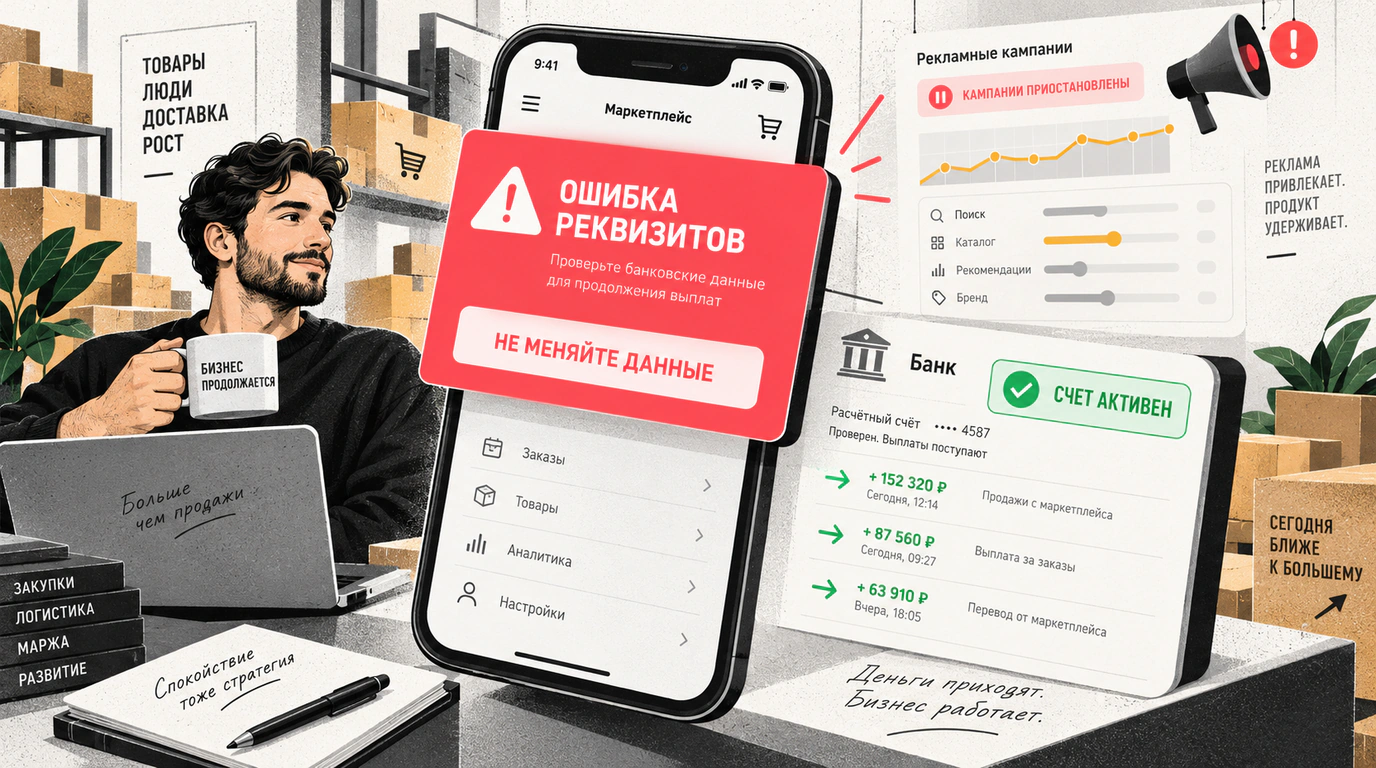
Monday mornings in e-commerce are rarely quiet, but on October 13, Ozon gave sellers a serious scare. Around 10:00 a.m., thousands of merchants opened their inboxes and dashboards to an alarming system alert: "Payout failed. We noticed incorrect bank details in your account, so we cannot transfer your earnings."
For a business owner whose working capital is scheduled down to the hour for factory payments, payroll, and warehouse fees, a sudden payout freeze means an immediate cash gap. A chain reaction followed. Sellers rushed to call their banks, only to hear that accounts were working normally and no incoming Ozon transfers had been rejected.
Ad Knockout: Why Stencils Stopped Running
While half of the sellers were checking their banking apps, the other half ran into a worse problem: the ad dashboard went down at the same time. In the middle of the workday, promotion campaigns (Stencils and Top Placement) started force-pausing with an "unpaid debt" status.
In support chats, marketplace reps confirmed the glitch, saying they were "already looking into it." On a marketplace, pausing ads isn't just a temporary drop in impressions. Listings immediately fall out of warmed-up ad auctions, organic rankings slip, and sales velocity drops. The outage hit hardest for sellers building Ozon ad management by combining search and shelf placements, where steady bids determine product position. With Ozon ad rates expected to rise starting October 20, any billing desync feels twice as frustrating.
Official Denial and the Root Cause
By noon, Ozon published an official statement in its seller channel. The platform admitted that the incorrect-details alert was caused by a technical bug in its notification service. It assured sellers that payouts were running on the regular schedule, bank details were valid, and the morning emails could simply be ignored.
Sure enough, transfers began hitting business accounts in their usual batches by afternoon. Ozon's billing gateway wasn't affected. The failure happened in the communication layer, where a notification script misread a routine payment registry export.
The One Mistake You Must Avoid
The October 13 incident exposed a dangerous behavioral trap that caught hundreds of inexperienced sellers. Seeing the bank-details error, many rushed into their account settings to "fix" their account number or BIC.
You should never do that. Under Ozon's rules, any manual change to bank details automatically triggers an anti-fraud security check that lasts up to three business days. During that window, the platform unconditionally freezes all real payouts. As a result, sellers who reacted too fast ended up locking their own working capital until the end of the week.
In e-commerce, staying calm pays off just as much as sharp math. If your bank confirms your account is active, the first rule during an anomaly like this is to take screenshots of your ad campaigns and wait for an official platform update.