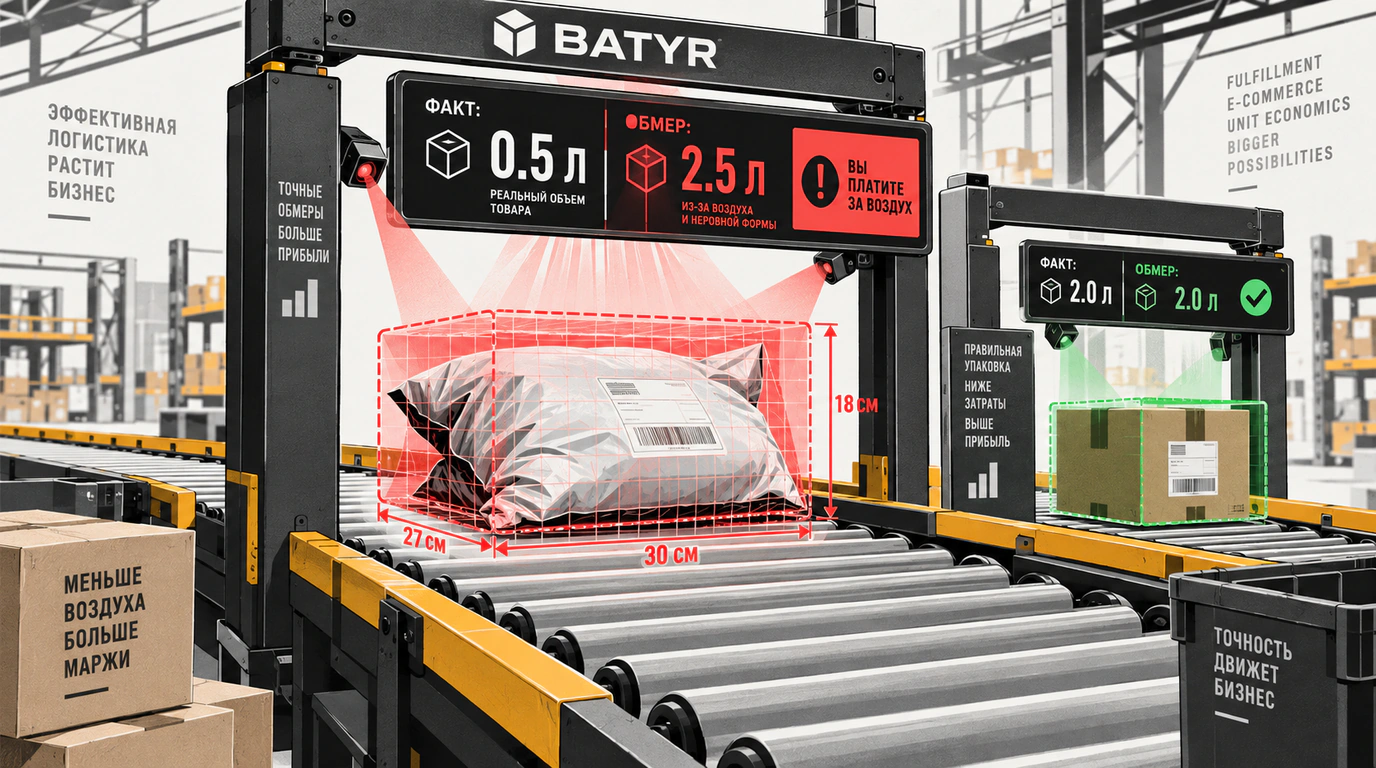
In marketplace unit economics, logistics stopped being a minor expense line long ago. When your profit margin per item is 150–200 rubles, any unexpected shipping hike can turn a healthy store into a money-losing project. Today, Ozon sellers are running into a quiet but destructive issue: automated warehouse dimension scanners are inflating product volumes by three to five times, multiplying delivery fees and triggering steep fines.
Machine Vision vs. Polybags: How BATYR and GAUSS Work
The root of the problem lies in automation hardware. Ozon sorting hubs use proprietary weight-and-dimension systems built by Ozon Tech: BATYR for small items and GAUSS for large boxes.
These systems use optical depth sensors and machine-vision cameras to calculate volume based on outer protrusions, drawing a bounding box around the item. When a product is packed in a standard courier polybag, stand-up pouch, or bubble wrap, the optics misread it:
- A sticking-out sealed bag corner or film fold registers as a solid, rigid edge;
- Air trapped inside the bag adds "virtual" thickness to the item;
- As a result, a pack of sweets or textiles that is actually 1–2 cm thick and under 0.5 liters gets logged as 5 cm thick and 2–3 liters in volume.
Double Fees and the Penalty Ladder
This measurement error hits sellers twice financially. First, base logistics (Ozon's linehaul and last-mile delivery) is billed directly by volume in liters. The more virtual liters BATYR counts, the more you pay to ship every unit.
Second, Ozon enforces a strict tiered penalty scale for dimension mismatches:
- 0.601 to 1 liter over — 150 rubles;
- 1.001 to 2 liters — 300 rubles;
- 2.001 to 3 liters — 600 rubles;
- 3.001 to 5 liters — 900 rubles;
- 5.001 to 10 liters — 1,200 rubles;
- Over 10 liters — 1,500 rubles per unit.
If a batch of 300 low-priced items enters a warehouse, automated re-measurement can push your account balance into a six-figure negative within a day. Earlier, we detailed how to optimize Ozon costs and stop profit leaks when tariffs rise unexpectedly.
A Wall of Auto-Replies and Barcode Syncing
Platform communication rules make things harder. Ozon long ago disabled direct email alerts for dimension changes. New measurements quietly appear in the product card, and unless you check reports daily, the deductions come as a shock on your closing statements.
Disputing measurements through support has become a dead end. Chat bots send a template rejection claiming the equipment is certified and calibrated, so errors are impossible. To break through, you need video and photos of the product next to a certified metal ruler from three angles with a readable barcode.
Worse still, sellers face "collective liability" on EAN-13 barcodes. If you list a factory item using a shared manufacturer barcode, the system can automatically pull in inflated dimensions from other sellers, even before your own shipment reaches the warehouse.
How to Protect Profits: Rigid Boxes and Unique Barcodes
Putting up with optical errors costs too much. To protect unit economics, experienced sellers rely on three proven fixes:
- Switch to self-assembling cardboard boxes: flat micro-corrugated edges eliminate glare and folds, ensuring accurate BATYR scans;
- Use unique barcodes: replace standard factory EANs with internal marketplace SKUs to isolate your listing from other sellers' mistakes;
- Hard reset: if an inflated volume sticks to a low-cost item and support refuses to re-measure, it's often cheaper to close the listing, sell off remaining stock, and launch a fresh SKU.