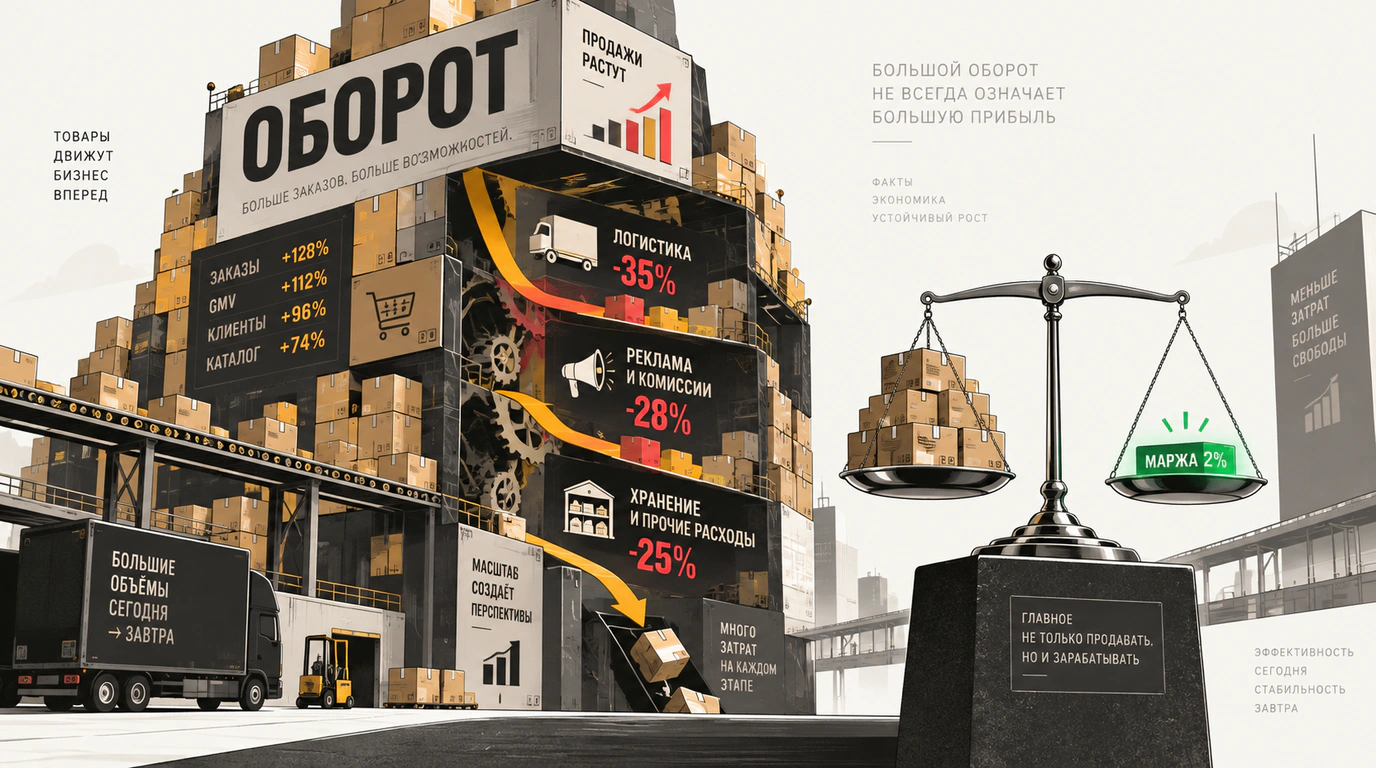
In news headlines, Russian retail looks like a winner. According to Rosstat, retail's share of GDP reached 30.5%, a six-year high. Marketplaces are driving that growth: combined annual turnover for the big three (Wildberries, Ozon, and Yandex Market) jumped 32% past an astronomical 8.6 trillion rubles.
Yet any seller who has worked on these platforms for more than a year knows there's a wide gap between gross revenue on a dashboard and actual cash left in the bank after fees. Behind the trillion-ruble headlines, the entire market is shifting into a tough, low-margin phase.
The Growth Illusion: Where the Percentages Disappear
Strip away the rosy charts, and the picture changes. Experts from the Higher School of Economics and RANEPA note that the nominal 11–12% rise in retail turnover largely reflects inflation passed into retail prices. In physical units sold, real trade growth was a modest 5.1%.
Meanwhile, the cost of generating sales is climbing faster than sticker prices:
- Logistics fees: marketplaces steadily raise receiving, storage, and linehaul tariffs, passing infrastructure costs onto suppliers;
- Ad tax: organic search visibility has shrunk to a minimum, pushing ad spend share (DRR) for top spots from a comfortable 5–7% up to 12–20% of revenue;
- Expensive working capital: the Bank of Russia's high key rate makes bank loans unaffordable, keeping mid-sized businesses from cheaply restocking for seasonal peaks.
As a result, consultancy Yakov & Partners and the Association of E-Commerce Representatives (APET) report that net profitability in e-commerce has settled into a 1.5–2% band, reaching 3–4% only for the leanest brands. The market has matured and now resembles Western retail, where every percentage point of net margin is a trench war. Earlier, we tracked these structural shifts when looking at e-commerce maturity and the fight against seller losses.
The Cautious Shopper and the Savings Boom
A cold wind is blowing from the buyer side too. According to the regulator, household savings have reached 16% of income. Attractive bank deposit yields are pulling up to 1 trillion rubles out of consumer spending every quarter.
Shoppers have become strictly rational. The era of impulse buying has given way to discount hunting, price-parser comparisons, and waiting for seasonal sales. Average order values are flat, and customers readily reject items at pickup points (PVZ) over minor doubts. Back in spring, analysts warned of this outcome in a study on e-commerce records amid a broader retail squeeze.
The New Playbook: Surviving on Unit Economics
The days when you could multiply sales just by flooding warehouses with stock and cranking up ad bids are gone for good. Today's winners aren't the ones flashing billion-ruble GMV, but the ones who protect net profit.
It's time for sellers to switch to crisis-mode management:
- Cut the product matrix ruthlessly: remove SKUs with margins below 10% that create an illusion of volume while draining cash on storage and returns;
- Focus on turnover: tighten your inventory cycle to 20–30 days instead of freezing working capital in slow-moving stock;
- Sell across multiple channels: build direct sales and alternative platforms so you don't depend on a single giant's tariff hikes.