You open your seller dashboard, and your withdrawal requests have been frozen for three weeks straight. It's a familiar scene. According to seller community data, about 40% of Wildberries sellers now wait more than three weeks for their payouts. Meanwhile, taxes, warehouse staff wages, and supplier invoices for seasonal stock have to be paid right now.
Then a tempting button pops up on your screen: "Instant Payout" or a personal loan from the platform. The fee looks tiny: "Only 2.5% for 2 weeks" or "4.49% for 3 weeks." Your hand reaches for the mouse, and your brain whispers: "What's two percent? At least I'll plug the cash gap."
Stop and take your hand off the mouse. Let's grab a calculator and see what that "two percent" really costs.
The "fast money" trap: how 2.5% turns into 96% a year
The main trick of marketplace fintech services is hiding the true rate behind an ultra-short loan term. They never show you the annual percentage rate because it would shock you.
Look at how the math works:
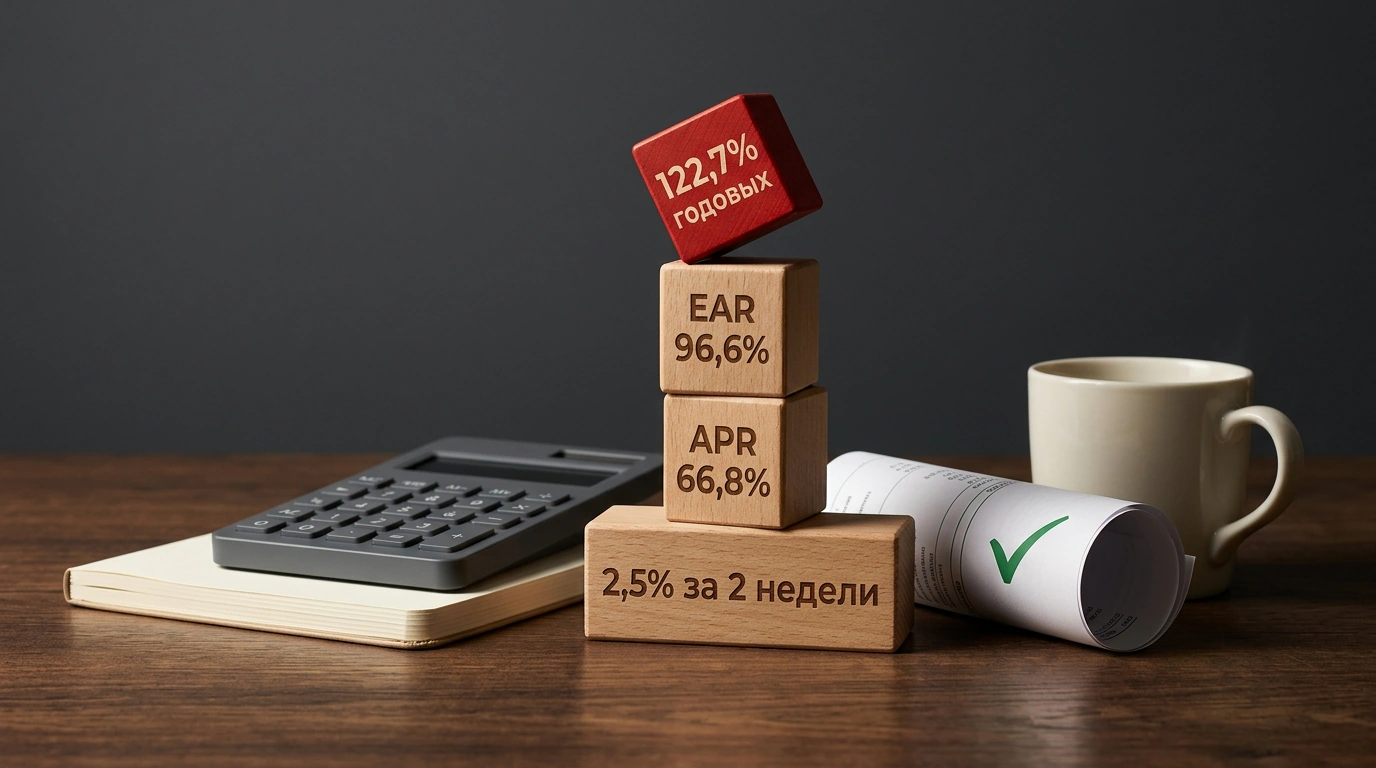
- If you borrow at 2.5% for 2 weeks, the simple annual percentage rate (APR) is already ~66.8% per year.
- However, the marketplace requires weekly repayments, constantly shrinking the principal you actually hold. When you convert those terms into an effective annual rate (EAR) with compounding, you get ~96.6% per year.
- With a 4.49% fee for 3 weeks, the picture gets even worse: the effective annual rate shoots up to an insane ~122.7% per year.
Look at the scale of this: it's not friendly platform support. It's a typical payday loan with harsh overpayments, wrapped in a sleek dashboard interface. With an average retail business margin of 15–20%, regular use of this money will eat up your entire quarterly net profit.
Weekly schedule: why this debt drains working capital faster than a bank loan
At a regular bank, you take out a loan, put the entire amount into inventory, buy a batch of goods, and make a small monthly payment. The full amount works in your business.
On a marketplace, the rules are different:
- The platform starts deducting principal and interest every single week, automatically taking them from your incoming sales revenue.
- As a result, you don't actually have the full borrowed amount for the stated term. Every week your working capital shrinks, yet you pay fees calculated on the original limit.
- You fall into a classic cash-gap spiral: to cover next week's marketplace deductions, you have to click "instant payout" all over again. Dependency sets in immediately.
In our previous analysis of the Wildberries liquidity crisis, we already noted how payout delays push sellers toward extreme measures. But borrowing at over 100% a year to put out a fire is like trying to extinguish flames with gasoline.
Anti-crisis financing hierarchy: where to get cash during a shortfall
I set a strict rule for my own store that has saved me more than once. Marketplace loans are acceptable only to scale a proven, profitable product, where the item's margin easily covers the cost of capital. To close cash gaps, follow a strict hierarchy of funding sources:
- Supplier payment deferral. Call your factory or distributor, honestly show them screenshots of your frozen balance, and agree on a 10 to 14-day payment extension. For regular partners, this is standard practice and costs you zero rubles in interest.
- Internal reserves and clearance of slow-moving stock. Cut prices on items sitting idle in the warehouse, sell them at break-even, and pull real cash out of your existing inventory.
- Private investor loan. Borrowing from trusted private lenders or partners at a fixed 25–30% annual rate with monthly payments is three times cheaper than marketplace fintech products.
- Traditional bank overdraft or SME loan. Even with a high central bank key rate, a standard bank loan with a clear schedule remains a reasonable tool.
- Factoring and marketplace instant payouts as a last resort. Use them only for two or three days if the alternative is going completely out of stock on your flagship SKU, where losing search rankings would cost more than any interest fee.