You can dial in your internal ads, collect hundreds of five-star reviews, and push millions in revenue—only to find your bank account nearly empty at the end of the month. In e-commerce, unit economics decides everything. In 2026, the rules have grown so complex that your net profit depends less on sales volume and more on where your company is registered and how you account for return logistics.
Marketplace analytics expert Pavel Novak shared a clear calculation using an updated tariff calculator (based on rate schedules as of October 13, 2026). Let's break down the math down to the last ruble.
Baseline inputs: a 3,500-ruble dress and its hidden costs
To keep the comparison fair, the model uses one standard Fashion item:
- Product: women's dress.
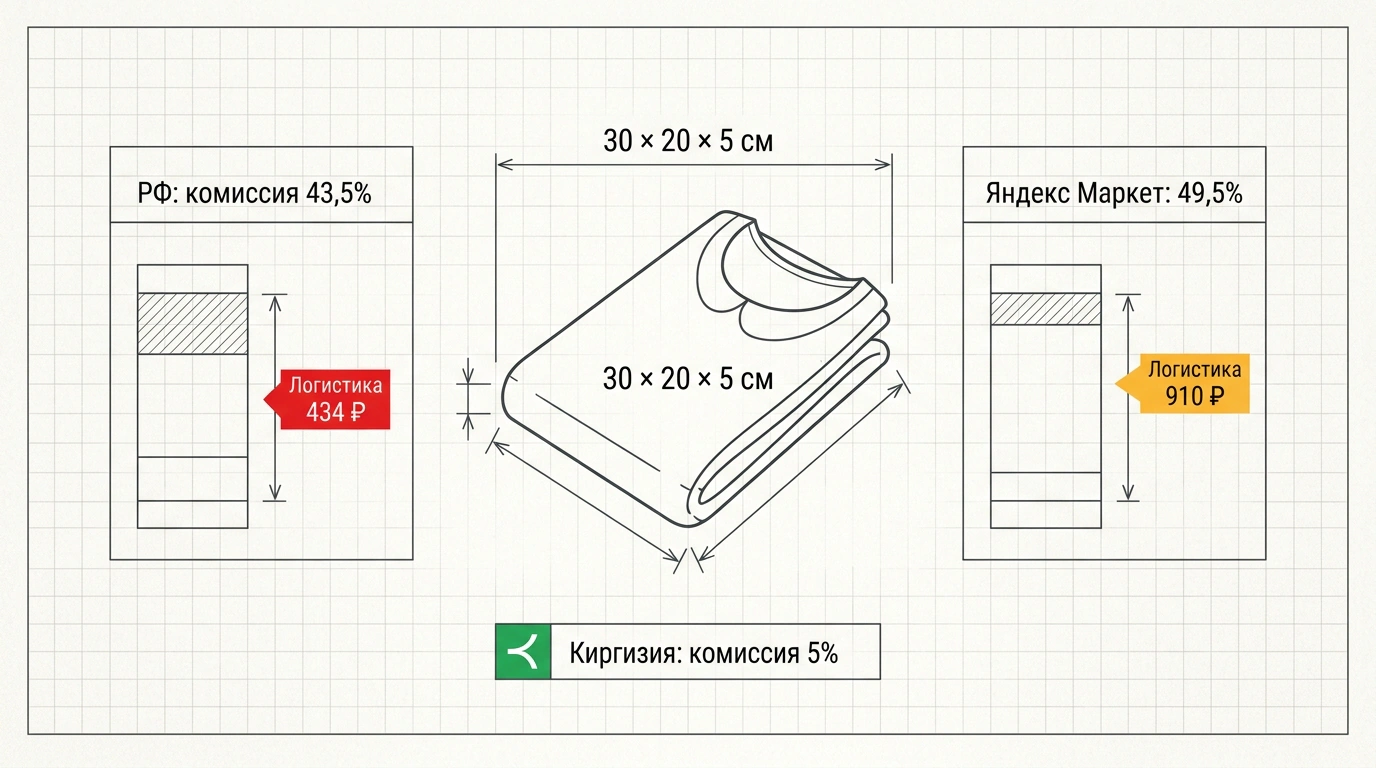
- Package dimensions: 30 × 20 × 5 cm (exact volume of 3 liters).
- Manufacturing cost: 500 rubles.
- Retail price before platform loyalty discount (SPP): 3,500 rubles.
- Niche benchmarks: buyout rate of 39.3%, 30-day inventory turnover, and a standard Russian Wildberries warehouse with a 170% acceptance coefficient.
With a 500-ruble cost and a 3,500-ruble price tag, the margin looks huge at first glance. Now watch what happens when marketplace commissions and logistics kick in.
Cost comparison table by jurisdiction and marketplace
Here is how mandatory expenses break down per sold unit across different setups:
| Platform & Seller Jurisdiction | Platform Discount (SPP) | Marketplace Commission | Return-Adjusted Logistics | Storage | Payment Processing |
|---|---|---|---|---|---|
| Wildberries (Russia) | 30% (price 2,450 RUB) | 43.5% (1,523 RUB) | 434 RUB | 12 RUB | 105 RUB |
| Wildberries (Kyrgyzstan) | 15% (price 2,975 RUB) | 5.0% (175 RUB) | 397 RUB | 12 RUB | 105 RUB |
| Wildberries (Kazakhstan) | 15% (price 2,975 RUB) | 24.5% (858 RUB) | 397 RUB | 12 RUB | 105 RUB |
| Wildberries (China) | 5% (price 3,325 RUB) | 20.0% (700 RUB) | 397 RUB | 0 RUB | 105 RUB |
| Yandex Market | — | 49.5% (1,733 RUB) | 910 RUB | 0 RUB | 98 RUB |
| M.Video (FBS) | — | 19.0% (665 RUB) | 265 RUB | 0 RUB | 53 RUB |
The numbers speak for themselves. A Russian seller on Wildberries sits in the toughest spot on base commission, handing over 43.5% of the item price (1,523 rubles) to the platform. Meanwhile, a seller with a legal entity in Kyrgyzstan pays a symbolic 5% (175 rubles) and keeps the lion's share of the markup. On Yandex Market, the commission is even steeper at 49.5%, and logistics for the same dimensions cost nearly twice as much.
Return logistics: why a 39% buyout rate means 2.5 trips per dress
The biggest mistake newcomers make in apparel is calculating logistics using the base rate for a single delivery (say, 150–180 rubles). In reality, Fashion buyout rates rarely top 40%.
At a 39.3% buyout rate, the math is unforgiving:
- To sell one dress, the marketplace has to ship an average of 2.5 units to customers.
- Every unbought item travels to a pickup point and then rides all the way back to a sorting center.
- As a result, real logistics costs per completed sale jump to 434 rubles on Wildberries and 910 rubles on Yandex Market.
Logistics now costs almost as much as sewing the dress itself (500 rubles). If you don't build round-trip shipping of unbought items into your unit economics, every big promo sale will push your business into the red. We covered the danger of chasing revenue without tracking costs in our breakdown of the revenue-without-profit trap.
Risks of "gray" jurisdictions: why you shouldn't blindly register in Bishkek
Seeing that 5% rate for Kyrgyzstan, many sellers get tempted: "I'll open a company in Bishkek through agents and save millions on commissions!"
Think twice before rushing into that:
- Currency controls and profit repatriation. Converting soms or tenge back into rubles and wiring revenue to Russian accounts now triggers strict bank scrutiny, conversion fees, and account freeze risks.
- Marketplace compliance. Wildberries actively hunts down shell companies. If goods physically ship from Russia while the account is registered to a nominee in the EAEU, the platform freezes payouts pending tax residency checks.
- Local tax burden. EAEU countries have their own reporting rules and VAT requirements for cross-border trade.
Calculating every single ruble before your first shipment is the only way to keep your store afloat.