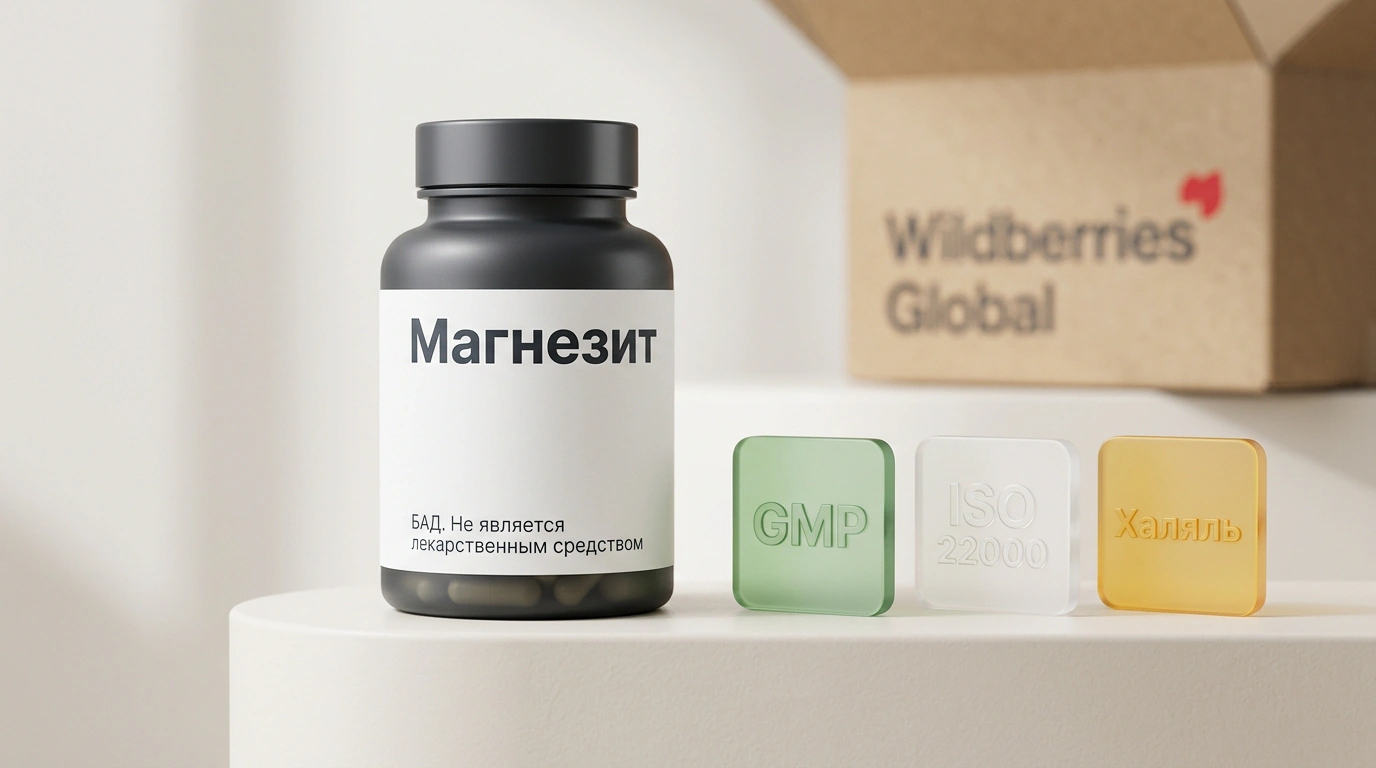
Anyone can learn to sell phone cases or basic T-shirts on marketplaces. When it comes to dietary supplements, though, most sellers back away from the wall of red tape: strict state oversight, six-month document approvals, bans on medical claims in ads, and heavy fines for the smallest labeling error.
That makes the real-world experience of manufacturers who made it through from scratch all the more valuable. Uzbek pharmaceutical group XOS Corporation scaled its supplement line across the entire CIS market through Wildberries Global. Strategy Director Diyas Mutalov openly shared how the business works under the hood.
Manufacturing foundation: from lab to international GMP and Halal standards
The company started in 2018 as a private venture by trauma surgeon Odiljon Khojayorov. Today, the holding includes seven manufacturing plants in Uzbekistan, one factory in Kyrgyzstan, and three trading entities in the UAE, with a portfolio of 92 registered products.
Going onto marketplaces required a complete overhaul of production standards:
- The factories are certified under international ISO 9001, ISO 22000, and FSSC 22000 quality standards, opening export doors to the US and Japan.
- 47 products passed multi-stage certification with Malaysia's World Halal Trust, verifying the halal status of both raw ingredients and capsule shells.
- Developing a single product—from biochemical formula to a test batch—takes an average of 8 months.
- Even sourcing jars requires tight math: the company imports GMP-certified bottles from China at 830 UZS per unit, while local equivalents cost 1,150–1,300 UZS with inconsistent plastic quality.
The regulatory marathon: why prep took 8 months
Newcomers often assume they can register an account in a day and start shipping right away. That never happens with supplements.
XOS Corporation opened its Wildberries supplier account in January 2025. Yet it made its first actual shipment to customers only in late August—after 8 months of intense prep work.
What caused the delay?
- State Registration Certificate (SGR). Selling supplements across Customs Union countries (under TR CU 021/2011) requires an SGR. This involves toxicology testing in accredited labs, dosage reviews, and sign-offs from sanitary authorities—a process that takes 6 to 9 months.
- Strict label rules. The front of every retail package must display a large, high-contrast notice stating "Dietary Supplement. Not a Medicinal Product," along with exact ingredient amounts and percentages of daily intake.
- Track-and-trace and customs clearance. Cross-border shipping through Wildberries Global required setting up end-to-end tracking codes and electronic shipping documents.
R&D from Wildberries search data: the birth of "Magnezit"
The sharpest insight from this case is using marketplace analytics as a free R&D lab.
Studying internal Wildberries search data in Russia and Belarus, the company's analysts spotted huge unmet demand for easily absorbed magnesium. Instead of copying standard pharmacy formulas, their technologists created an original complex called Magnezit, combining magnesium citrate with vitamin B6 and natural lemon balm extract for a stronger calming effect. The product shot straight into the brand's top sellers, proving that marketplaces give manufacturers direct feedback from the market.
We looked at direct-to-consumer distribution in our breakdown of Wildberries supply distribution and logistics. Cutting out wholesale distributors and pharmacy chains with their 50–100% markups allowed XOS to offer shoppers a fair price while keeping healthy factory margins.
Advertising limits and key lessons for product brands
The hardest part of marketing supplements is complying with advertising laws. Inside product listings and infographics, you are strictly forbidden from:
- Claiming that a supplement has healing properties or cures specific diseases.
- Citing recovery testimonials or doctor endorsements.
- Implying that taking a supplement replaces a balanced diet.
Marketing has to rely solely on verified nutritional properties of active ingredients, transparent formulas, and a solid brand reputation. If you plan to enter a complex category, be ready for the long game. The winner isn't whoever launches fastest, but whoever builds rock-solid certification and product quality.