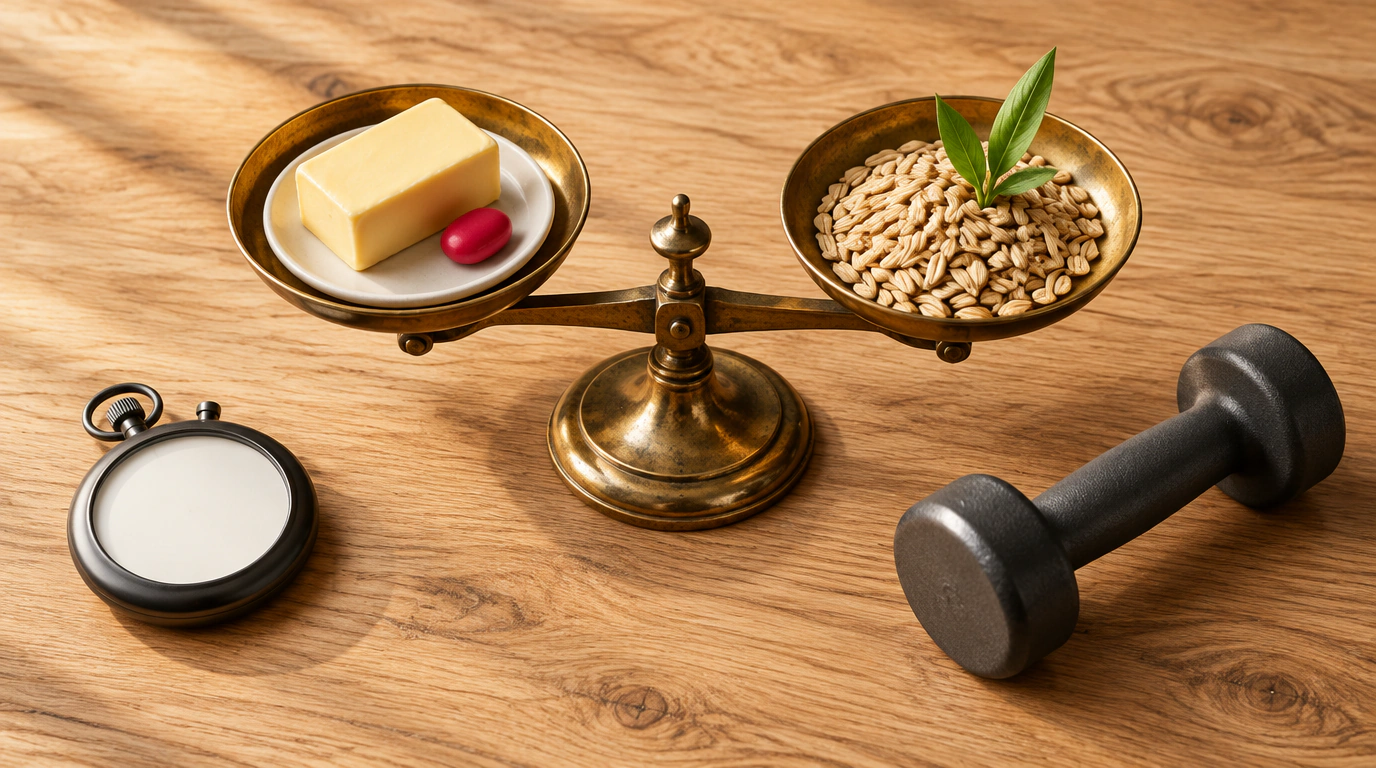
In the health and wellness world, it's tempting to fall for simple recipes: cut out carbs, shift lunch back by a couple of hours, or buy a tub of sports powder, and your body will magically torch fat while protecting muscle. What I love about evidence-based medicine is that it regularly puts the trendiest theories to the test.
This week, three intriguing clinical studies compiled by Dr. Burlakov caught my eye. They touch on things almost all of us run into on social media or at the gym: high-fat keto diets, intermittent fasting, and recovery supplements after injury. Let's calmly sort out what actually held up—and where marketing myths ran straight into hard physiology.
The Keto Catch and Fasting Arithmetic
The first finding comes out of Norway. The journal eBioMedicine published a secondary analysis of the two-year randomized CARBFUNC trial, where 193 overweight participants were assigned to different diets. The low-carb, high-fat (LCHF) keto group got 75% of their calories from fat, with a third of their daily intake coming from saturated fats—butter, fatty meats, and heavy cream.
At first glance, the numbers looked celebratory: triglycerides dropped by 20–35%, and "good" HDL cholesterol rose by 5–18%. Keto fans usually pop the champagne right there. Yet over the first 9 months on the diet, atherogenic LDL ("bad") cholesterol jumped by an average of 13%, while in the moderate-carb control group it fell by 9%.
The biochemistry is straightforward: excess saturated fatty acids suppress hepatic LDL receptors (LDL-R), which normally pull LDL particles out of the bloodstream. As a result, atherogenic particles linger in circulation longer, raising atherosclerosis risk. The juicy detail? The study was partially funded by a foundation that promotes low-carb eating—yet even their researchers couldn't hide that uncomfortable spike.
The second paper, published in Obesity, tested the rivalry between 16/8 intermittent fasting (an 8-hour eating window) and the 5/2 protocol (two low-calorie days of 500–800 kcal per week). After four weeks, the 5/2 group lost 3.1 kg, while the 16/8 group lost 2.2 kg. Muscle loss was virtually identical in both groups—around 600 grams.
When researchers checked actual food logs, all the timer magic evaporated: both groups spontaneously cut their daily intake by roughly 540 kilocalories. You lose weight because you create an energy deficit—not because of the exact minute you close the kitchen.
If skipping breakfast and fitting your meals into an 8-hour window feels easier psychologically, go for it. Just don't expect a cellular miracle: fat loss speed comes down to your overall calorie deficit, not the clock.
Creatine in a Cast: Why Muscles Need Mechanical Load, Not Just Powder
The third paper, in Experimental Physiology, poured cold water on a common athletic hope. Creatine monohydrate is one of the best-studied, most effective fitness supplements out there—it boosts muscle phosphocreatine stores so you can push heavier weights. But can it shield a muscle from atrophy when your arm or leg is locked in a cast after an injury?
Scientists pooled data from 6 clinical trials involving 118 young volunteers whose limbs were immobilized for 7–14 days: one group took creatine, the other took a placebo. High-precision MRI scans showed that the creatine group lost 5.6% of quadriceps muscle volume, while the placebo group lost 5.5%. Zero difference.
Physiology plays by strict rules: when a joint is completely immobilized and the muscle stops contracting (no mechanotransduction), the mTORC1 growth switch shuts off while protein-breakdown enzymes kick into high gear. Without mechanical tension, creatine simply can't hold protein inside muscle fibers. Notably, most of the meta-analysis authors consult for supplement brands themselves—yet they honestly reported that the powder is powerless against a cast.
This week's takeaway is refreshingly sober: stop hunting for magic pills where basic physiological laws are running the show. Your body needs an honest calorie balance, sensible fat choices, and regular movement.