When you hear the word "ultramarathon" or the classic "100 miles," your imagination pictures rocky mountain passes, taiga, and extreme athletes running in isolation. Few people realize that you can run a full 100-miler inside Moscow's MKAD ring road, through the capital's parks and small river valleys.
This circular walking-and-running route is called Зелёное кольцо Москвы (ZKM), and its length is 163 kilometers. The track was designed in 2017 by traveler Alexander Sovetov, linking more than 30 of Moscow's forest parks and embankments with a green thread. 80% of the distance runs along dirt paths and forest trails—from Losiny Ostrov to Bitsevsky Forest.
While road races like the Moscow Marathon are battles for seconds on asphalt, and hikes along the Volga Trail involve carrying heavy backpacks, the capital's 100-miler blends these formats in an urban relay.
A 100-Mile Relay: Logistics and Four Stages
The core idea of ZKM is a club relay where Moscow running clubs (#яuzarun, бЕЖИм в Филях, Mytischi be Good, #khimkirunbar, Blizko Trails) split the ring into four self-contained stages of ~40 km each:
- Izmaylovo — Shchukino (41.8 km): starts October 31 at 19:00, heading through Losiny Ostrov, the Yauza floodplain, the Botanical Garden, and Pokrovskoye-Streshnevo.
- Shchukino — Nikulino (41.2 km): starts at midnight through the Strogino floodplain, Serebryany Bor, and Filyovsky Park.
- Nikulino — Tsaritsyno (39.7 km): starts at 05:00 through Troparyovo, Tyoply Stan, and Bitsevsky Forest.
- Tsaritsyno — Izmaylovo (41.8 km): the final daytime leg from 10:00 through Kuzminki and Terletsky Forest Park.
Pacers hold a 6:15–6:30 min/km pace, while sweep marshals guard the back of the pack. The leaders' position is broadcast live on Telegram. Mobile aid stations are set up every 20 km, and a dedicated vehicle transports participants' gear. Meanwhile, the route crosses more than 50 metro and MCC stations, so you can drop out at any moment if fatigue sets in.
Physiology and Gear for a Night Trail
Still, one hundred and sixty kilometers in late autumn at temperatures around zero degrees Celsius require strict adherence to the guidelines of the American College of Sports Medicine (ACSM):
- Carbohydrates: muscle glycogen stores last for 90–120 minutes. To avoid "hitting the wall," you need a steady intake of 60–90 g of carbohydrates per hour (gels, isotonic drinks, bananas).
- Drinking to thirst: in cold weather, moisture is lost through breathing. Sports medicine warns against forcing fluids: excess water without electrolytes risks hyponatremia. Drink to thirst, adding 300–600 mg of sodium per liter.
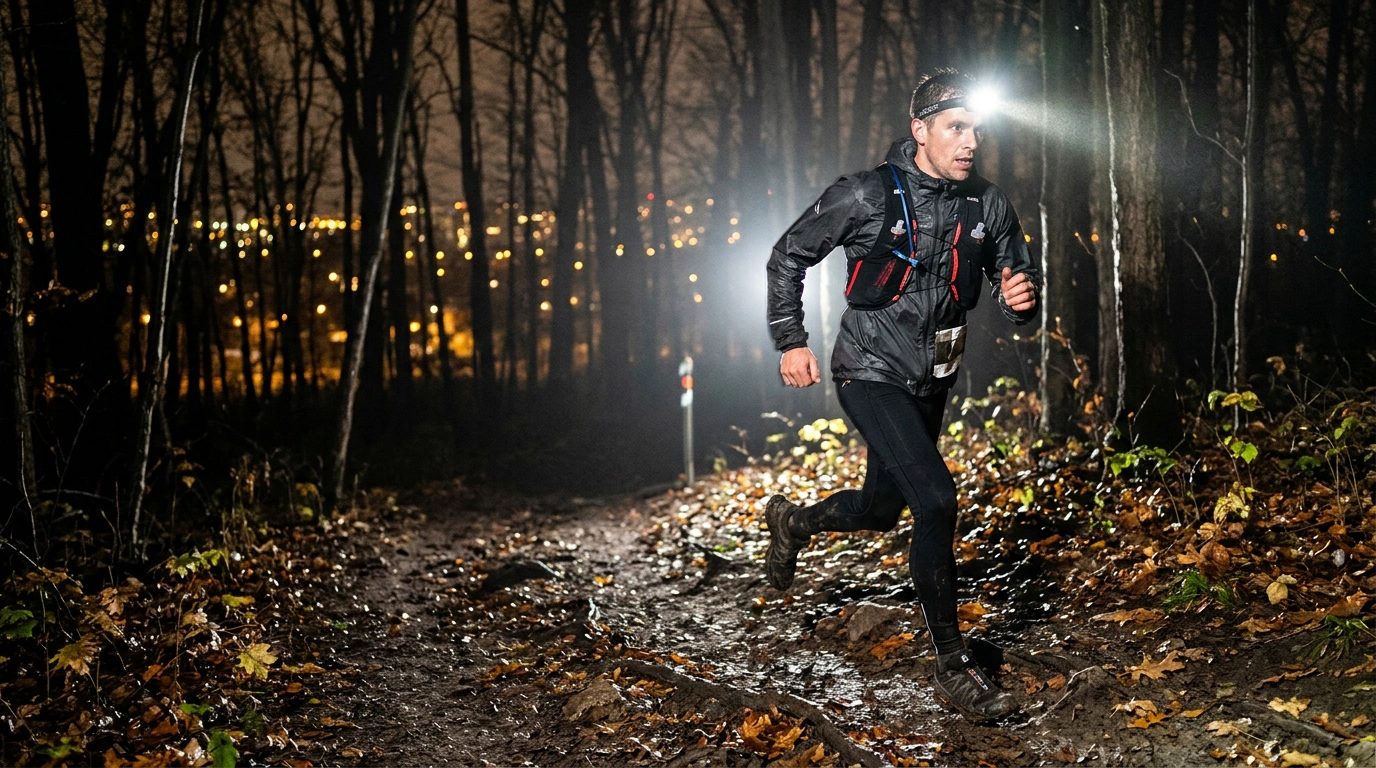
- Light and footwear: the first three stages are run in the dark. A 200–300 lumen headlamp and trail running shoes with 4–6 mm lugs are mandatory.
Whereas 52 people ran the full loop in 2021, the number of participants exceeded 885 in 2025, and a cap of 200 runners for the entire 100-miler has been introduced for 2026. A well-organized relay makes the ultra distance accessible and safe.