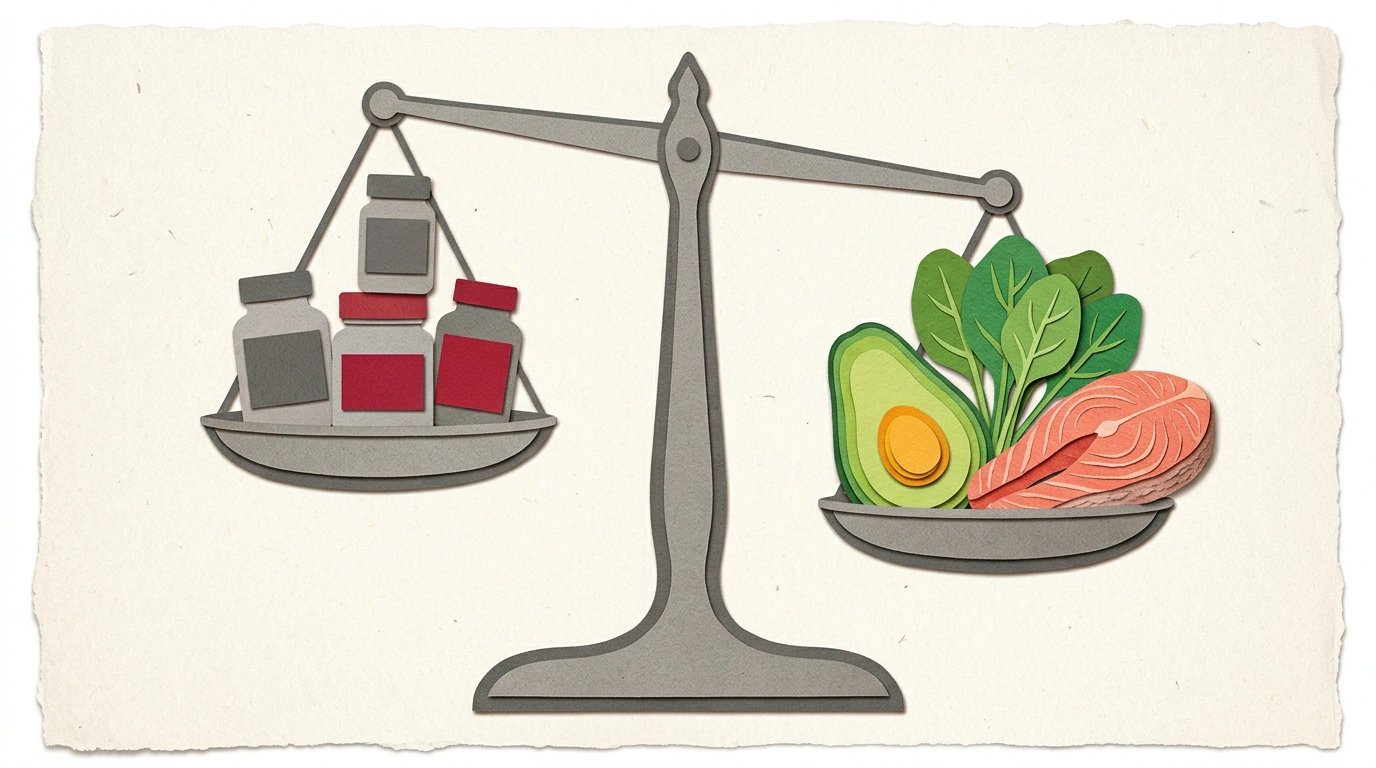
Getting lost in front of a supplement display has never been easier. When every other feed promises that one scoop of powder will rebuild your joints and a dropper of green liquid will "cleanse your blood," it is tempting to assemble a rescue kit. I see the same scene all the time: an office worker's bathroom shelf lined with five jars—collagen, chlorophyll, a testosterone booster, a fat burner, and magnesium—while lunch on their plate is still missing basic fish and vegetables.
Endocrinologist Maxim Kuznetsov broke down this lineup through the lens of physiology and evidence-based medicine. Let's look at whether these trending social-media supplements actually work, or whether your body handles them very differently from what the label promises.
The Direct-Delivery Illusion: Why Collagen and Chlorophyll Never Reach Skin or Blood Intact
First on the shelf sit the "beauty and freshness" staples: drinkable collagen and liquid chlorophyll. The myth relies on a direct-delivery fantasy—drink collagen and it plugs straight into your knee cartilage; drip chlorophyll into water and it refreshes your blood. Digestion does not work that way.
Collagen is a large protein that cannot cross the intestinal wall whole. In your stomach and small intestine, acid and enzymes chop it down into peptides and individual amino acids (glycine, proline, hydroxyproline). Drinking collagen for your joints is like tossing bricks through an open window hoping they will stack themselves into a wall. Your body breaks every protein down into the same building blocks without remembering whether they came from a pricey tub, cottage cheese, fish, or an egg—and sends them wherever repairs are needed most.
The second bottle is liquid chlorophyll, pitched as "plant blood" because its structure resembles hemoglobin. Yet the core of human hemoglobin holds iron, whereas chlorophyll holds magnesium for plant photosynthesis. In humans, this pigment is barely absorbed, plays zero role in making blood cells, and passes straight through the digestive tract. Meanwhile, your liver and kidneys run round-the-clock cleanup on their own, as we covered in our breakdown of popular detox myths.
Risky Promises: Hidden Dangers in Fat Burners and Useless Herbal Testosterone Boosters
Jars three and four on the shelf are testosterone boosters and fat burners. This is where people looking for quick energy and definition in capsule form tend to get burned.
Take over-the-counter testosterone boosters packed with tribulus, Peruvian maca, or D-aspartic acid. Maxim Kuznetsov offers a straightforward reality check: if herbal pills actually raised testosterone, medicine wouldn't need prescription ampoules, injections, and gels. Reviews indexed on PubMed confirm that in men with normal hormone levels, these supplements produce no meaningful increase—testosterone production is tightly governed by the brain via a feedback loop. And if there is a genuine deficiency, you need an in-person workup with a doctor.
Thermogenic fat burners carry an even sharper edge. Legal blends of caffeine and synephrine mainly jack up your heart rate while adding a modest 50–100 kcal to daily burn. Worse, US FDA inspectors routinely find undeclared pharmaceuticals hidden inside "all-natural" slimming pills—most notably sibutramine, pulled from the market in 2010 over heart-attack and stroke risks, along with the toxic laxative phenolphthalein.
The Magnesium Paradox: Why Most People with a Varied Diet Never Run Short
The fifth jar is magnesium "for stress and insomnia." Healthy kidneys hold onto this mineral remarkably well, and as Maxim Kuznetsov notes, 95% of people eating a balanced diet do not need extra magnesium pills.
The daily requirement—350–420 mg for men and 300–320 mg for women—is easy to hit with everyday food: buckwheat, oatmeal, legumes, almonds, cashews, pumpkin seeds, and leafy greens. Without an actual deficiency, a tablet acts as either a calming placebo or a mild laxative. One key safety rule: if a doctor prescribed magnesium or another supplement based on lab results, never stop taking it on your own. For more on how the industry swaps basic habits for pill bottles, check out our piece on why handfuls of capsules can't replace foundational routines.
In the end, all five jars on our office worker's shelf turn out to be expensive bathroom decor. So before you hit "buy" on the next trending supplement, ask yourself one quick question: "Am I buying something my doctor prescribed for a real reason, or am I trying to replace a normal plate of grains, greens, and protein with a capsule again?"