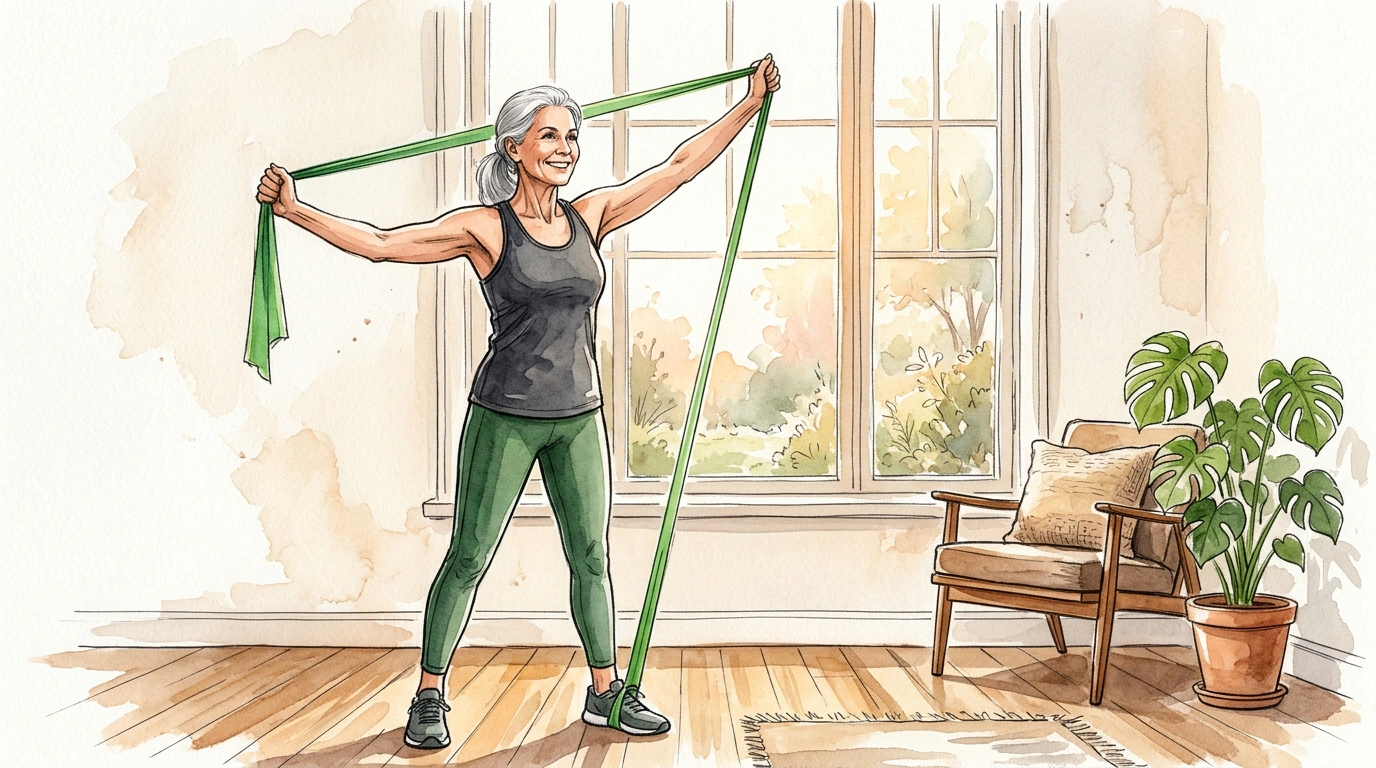
Is plenty of daily walking enough to keep your energy and independence as you get older, or does your body still need resistance training? Picture a familiar story: a 65-year-old woman keeps a healthy weight, eats thoughtfully, and logs 10,000 steps a day with Nordic walking poles. Yet the moment she carries a grocery bag into her building, climbing to the third floor feels like a slog, tying her shoes while standing is awkward, and her legs refuse to speed up when a crosswalk light starts blinking.
Fitness coach Artyom put his finger on this paradox: we rarely appreciate physical strength until ordinary daily movements start feeling heavy. I went through the clinical reviews backing his point—let's see why walking alone cannot shield you from age-related weakness.
The "Cardio-Only" Trap: Why Steps Don't Stop Muscle Loss
Walking is appealing because you don't have to learn technique, buy gear, or push against resistance. It does wonders for your heart, but skipping strength work comes at the cost of muscle tissue. After age 40–50, the body loses 0.5% to 1% of its muscle mass every year, and by age 70 that decline—sarcopenia—speeds up to 1.5–2% annually.
What caught my attention in the physiology is which fibers disappear first. Easy-paced walking recruits slow-twitch endurance fibers and never creates enough tension to trigger protein synthesis. Without resistance, fast-twitch fibers melt away—the exact fibers our walker needs to haul groceries upstairs, rise smoothly from an armchair, or catch her balance on an icy sidewalk. Relying only on walking poles can eventually shrink your world to a slow loop around the block, even though combining cardio and strength training smartly is completely doable without burning out.
A Safety Harness for Your Skeleton: How Lifting Protects Your Bones
As muscle fades, the skeleton weakens right behind it. Bone is living tissue that constantly remodels its internal lattice in response to mechanical load. Your muscular corset acts like a system of safety cables: when a muscle contracts against weight, its tendon tugs on the bone, signaling bone cells to deposit more calcium.
A review in Medicine & Science in Sports & Exercise (PMID: 9927006) showed that progressive strength training raises bone mineral density in the femoral neck and lumbar spine, whereas regular walking provides no such stimulus. And in a meta-analysis on sarcopenia rehabilitation (PMID: 36497565), I found a clear practical benchmark: 40–60 minute sessions at least three times a week for a minimum of 12 weeks—even using simple home resistance bands—rebuild muscle mass, quicken walking speed, and boost grip strength, one of the strongest predictors of longevity.
Signals from Muscle to Memory—and How to Train Safely
Strength work protects your brain too. A meta-analysis of clinical trials (PMID: 40320221) confirmed that resistance exercise in older adults sharpens cognitive function, improving working memory and verbal fluency. As muscles contract, they release signaling molecules into the bloodstream that ramp up production of BDNF—a neurotrophic factor that acts like fertilizer, helping neurons maintain their connections. We also covered how to preserve muscle power as you age in an earlier piece.
Of course, your workouts have to respect your joints. If you have no active flare-ups, chair squats, glute bridges, chest presses, and band rows work great. However, with stage 3 osteoarthritis, uncontrolled high blood pressure, or acute pain, unsupervised spinal-loading exercises are off-limits—a physical-therapy physician should select safe, supported movements for you.
- Move smoothly without jerking: take 2 seconds to lift and 3 seconds to lower.
- Exhale on effort and never hold your breath while straining, so you avoid blood-pressure spikes.
- Alternate strength days with rest and walks; brief pauses between sets give your heart a healthy break too.
The golden rule when starting out is to avoid extremes and stop chasing personal records. Forcing heavy dumbbells through joint pain or swinging weights with momentum only wrecks tendons. Steady consistency with your bodyweight or a resistance band gives your body what actually matters in daily life: an easy climb upstairs with groceries, resilient bones, and a sharp mind.
